Elevate User Experience: How AI Optimizes Website Performance
Unlock superior website performance and elevate user experience with AI. This guide explores how artificial intelligence is revolutionizing optimization, from boosting page speed and personalizing content to streamlining SEO. Learn to create faster, smarter, and more engaging digital experiences for your audience.

The era of reactive website optimization is ending. For too long, improving an online presence has relied on iterative A/B testing and manual adjustments that yield only incremental gains. While foundational, this approach is increasingly insufficient in a dynamic digital landscape where user expectations are constantly rising. Achieving sustained growth and user engagement now requires a fundamental shift from reactive guesswork to proactive, data-driven intelligence.
This guide demonstrates how artificial intelligence provides a significant strategic advantage by transforming key aspects of website performance and user experience. It outlines a path to creating digital platforms that are not merely functional, but inherently intelligent, responsive, and engaging.
Readers will gain insight into how AI moves beyond conventional methods to deliver superior website performance. We will explore the pivotal shift from traditional optimization to an intelligent, predictive model driven by AI. This includes achieving near-instant load times through advanced resource management, crafting hyper-personalized user experiences where content is dynamically tailored, and refining SEO strategies for a competitive advantage. We will also examine how AI automates UX analysis by converting user data into actionable decisions and systematically enhances digital accessibility. This holistic approach transforms website management into a streamlined, high-performance engine for growth.
TL;DR
Artificial intelligence is reshaping digital performance by transforming website optimization from a reactive, manual process into a proactive, automated one.
AI is no longer a futuristic concept but a practical toolset for creating faster, more intuitive, and highly personalized websites that drive engagement and conversions. By analyzing user behavior and server data in real-time, AI engines can predict needs, streamline resource delivery, and tailor experiences at an unprecedented scale. This strategic shift is reflected in broad industry adoption, with Passionate Agency (2025) reporting that the use of AI in UX design has surged to over 70% in recent years.
- Performance Acceleration: AI intelligently pre-fetches resources and optimizes asset delivery, significantly improving page load speeds and key metrics like Core Web Vitals.
- Hyper-Personalization: It dynamically adjusts content, product recommendations, and UI elements for each user, creating a uniquely relevant and engaging journey.
- Strategic SEO: AI automates advanced keyword analysis, discovers content gaps, and can implement technical SEO fixes without human intervention.
- Deep UX Intelligence: AI processes vast datasets to uncover actionable insights into user behavior and automates critical accessibility enhancements.
Integrating AI is no longer an option but a strategic imperative for achieving market leadership through a superior user experience.
Beyond A/B Testing: The Shift to AI-Driven Optimization
For years, A/B testing has been the standard for website optimization, but this reactive, hypothesis-driven approach is reaching its limitations. A fundamental transformation in performance optimization is now underway, driven by intelligent automation.

The core distinction lies in the shift from reactive analysis to proactive adaptation. Traditional optimization relies on manual tests of isolated variables against historical data, a process that is often slow and produces generalized insights. In contrast, AI-powered optimization leverages machine learning to analyze complex user behavior patterns in real-time, moving beyond simple comparisons to build predictive models. This allows a digital platform to not only understand current user actions but also to anticipate future needs and dynamically adjust the experience to meet them. AI transforms website optimization from a series of manual adjustments into a continuous, predictive process that learns and adapts.
This industry-wide pivot is a documented trend. The global adoption of AI is projected to grow at a compound annual growth rate of 37.3%, according to analysis by Grand View Research (2023), signaling a decisive move toward intelligent, automated systems.
| Aspect | Traditional Optimization (e.g., A/B Testing) | AI-Driven Optimization |
|---|---|---|
| Methodology | Manual, hypothesis-driven experimentation | Automated, data-driven learning and prediction |
| Data Analysis | Historical, aggregated, and segmented | Real-time, individualized, and contextual |
| Adaptability | Static; changes implemented post-test | Dynamic; continuous adaptation and personalization |
| User Experience | Generalized, 'one-size-fits-most' approach | Predictive, uniquely tailored user journeys |
| Strategic Outcome | Incremental improvements based on guesswork | Transformative performance gains and efficiency |
This evolution moves the objective from identifying a single "winning" variant to architecting an intelligent, fluid digital environment. Instead of serving a static page that performed best for a past audience segment, AI enables the delivery of a personalized experience for every user, at every moment. It identifies points of friction and opportunity invisible to human analysis, allowing for the automatic deployment of solutions that enhance engagement and drive conversions. The result is a high-performance asset that is not just optimized, but truly intelligent.
Ultimately, embracing AI-driven optimization is becoming a strategic necessity for succeeding in the digital landscape.
Achieving Near-Instant Load Times with AI
In the digital marketplace, fractions of a second can be the difference between user engagement and abandonment. The expectation for instantaneous access is no longer a preference but a baseline requirement.
Artificial intelligence elevates website performance beyond conventional optimization tactics. It introduces a predictive layer to resource management, transforming site speed from a reactive checklist into a proactive, intelligent system. By anticipating user needs and automating complex optimizations, AI directly improves the Core Web Vitals that influence search rankings and user satisfaction. Research from Deloitte confirms that even a 100-millisecond improvement in load time can significantly boost conversion rates and engagement.
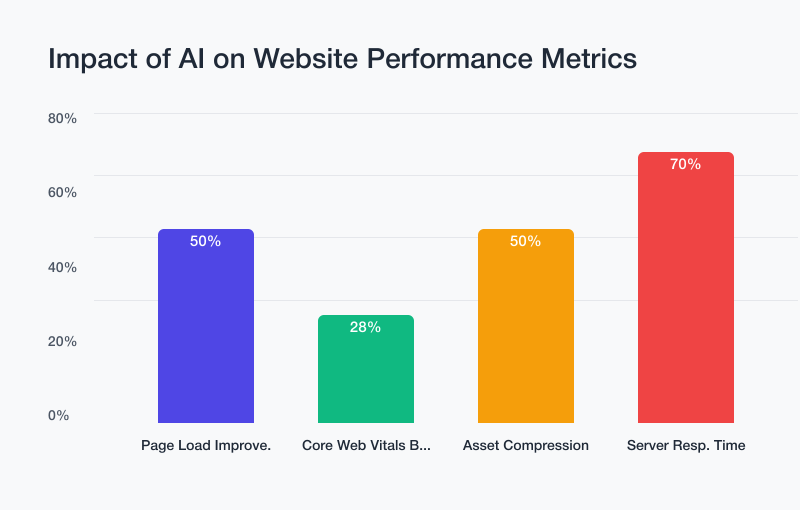
This performance improvement is achieved through a multi-faceted, AI-driven approach that systematically targets the primary causes of latency.
- Predictive Page Prerendering: AI models analyze real-time user behavior, including cursor movements, scroll depth, and navigation patterns. Based on this data, the system predicts the user's most likely next action and begins loading the corresponding page's assets in the background. This predictive prerendering makes subsequent navigation feel instantaneous, as the page is already rendered before the user even clicks the link.
- Intelligent Asset Compression: Static compression rules often result in a trade-off between file size and visual fidelity. AI-powered tools analyze the content of each image and video individually, applying bespoke compression algorithms that can reduce file sizes by 30-70% without perceptible loss of quality. This ensures maximum optimization for every asset, drastically reducing overall page weight.
- Dynamic Caching and CDN Optimization: An AI-enhanced Content Delivery Network (CDN) moves beyond simple geographic distribution. It uses predictive analytics to forecast traffic spikes and regional demand, proactively caching specific assets at edge locations where they are most likely to be requested. According to a DevDreaming (2025) analysis, this intelligent resource staging can reduce server response times by up to 70%.
- Automated Code Refinement: AI can autonomously analyze a website
eeds_elo_rating_because_its_too_long## Smarter SEO: How AI Refines Content and Ranking Strategy

Achieving search engine visibility is no longer a matter of simple keyword matching. The modern competitive environment demands an intelligent, predictive approach to outperform competitors and establish search authority.
Artificial intelligence transforms SEO from a reactive, labor-intensive discipline into a proactive, data-driven engine. It automates demanding analytical tasks and technical optimizations, providing insights that allow marketing teams to execute strategy with greater precision and speed. This shift allows resources to be reallocated from manual execution to high-level strategic planning.
AI platforms conduct deep competitive analysis, moving beyond surface-level keyword volume to identify strategic content gaps and high-intent search queries that competitors overlook. These systems analyze SERPs at scale, predicting which topics a specific domain has the authority to rank for. Generative AI further accelerates this process by producing comprehensive, SEO-optimized content briefs that serve as a blueprint for writers, ensuring every piece of content is engineered to capture target keywords.
The technical foundation of SEO is also transformed by AI-powered automation. Repetitive yet critical tasks such as generating unique meta tags, implementing schema markup, and optimizing internal linking can now be managed by intelligent systems. As noted by UXify (2025), a seamless user journey is crucial for site authority. To that end, AI can monitor for site errors like broken links and automatically create smart redirects, preserving both user experience and link equity.
A comprehensive analysis by GemPages (2025) confirms that websites leveraging AI for content strategy and technical optimization see a significant, measurable uplift in organic traffic and keyword rankings. Furthermore, AI leverages advanced Natural Language Processing (NLP) to align content with the nuances of modern search behavior. As user queries become more conversational, an understanding of semantic context and user intent is non-negotiable. AI optimizes content not just for keywords, but for the questions and concepts behind them.
| SEO Domain | AI Application | Strategic Outcome |
|---|---|---|
| Keyword Strategy | Predictive analysis of SERPs & competitor gap identification. | Focus resources on high-probability ranking opportunities. |
| Content Optimization | Automated brief generation & on-page SEO refinement. | Increased content velocity and consistent quality. |
| Technical SEO | Automated internal linking, schema markup & 404 redirects. | Improved site health, crawlability, and user experience. |
| Performance Analysis | Anomaly detection and predictive traffic modeling. | Proactive strategy adjustments and superior ROI tracking. |
AI provides the strategic leverage required to scale authority and improve search rankings with greater efficiency.
From Data to Decisions: AI in UX Analysis and Accessibility
The modern digital landscape generates a large volume of user data. Manually interpreting session recordings, heatmaps, and survey feedback is an inefficient strategy that can impede rapid optimization.
AI transforms this operational bottleneck into a strategic asset. It acts as an intelligent engine, processing vast, unstructured datasets to identify critical user friction points and behavioral patterns with unparalleled speed. This capability extends to predictive UX analytics, which can forecast the outcomes of design changes, allowing teams to optimize experiences with greater certainty.
This analytical power is crucial for a domain where most websites fall short: accessibility. A staggering 98% of websites have detectable accessibility issues, as highlighted in a report by Passionate Agency (2025). This represents a significant failure in user experience. AI-driven platforms directly address this by using computer vision to analyze and describe images, automatically generating accurate alt text where it is missing.
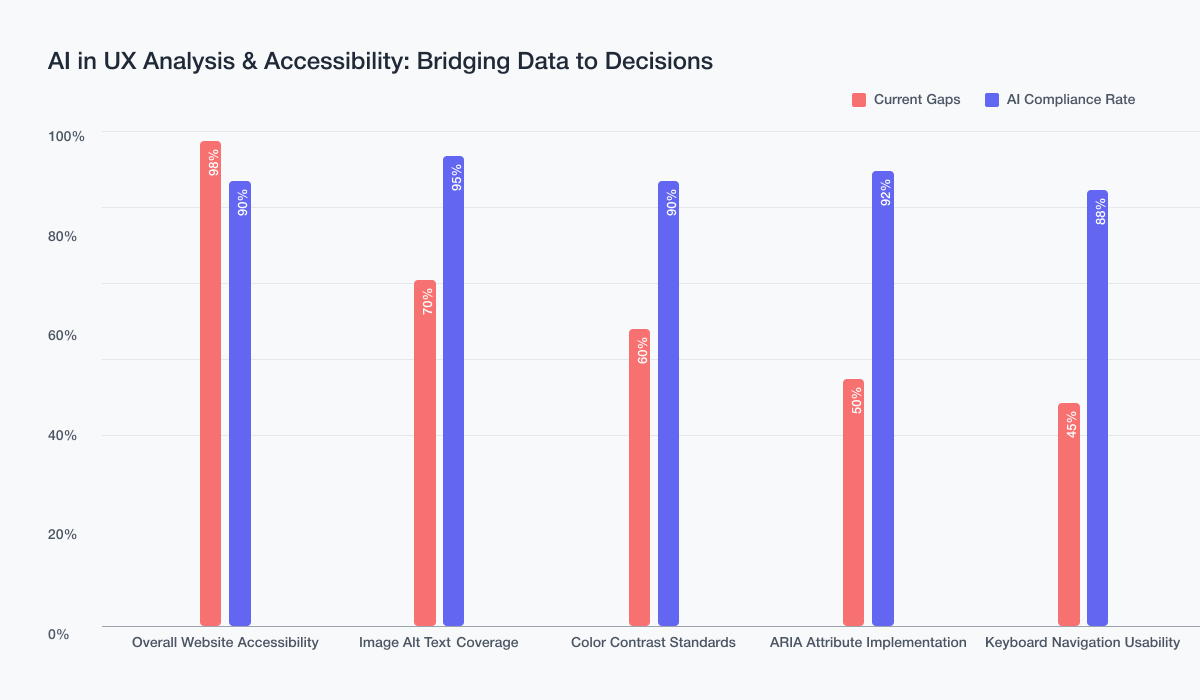
AI automates a comprehensive suite of accessibility enhancements to achieve compliance and elevate the user experience for all.
- Automated Alt Text Generation: The AI engine analyzes the visual content of an image and generates contextually relevant, descriptive alt text, making visual information accessible to users with screen readers.
- Color Contrast Auditing and Correction: AI systematically scans a website
eeds_elo_rating_because_its_too_long## Putting AI to Work: A Guide to Implementation and Tools
Transitioning from theory to practical implementation is the key step in gaining a competitive advantage. This is where strategic action transforms potential into tangible performance gains.
The process should be one of strategic precision, not technical guesswork. It begins with a clear diagnosis of a primary business challenge, whether it is a high bounce rate, a suboptimal conversion funnel, or weak organic search visibility. Once the key performance indicator (KPI) is isolated, the objective is to select an AI tool engineered specifically to address that bottleneck. This targeted approach ensures that technology investments are directly mapped to a measurable business outcome.
The efficacy of specialized tools is well-documented. For instance, research from UXify (2025) highlights how platform-agnostic solutions can integrate with systems like Shopify or WordPress. By leveraging techniques like predictive preloading, these tools can create a near-instant browsing experience, directly combating user friction and abandonment.
Selecting the right tool requires understanding the distinct categories of AI-powered optimization. The following matrix outlines key areas where AI delivers a significant competitive edge, with examples of solutions built for specific, high-impact tasks.
| Optimization Area | Example Tools | Primary Use Case & Strategic Impact |
|---|---|---|
| Site Speed & Performance | Uxify | Employs predictive preloading to anticipate user navigation, delivering near-instant page loads and dramatically reducing bounce rates. |
| SEO & Content Strategy | Frase.io, Semrush | Automates competitive analysis and generates data-driven content briefs to ensure content meets search intent and outranks competitors. |
| E-commerce Personalization | Rebuy, Wiser | Deploys recommendation engines for AI-driven upsells and cross-sells, systematically increasing average order value. |
| Web Accessibility | accessiBe | Provides automated analysis and remediation to align the website with WCAG standards, expanding audience reach and mitigating compliance risk. |
The strategic deployment of specialized AI tools transforms website optimization from a reactive, manual process into a proactive, automated engine for superior user experience.
The Co-Pilot Model: The Future of Human-AI Collaboration

The evolution of artificial intelligence is shifting its role from a passive tool to an active, collaborative partner. This new paradigm is the co-pilot model, where AI serves as an intelligent engine to augment human expertise, not supplant it.
The objective is to automate data-intensive processes, allowing human talent to focus on high-level strategy, creativity, and empathy. The next frontier includes affective computing, where AI can detect user frustration and adapt interfaces in real time. As observed by GemPages (2025), the most effective strategy is to deploy AI as an amplifier for business operations while leveraging human intelligence for critical work. This integrated approach enables teams to achieve greater efficiency and effectiveness.
Note: The strategic imperative is to maintain human oversight. While AI can execute experiments and analyze data at an immense scale, the qualitative understanding of brand narrative, ethical considerations, and true user empathy remains the domain of human experts.
This collaborative framework ensures that technology serves strategy, not the other way around. By delegating tactical execution to a capable AI, strategists are liberated to architect the vision and creative direction that drives genuine market differentiation. Success in this new era requires a disciplined approach, using AI to accelerate performance without compromising the human-centric focus that builds lasting brand value.
The future of website optimization lies in a partnership where AI handles data-heavy lifting, freeing human experts to focus on strategic goals.
The integration of artificial intelligence is no longer an option but a strategic imperative for achieving superior website performance and an elevated user experience. This shift empowers digital platforms to operate with greater efficiency and precision.
The impact of AI on website optimization is multifaceted. It shifts the process from manual and reactive to an automated, predictive approach that elevates site speed and Core Web Vitals. It facilitates hyper-personalization, tailoring the user journey to individual behaviors. It also refines SEO, delivers deep UX insights, and automates accessibility improvements, ensuring a better digital experience across the board.
Embracing AI capabilities is about establishing a significant strategic advantage, moving beyond incremental gains to redefine what is possible. It represents an evolution in how we execute a digital presence, demanding intelligent adoption rather than mere experimentation. The mandate is to identify specific areas where AI can automate inefficiencies, predict user needs, and personalize interactions to secure a competitive edge.