
SEO content marketing is the practice of creating content — blog posts, guides, videos, etc. — that's specifically researched and optimized to rank in search engines, so that it attracts organic traffic while also serving the broader content marketing goals of building trust, educating your audience, and moving them toward a purchase.
TL;DR
- SEO content marketing is a single system: content marketing produces substance (the assets), SEO makes those assets discoverable (the pathway). Run them together or neither compounds.
- The commercial case is strong and structurally durable. Content marketing generates roughly 3x more leads than outbound at 62% lower cost per lead (Demand Metric, replicated by CMI and HubSpot), and SEO returns a median 748% ROI over three years (First Page Sage, 2026).
- Six components make the system work: audience and intent research, topic and keyword strategy, content production, on-page and technical SEO, internal linking and cluster structure, and measurement against pipeline, not just sessions.
- The biggest failure mode is treating SEO as a checklist and content marketing as a publishing calendar. Both halves without the other produce activity, not growth.
- Treat the same playbook you would any production system: build the editorial plan first, write to intent, ship on a cadence, measure against leads and revenue, then update.
If you remember one thing: SEO content marketing is not "blog more, rank faster." It is the operating system that turns useful content into a durable organic acquisition channel.
What SEO Content Marketing Actually Means
SEO content marketing is the discipline of planning, creating, and optimizing content specifically so it ranks in organic search, gets cited by AI answer engines, and converts readers into leads or customers. It is not a synonym for "blogging." It is not a synonym for "doing SEO." It is the intersection: the content exists because of search demand, and it is engineered to be found, read, and acted on.
A useful definition has three parts:
- Content strategy first. Every asset starts from a topic a real person is searching for, with intent the asset intends to satisfy. Not from a sales pitch. Not from a product update. Not from whatever the founder wanted to write about this quarter.
- Search and discovery engineering second. The content is structured so search engines can crawl, understand, and rank it, and so AI systems can summarize and cite it. That means clean information architecture, internal linking, schema where it helps, and honest metadata.
- Distribution and iteration third. The asset is published, measured against real pipeline signals (rankings, traffic, assisted conversions, leads, revenue), then updated or expanded based on what the data shows.
Put those three together and you have the working definition. Strip any one out and the system underperforms.
How SEO and Content Marketing Work Together
The simplest way to think about the relationship: content marketing creates the substance, SEO creates the pathway. Individually, both strategies can move numbers. Together, they compound.
Content marketing without SEO is a beautiful magazine nobody can find. The team produces thoughtful, well-written articles, but they rank for nothing, get cited by nothing, and slowly decay into archive pages that nobody visits.
SEO without content marketing is a slick doorway into an empty room. The technical audit is clean, the metadata is perfect, the site architecture is textbook, and there is nothing on the page worth ranking for.
The compounding happens when each side feeds the other:
- Keyword research tells the content team what to write. Each piece is built to satisfy a real query, not to satisfy a brand's editorial mood.
- High-quality content earns links and engagement, the off-page signals that search engines reward. As the Content Marketing Institute's 2026 B2B research reports, content relevance and quality were the most cited drivers of marketing effectiveness among teams that met their goals (65%), ahead of tools and budget.
- Published content gives technical SEO something to work with. Internal links, topic clusters, and entity relationships only exist if there is real content to connect.
- Performance data loops back to content strategy. A page that ranks on page two with high impressions is a rewrite candidate. A page that ranks on page one but does not convert is a CRO candidate. Neither insight exists without both halves running.
This is why "SEO content strategy" and "content marketing for organic search" are not separate disciplines with separate playbooks. They are two sides of the same engine. Google's Search Central documentation makes the same point in its people-first content guidance: ranking systems prioritize content created to benefit people, and the technical mechanics exist to surface that content, not to substitute for it.
SEO Content Marketing vs Traditional SEO vs General Content Marketing
The three terms get used interchangeably, which causes real confusion inside teams. They overlap, but they are not the same job.
| Dimension | General Content Marketing | Traditional SEO | SEO Content Marketing |
|---|---|---|---|
| Primary goal | Build audience, trust, and brand affinity | Maximize organic visibility and traffic | Build organic traffic that converts to leads and revenue |
| Main deliverable | Useful, often evergreen content | Optimized pages, links, and technical signals | Content designed for both readers and search engines |
| Success metric | Engagement, shares, brand lift | Rankings, traffic, crawl health | Pipeline contribution, assisted revenue, share of voice |
| What it emphasizes | Voice, narrative, and audience | Keywords, backlinks, technical fixes | Intent, structure, quality, and iteration |
| Typical failure mode | Beautiful work that ranks for nothing | Perfect technical score with thin pages | Either half running without the other |
If a team only does general content marketing, they have a brand play. If a team only does traditional SEO, they have an acquisition function with nothing to acquire. SEO content marketing is what happens when the brand function and the acquisition function sit at the same table and plan against the same goal.
Note: Most "we need an SEO strategy" conversations are actually SEO content marketing conversations. The team does not need another technical audit. They need a content plan that search engines can rank and customers can act on.
The Content Marketing SEO Benefits Worth Knowing
The commercial case for SEO content marketing is unusually strong because it combines two compounding advantages: organic search is the dominant acquisition channel for most websites, and content assets appreciate rather than depreciate over time.
A few benchmarks that frame the upside honestly:
- Organic search is the largest trackable channel. BrightEdge's recurring research has consistently measured organic search as roughly 53% of all trackable website traffic, more than any other single source. Paid search sits second, organic social a distant fifth. (BrightEdge, organic share analysis)
- The lead math favors content. Content marketing generates roughly 3x more leads than outbound marketing at about 62% lower cost per lead, a benchmark first published by Demand Metric and validated repeatedly since by the Content Marketing Institute and HubSpot.
- SEO ROI is high and slow. Across hundreds of tracked campaigns, the median SEO ROI is 748% over three years, with B2B SaaS averaging 702% to 844% and typically breaking even around month seven (First Page Sage, 2026, summarized in the Omnibound 2026 content marketing ROI research roundup).
- Compounding beats spending. A blog post published today keeps generating organic traffic and leads for years with no incremental cost per visit. Paid channels need constant spend to maintain the same level of visibility.
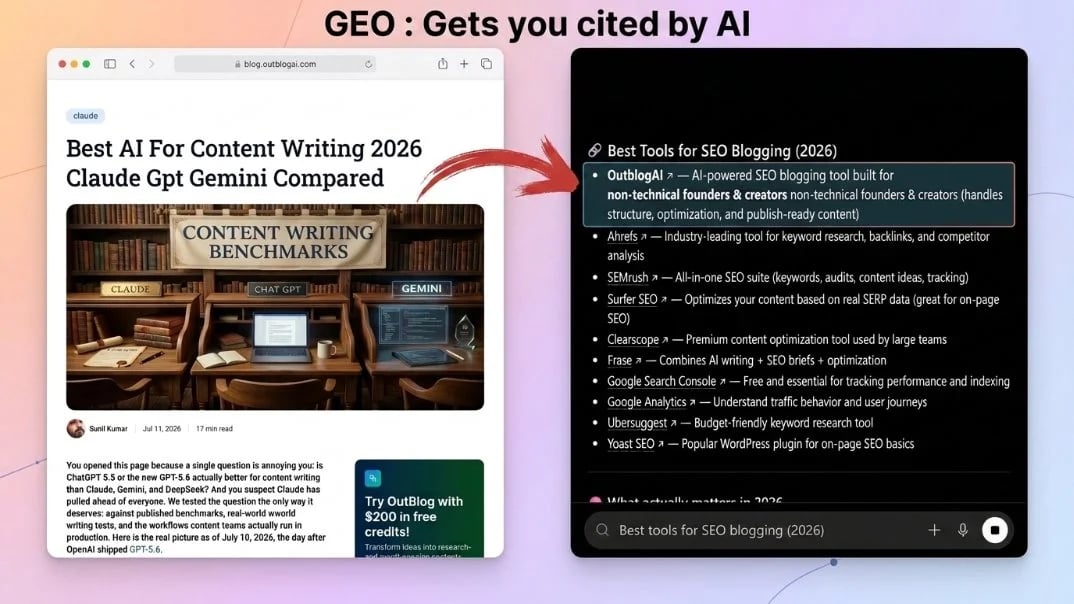
- AI search has raised the bar, not lowered it. As Google surfaces more AI Overviews and as ChatGPT, Perplexity, and Gemini cite sources directly, the brands that show up are the ones with clear, well-structured, expertise-backed content. The mechanism changed; the underlying requirement did not.
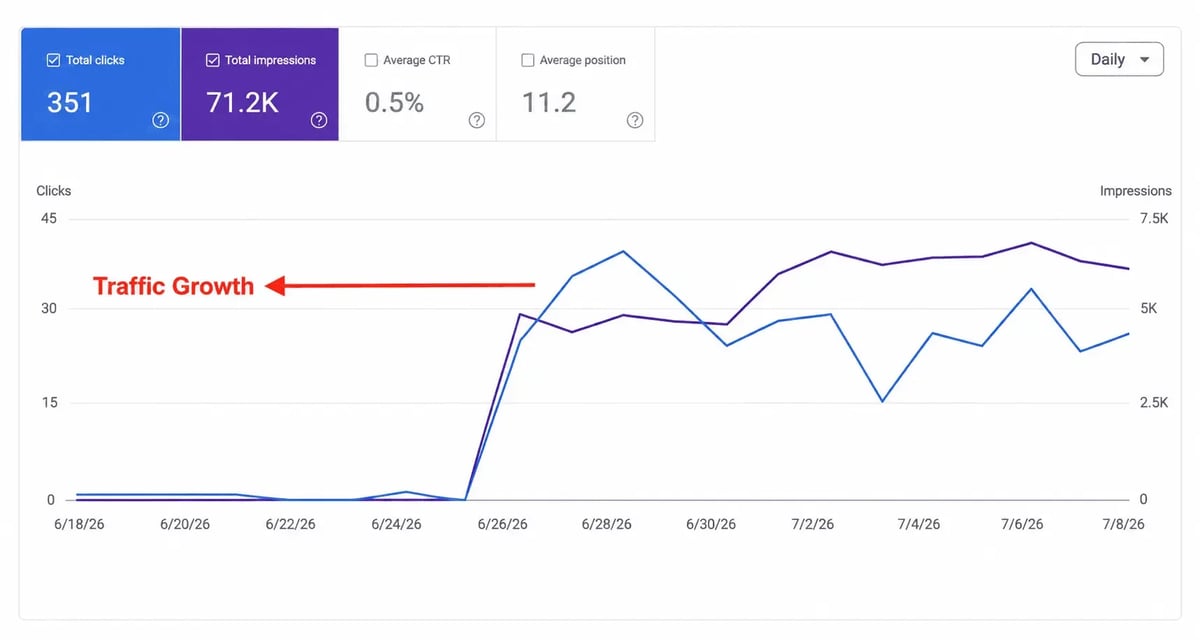
There is a real risk in romanticizing these numbers. CMI's same 2026 research found that only 36% of marketers can accurately measure content ROI, and 56% of B2B marketers say they struggle to attribute ROI to content efforts. So the returns are real, but most teams do not have the measurement discipline to capture them. That gap is exactly what a sound SEO content marketing program is built to close.
The Six Components of a Working SEO Content Marketing Program
Strip the buzzwords away and every functioning SEO content marketing program has six components. The order matters because each one feeds the next.
1. Audience and intent research
Before any keyword tool opens, you need a clear picture of who you are trying to reach and what they are trying to accomplish. For a B2B SaaS team, that means knowing the three to five buyer personas, the questions they ask before talking to sales, and the problems they Google at 11pm when they cannot figure something out. For a DTC brand, it means the same thing from the customer's perspective.
Google's own guidance is blunt about this. The Creating helpful, reliable, people-first content page in Search Central tells creators to evaluate whether the content they are producing demonstrates genuine expertise and satisfies the reader. That cannot be faked, and it cannot be researched away.
2. Topic and keyword strategy
Once you know your audience, you map topics to the questions they ask. The most useful framing is the topic cluster: one comprehensive pillar page on a core subject, surrounded by supporting articles that each answer a specific sub-question and link back to the pillar.
Inside each cluster, the keyword work is straightforward. Find the head term you want the pillar to rank for, find the long-tail and question queries each supporting article should target, and confirm that search intent for each term is something your content can actually satisfy. Tools like Ahrefs, Semrush, and Moz are the standard for this work, and the OutBlogAI keyword generator is a faster way to spin up an initial topic universe when you do not yet have a paid subscription.
A practical note from experience: do not chase volume for its own sake. A 50-search-a-month query with clear commercial intent beats a 10,000-search-a-month query that you will never rank for. Our internal keyword research logic ranks topics by intent clarity and ranking feasibility before raw volume, which prevents the common failure mode of building a content plan around traffic the site has no chance of capturing.
3. Content production with search structure baked in
Each article gets produced as a structured asset, not a stream of prose. The H1 carries the primary keyword. The H2s and H3s mirror the reader's question hierarchy, not the writer's outline preference. The opening paragraph answers the core query in two to three sentences so the reader (and the search snippet) gets the point fast. The body adds depth, examples, and the brand's specific point of view.
This is the part where OutBlogAI's own pipeline earns its keep. Our agent builds a keyword-informed outline, drafts the article, and runs a quality review that scores for structure, intent match, factual claims, and brand voice alignment. Most generated posts come back with quality scores of 9 out of 10 or 10 out of 10, and a single post takes 7 to 15 minutes to produce end to end. That is not a productivity hack. It is a way to keep the cadence consistent enough for compounding to kick in, which is the actual requirement.
A note on voice: structure without voice reads like a spec sheet. The article still needs a perspective, a few sentences only the brand could have written, and an honest point of view. The structure is what makes the content findable. The voice is what makes it worth linking to and remembering.
4. On-page and technical SEO
The technical work supports the content, not the other way around. For each piece, that means:
- A unique, descriptive title tag and meta description (the OutBlogAI headline analyzer and meta description generator cover the basics).
- Clean URL slug with the primary keyword.
- Internal links to and from related cluster content.
- Compressed images, descriptive alt text, and Core Web Vitals within Google's thresholds.
- Schema markup where it actually helps (Article, FAQ, HowTo, Product, Organization).
- Crawlable, indexable pages with no accidental noindex or canonical mistakes.
For a pillar piece, this is also where you build the topical authority signal. Internal links from supporting articles back to the pillar tell search engines what the pillar is the authoritative page about.
5. Internal linking and cluster structure
Topic clusters only work if they are wired together. Each supporting article links to the pillar, the pillar links to each supporting article, and adjacent clusters link where the topic naturally crosses. This is also how you build the entity relationships that AI systems use when deciding which sources to cite.
A practical rule of thumb: every new article should add at least two internal links (one outbound to a related pillar or supporting piece, one inbound from a relevant existing article that gets updated to include the new link). Two links is the minimum for compounding. Three or more is better.
6. Measurement against pipeline, not just sessions
Traffic is a vanity number if it does not convert. The minimum measurement stack for a SEO content marketing program is:
- Rankings for the target keyword set, tracked weekly in a tool like Ahrefs or Semrush.
- Organic sessions to each cluster, segmented by landing page.
- Engaged sessions and conversions, ideally tied to a goal in Google Analytics 4 or your analytics platform.
- Pipeline contribution, which means tracking which articles and clusters actually produce leads, not just which ones produce sessions. UTM tagging, hidden form fields, and CRM attribution are how this gets done honestly.
- AI citation presence, which is increasingly measurable through tools that track brand mentions in ChatGPT, Perplexity, and Gemini answers.
If your measurement stops at sessions and keyword rankings, you are running a traffic program, not an SEO content marketing program.
A Simple Example: How a Topic Becomes Traffic and Leads
Theory gets clearer with a worked example. Here is how a topic moves from idea to pipeline for a fictional B2B SaaS team that sells project management software to mid-market agencies.
Step 1, the trigger. The team notices a recurring question from prospects: "How do agencies bill clients when projects run over scope?" It comes up in every sales call. The team's SEO content strategy treats that question as a topic opportunity, not just a sales objection.
Step 2, the keyword research. The team checks search volume and intent. They find:
- "agency scope creep billing" (low volume, clear intent, winnable)
- "how to bill clients for out of scope work" (medium volume, clear intent, winnable)
- "agency billing methods" (high volume, mixed intent, dominated by software comparison pages)
They pick the first two for supporting articles and decide to build the pillar page around "agency scope creep" as the parent topic.
Step 3, the content plan. They outline:
- Pillar: "Scope Creep in Agencies: How to Prevent It and Bill for It When You Can't" (comprehensive, 3,000+ words, owns the topic).
- Supporting article 1: "How to Bill Clients for Out-of-Scope Work Without Killing the Relationship" (1,500 words, clear commercial intent).
- Supporting article 2: "Scope Creep Email Templates for Agencies" (1,000 words, transactional intent).
- Supporting article 3: "How to Write a Scope of Work That Prevents Scope Creep" (1,800 words, top-of-funnel).
Step 4, the production. Each article is written to intent, structured with H2s that mirror the reader's questions, and includes a clear CTA. The pillar gets a free scope-of-work template as a lead magnet. The billing article gets a calculator. The email templates article gets a downloadable pack.
Step 5, the technical layer. Each piece is published with a clean URL, schema where relevant, compressed images, and a clear internal linking structure. The supporting articles each link up to the pillar. The pillar links down to each supporting piece. Two existing blog posts on the site are updated to link into the new cluster.
Step 6, the distribution. The team shares each piece in two places: a relevant LinkedIn post from the founder and a one-paragraph note in the next client newsletter. No paid promotion for the first 90 days, because the goal is to learn what the cluster does on organic traffic alone.
Step 7, the measurement. After 90 days, the cluster is generating about 1,200 organic sessions per month. The pillar ranks in the top five for "scope creep agencies." The billing article ranks on page one for "how to bill clients for out of scope work." The calculator and template pages convert at 4 to 6% to a lead. The sales team reports that two of their last ten closed deals mentioned reading the billing article during evaluation.
That last sentence is the only metric that matters. The traffic was the mechanism. The pipeline was the result.
Common Misconceptions and Failure Points
Most SEO content marketing programs fail for predictable reasons. These are the ones we see most often in practice.
Misconception 1: "More content equals more traffic." Volume without intent is just noise. A small, tightly built cluster of well-written, well-linked pages consistently outperforms a sprawling blog of mediocre posts. Publish less, publish better, ship on a cadence you can actually maintain.
Misconception 2: "Keyword stuffing is a thing of the past, so I can ignore keywords." Keyword stuffing is dead. Keyword strategy is not. You still need to know what your audience is searching for, what intent lives behind each query, and how your page maps to that intent. The keywords are not the destination. They are the directional signal.
Misconception 3: "SEO is a one-time project." SEO content marketing is closer to a manufacturing process than a website redesign. The initial work matters, but the compounding only happens if the cadence continues for years, not weeks.
Misconception 4: "Long-form always wins." Length is not a ranking factor. Comprehensiveness, intent satisfaction, and structure are ranking factors. A 600-word FAQ page that completely answers the question beats a 3,000-word piece that buries the answer in throat-clearing. Write to the query.
Misconception 5: "We can just publish AI content and rank." AI content can absolutely rank. It ranks when it is trained on the brand, structured for intent, reviewed for accuracy, and aligned with voice. The Ahrefs study of 331,000 pages found that Google does not penalize AI content per se; it penalizes bad content. The distinction matters more than the tool used.
Misconception 6: "If it ranks, it works." Ranking is upstream of revenue. A page one ranking for a query that will never convert is an interesting trophy and an unhelpful metric. The job is to pick queries that can produce leads, then rank for them, then measure whether they do.
Misconception 7: "Once a page is published, the work is done." Content decays. Rankings drift. Competitors publish better answers. A working program includes a quarterly review where every top-50 ranking page is checked for freshness, accuracy, and competitive gaps. The pages that need updating get updated. The pages that should be retired get redirected.
The pattern underneath all of these: teams that treat SEO content marketing as a craft that compounds over time outperform teams that treat it as a campaign with an end date.
Best Resources and Tools for Content Marketing SEO
A trustworthy learning stack saves months of trial and error. Here is what we recommend, organized by what each one is best at.
Foundational documentation (read these first)
- Google Search Central, Creating helpful, reliable, people-first content. Google's official guidance on what content their ranking systems are designed to reward. If you only read one document on this list, read this one.
- Google Search Central, Optimizing for generative AI. The newer guidance on how to make content citable by AI answer engines. Worth reading alongside the people-first page.
- Content Marketing Institute, B2B Content Marketing Trends Research. The annual benchmark for B2B content effectiveness, budget allocation, and team structure.
Ongoing learning (weekly reading)
- The Ahrefs Blog. Heavy on original data studies and practical SEO experiments. Their keyword research and link building content is consistently strong.
- The Moz Blog. Whiteboard Friday is the long-running video series, and the blog itself covers SEO, content marketing, and the new world of AI search. Good for breadth.
- Backlinko. Brian Dean's site, now part of Semrush. The Skyscraper Technique and the link building resources are the most cited pieces for a reason.
- Search Engine Land. The best daily source for breaking SEO news, Google algorithm coverage, and industry shifts.
Tooling (paid)
- Ahrefs for keyword research, backlink analysis, and content gap work.
- Semrush for the broadest SEO and content marketing toolkit, with strong reporting features for agencies.
- Moz Pro for domain authority tracking, link research, and a clean interface for smaller teams.
- Screaming Frog SEO Spider for technical audits and site crawling.
Tooling (free and lightweight)
- OutBlogAI Content Brief Generator. Spins up an intent-matched brief for any target keyword in under a minute. Useful for planning before you write.
- OutBlogAI Keyword Generator. Fast topic universe generation when you do not yet have access to Ahrefs or Semrush.
- OutBlogAI Blog Outline Generator. Produces a search-structured outline you can hand to a writer or feed into a draft.
- OutBlogAI Headline Analyzer. Scores title tags and H1s against the patterns that historically earn clicks.
- Google Search Console, free, for tracking your actual rankings, impressions, and click-through rates by query.
- Google Analytics 4, free, for engagement and conversion tracking once the traffic shows up.
An honest note: the free stack above can take a solo founder or a one-person marketing team from zero to a functioning program. The paid stack is worth it once you are producing at volume and need competitive intelligence, faster data, and team collaboration features.
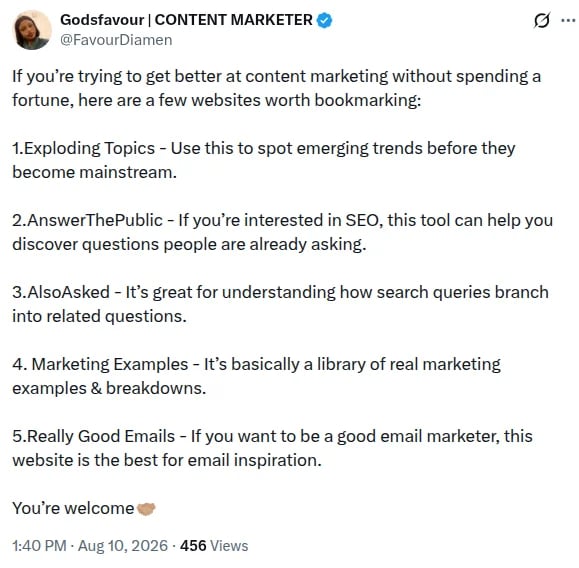
Here are some more tools that are often suggested by people.
Your First Practical Step
Most teams stall because they try to do everything at once. The first step is intentionally small.
Block two hours this week. Pick one customer problem you solve well. Write down the five questions that person Googles before they find you. Pick the one question that has clear search volume and clear commercial intent. Build a single article that answers that question better than anything currently on page one.
That is the entire first step. One article. One intent. One chance to prove the loop works.
If the article ranks within 90 days, if it earns clicks, if it produces even one lead or one meaningful conversation with a prospect, the model is proven. From there, you replicate the loop: another article, another cluster, another quarter. The compounding is not a slogan. It is the math of organic search applied consistently over two to three years.
The teams that win at SEO content marketing are not the ones with the biggest budgets or the most sophisticated tools. They are the ones who pick the right questions, answer them honestly, structure the work for both readers and search engines, and keep going long enough for the compounding to kick in. That is the whole game.
To read more about how to actually use SEO content marketing to your advantage, consider reading this article: https://blog.outblogai.com/blog/en/seo-content-marketing-10-step-execution-system-that-ranks-06f261e26493
For more on the production side of this system, see OutBlogAI's guide to brand voice matching at scale, the blueprint for AI-powered content outlines, and a worked example of closing content gaps with competitive analysis.