
Most SEO advice online is built on assumptions. Some of it has aged poorly. Some of it was never true in the first place. And yet we still see blog posts, checklists, and "SEO guides" repeating the same claims as if they were settled facts.
We built OutBlogAI to generate content that ranks, so we pay attention to which assumptions match what we observe in our own pipeline and what Google's own documentation actually says. Below are six common SEO assumptions we run into, with what we have learned about each one.
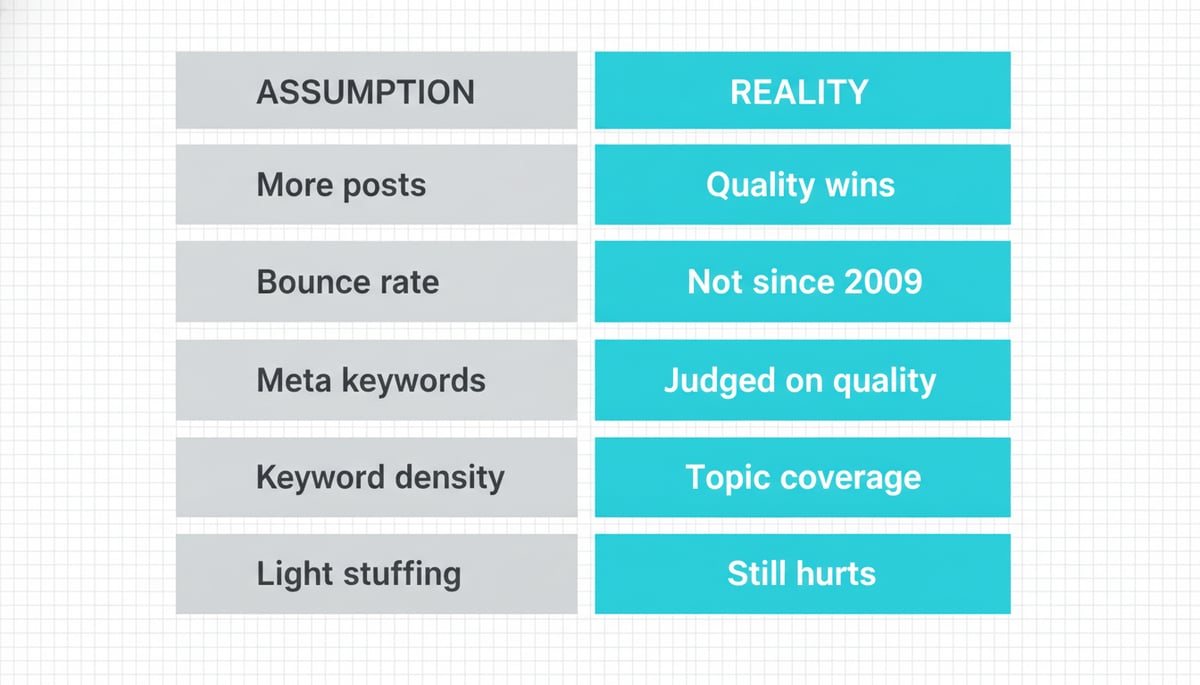
TL;DR
- More content does not equal more rankings. Quality and topical coverage beat raw volume.
- Bounce rate is not a confirmed Google ranking factor. Google representatives have said so directly.
- The meta keywords tag has carried zero ranking weight since 2009.
- AI-generated content is not banned from Google. It is judged on quality like everything else.
- Exact-match keyword density matters far less than topical coverage.
- Keyword stuffing still hurts. Google's systems reward natural language.
Assumption 1: "More Content Means More Rankings"
This is the assumption we hear most often from new customers: "If we just publish more, we'll rank more."
In our own generation pipeline, we measure quality, not quantity. A single blog post takes 7 to 15 minutes to generate end to end, but our quality review layer still returns 9 out of 10 or 10 out of 10 most of the time. The point of that score is to stop more content from going out the door than the site can absorb without diluting topical authority.
Posting 50 low-effort articles per month does not help a small site. Posting 4 to 8 deeply researched ones usually does. Volume is only useful when each piece passes a quality bar.
Assumption 2: "Bounce Rate Is a Ranking Factor"
Google has repeatedly denied this. As Google's John Mueller has said publicly, the company does not use the bounce rate shown in Google Analytics as a ranking signal. Industry analyses of ranking factors confirm Google representatives have made the same point across multiple conversations over the years.
Bounce rate is still a useful engagement metric for your own reporting. It tells you whether a page matched what visitors expected. Just do not optimize for it as if moving the number will move your rankings.
Assumption 3: "The Meta Keywords Tag Still Helps"
It has not helped in 17 years. Google published this directly on its Search Central blog in September 2009, and the policy has not changed since. Google's own post explains the meta keywords tag was abandoned because it was being abused to stuff irrelevant keywords onto pages.
You will see SEO plugins that still let you fill in a meta keywords field. Filling it in is harmless, but it is also pointless for ranking. Skip it and spend the time on your meta description and your actual page content instead.
Assumption 4: "AI-Generated Content Cannot Rank"
This one usually comes from a Google blog post that was widely misread. Google's guidance since the helpful content system update has been about the quality of automatically generated content, not its origin. As Google has stated publicly, the systems reward content that is reliable and helpful regardless of how it was produced.
That lines up with what we see running an AI content pipeline. Quality review scores on our generated posts do not correlate with whether the post was AI-assisted or human-only, they correlate with how well the post answers the search intent. We have covered this kind of structural question in more depth in our breakdown of AI-powered content outlines. The same principle applies to whole articles as it does to outlines.
Assumption 5: "Keyword Density Is the Main Thing"
Modern search systems use natural language processing. They judge whether a page covers a topic, not whether a phrase appears exactly N times. Exact-match density is a 2010-era metric.
What still matters is that the target topic, related entities, and the questions readers actually ask are covered. When we onboard a new brand, we run keyword research that maps the priority terms and the surrounding semantic field so the post addresses the topic, not just the keyword string.
Assumption 6: "A Little Keyword Stuffing Is Fine"
It is not. Google's helpful content system specifically targets content written primarily to manipulate rankings rather than to help readers. Stuffing a phrase into every paragraph makes posts read like spam, increases the chance of being flagged by automated classifiers, and now shows up as a pattern after core updates like the March 2026 core update.
Our keyword research step is built to prevent stuffing by design. The agent plans the topic, places keywords where they read naturally, and stops short of repeating them past the point of usefulness. If a draft we generate ever reads like it is hitting a keyword for the sake of hitting the keyword, that is a 6 out of 10 score and we treat it as a revision trigger.
What to Do Instead of Trusting Assumptions
SEO is one of the few marketing disciplines where the official source, Google, publishes its own documentation and answers public questions. Treat that documentation as the baseline. Then test every other claim against your own data, your own traffic, your own quality scores.
If you are running an AI-assisted workflow, the same rule applies. Ask what your quality review layer is actually measuring. Ask whether the keyword plan was built by analysis or by gut feel. Ask whether the post answers the search intent or just matches a phrase.
The brands we see win at SEO today are the ones treating every "rule" as a hypothesis to test, not a fact to follow.