Google's March 2024 Core Update represents a significant evolution in its approach to search quality, with a stated goal of reducing unhelpful, unoriginal content by 40%. This is more than a routine adjustment; it is a foundational shift requiring a strategic recalibration of content initiatives. The update signals a clear move away from rewarding low-quality, scaled content and reinforces the need for authentic value and demonstrated expertise.
This analysis deconstructs the implications of the March 2024 Core Update and Google's new spam policies, particularly the "Scaled Content Abuse" policy. We will clarify what these changes mean for AI-generated content, moving beyond misconceptions to establish that AI is not banned, but its strategic, high-quality application is now critical. You will learn why the 'Helpful Content' system is now a fully integrated component of the core algorithm, making people-first content a fundamental ranking signal. We provide actionable strategies for using AI to enhance human expertise and achieve genuine E-E-A-T (Experience, Expertise, Authoritativeness, and Trust), rather than as a tool for mass content generation. This update compels creators to align every content initiative with Google’s renewed emphasis on quality and originality to ensure sustained organic growth. Adopting a comprehensive content workflow is key to meeting these new standards.
TL;DR
Google's latest algorithm update is not a minor adjustment but a strategic effort to improve search quality. It signals a definitive move to elevate authentic, human-centric content and devalue manipulative, low-effort publishing tactics.
The March 2024 Core Update is engineered to reduce unhelpful, unoriginal search results by an estimated 40%. It achieves this by fully integrating the ‘Helpful Content’ system into the core algorithm and introducing new spam policies targeting scaled content, expired domains, and site reputation abuse. According to Google's Search Central Blog (2024), the focus is on rewarding content created for people, not just for search engine rankings. This update does not outlaw AI, but it penalizes its use as a tool for low-quality, mass content generation.
- Core Algorithm Integration: The 'Helpful Content' system is no longer a separate signal; it is now a fundamental part of the main ranking algorithm.
- New Spam Policies: Three specific policies now target Scaled Content Abuse, Expired Domain Abuse, and Site Reputation Abuse.
- AI Content Is Not Banned: AI-generated content is permissible if it is high-quality, original, and demonstrates E-E-A-T (Experience, Expertise, Authoritativeness, Trust). The penalty is for abuse, not use.
- Focus on User Value: The ultimate goal is to reward content that provides a satisfying user experience and demonstrably helps the reader.
A successful SEO strategy moving forward requires using AI as a powerful assistant to augment human expertise, not as a replacement for it.
What Is the March 2024 Core Update? A Foundational Shift
This update is a more fundamental restructuring than a typical core update, representing a calculated move by Google to refine its ranking systems to better identify and reward content that provides genuine value.
The March 2024 Core Update is a complex evolution involving simultaneous changes to multiple core systems. Its primary objective, as stated by Google, is to improve search quality by cutting low-quality, unoriginal content in the results by 40%. This is not merely about tweaking individual ranking factors; it is an overhaul of how Google understands content helpfulness. The previous 'Helpful Content' system has been absorbed into the main core algorithm, making its signals a continuous and foundational part of content evaluation.
The complexity of this update was underscored by its extended rollout period. While most updates conclude within two weeks, this one took 45 days, completing on April 19. According to analysis from Search Engine Journal (2024), this prolonged duration indicates deep, interconnected changes to the ranking infrastructure. It signifies a decisive shift away from rewarding content that mimics helpfulness toward rewarding content that delivers it.
Note: Google explicitly stated this update is more complex than previous ones, involving refinements to several core systems. This is not a single change but a convergence of multiple algorithmic enhancements designed to work in concert to better identify content created for people.
The integration of helpfulness signals into the core algorithm means that producing substantive, authoritative material is now a continuous requirement for search visibility.
Deconstructing Google's Three New Spam Policies
To enforce its new quality standards, Google has introduced policies against several manipulative SEO tactics. These three new spam policies provide a clear framework for enforcement, targeting specific methods of exploiting search rankings.

These policies are designed to close loopholes that have been exploited at scale. They address the generation of low-value pages, the repurposing of domain authority, and the "renting" of site reputation. Understanding the distinctions is critical for compliance and for developing a resilient content strategy. The official guidance from Google's Search Central Blog (2024) leaves little room for ambiguity, defining precisely what constitutes a violation. These are not suggestions; they are new rules of engagement for achieving organic visibility.
| Spam Policy | Definition & Target | High-Level Example |
|---|---|---|
| Scaled Content Abuse | Generating a large number of pages, with or without AI, for the primary purpose of manipulating search rankings rather than serving users. This applies whether automation or human effort is used to create the content at scale. | An AI engine generates hundreds of pages for every city in a state, each with nearly identical content, only changing the city name to rank for hyper-local search terms. |
| Expired Domain Abuse | Purchasing an expired domain with a positive reputation and repurposing it with low-quality or unrelated content to benefit from its past authority and backlink profile. | A former medical school's domain is purchased and repurposed to host low-quality affiliate content about online gambling, exploiting the domain's high authority. |
| Site Reputation Abuse | A reputable website hosts low-quality, third-party content with little to no editorial oversight, allowing the third party to leverage the host site's authority. This is often called "Parasite SEO." | A major news publication hosts a "coupon" section run by a third party that publishes thousands of low-quality pages, which rank highly due to the news site's overall domain authority. |
The policy against Site Reputation Abuse began active enforcement on May 5, 2024, giving site owners a window to remove offending third-party content. These policies collectively represent a significant tightening of content standards. Ultimately, these new rules are designed to ensure that a site's ranking authority is a direct result of its own valuable, first-party content.
AI Content in the Crosshairs: What 'Scaled Content Abuse' Really Means

The March 2024 Core Update directly addresses the proliferation of AI-generated content, not by banning AI, but by redefining the rules for its use in content creation.
Google's updated spam policies do not penalize content simply because it was created with AI. The focus is exclusively on the intent and outcome of its use. The policy now targets what Google defines as scaled content abuse: generating large volumes of unoriginal content with the primary purpose of manipulating search rankings, regardless of whether it is produced by AI, humans, or a combination. This adjustment clarifies that the method of creation is irrelevant; the production of low-value, unhelpful material at scale is the violation.
This policy evolution is consistent with Google's established principles. The Google Search Central Blog (2024) reiterated that their long-standing spam policy considers any use of automation, including generative AI, to be spam if its primary goal is to manipulate search rankings rather than help users. The new language simply makes this stance more explicit in the modern AI era.
Caution: Deploying AI to generate articles without significant human oversight, editing, and fact-checking is now a high-risk strategy. Content that lacks original insight, demonstrates factual inaccuracies, or fails to provide genuine value to the reader is directly targeted by this updated policy.
The core directive remains unchanged: create helpful, reliable, people-first content that serves user intent with authority and precision.
Helpful Content Is No Longer an Update, It's the Algorithm
A key architectural change has occurred within Google's ranking systems, transforming how content quality is evaluated. The Helpful Content Update is no longer a separate, periodic event but an integral and continuous component of the core algorithm.

This integration marks a fundamental shift from a system that applied a periodic, sitewide signal to one where helpfulness is assessed constantly and on a more granular level. Previously, a site might be impacted by a distinct "Helpful Content Update." Now, the signals that constitute the Helpful Content System are woven into the main ranking engine, influencing rankings in real-time. This means there is no longer a discrete "recovery" period; every page is perpetually judged on its ability to deliver a satisfying user experience.
According to analysis from the Google Search Central Blog (2024), this evolution means a variety of signals and approaches are now used to identify helpfulness, rather than a single, isolated system. The assessment is more sophisticated and deeply integrated, making user-centricity an inescapable requirement for search performance.
| Aspect | Old System (Pre-March 2024) | New System (Post-March 2024) |
|---|---|---|
| Signal Type | A distinct, sitewide signal | A variety of integrated, core signals |
| Application | Applied periodically via named updates | Assessed continuously and in real-time |
| Scope | Primarily a sitewide classifier | Granular, page-level analysis |
| Impact | Periodic ranking adjustments | Constant influence on SERP visibility |
By embedding helpfulness signals directly into its core algorithm, Google has made user-centric, high-value content a continuous and fundamental requirement for search visibility.
How to Use AI as a Tool, Not a Crutch, in 2024
In this refined search environment, the role of AI must shift from content generator to intelligent assistant. The goal is to leverage AI for efficiency while ensuring human expertise provides the ultimate value.
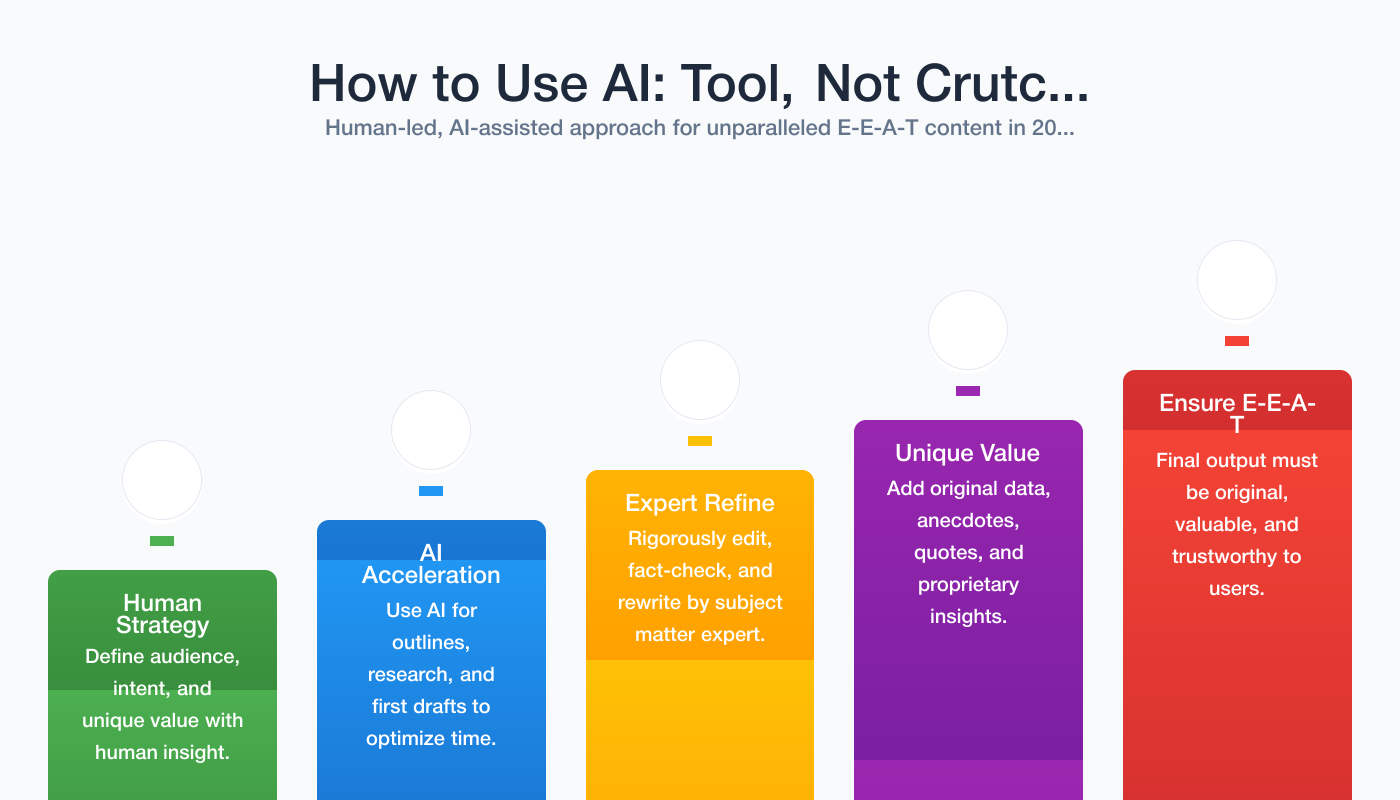
To succeed, content workflows must be human-led and AI-assisted. This means using AI for foundational tasks like ideation, outlining complex topics, summarizing research, or drafting initial sections. However, the critical stages of refinement, fact-checking, and injecting unique perspective must be handled by humans. The goal is to augment human intellect, not replace it, ensuring the final output demonstrates profound E-E-A-T (Experience, Expertise, Authoritativeness, and Trustworthiness) through original analysis and authentic insights.
This approach aligns with the core principles of effective SEO strategy. As analysis from Leadflask (2024) highlights, a superior strategy always maintains the human perspective and considers the real-life context of a search query, a dimension where human oversight is irreplaceable. The focus must shift from content volume to content value.
- Strategize with Human Insight: Define the target audience, search intent, and unique angle. Identify opportunities to provide value that competitors have overlooked.
- Leverage AI for Acceleration: Use AI tools, like those from OutblogAI, to generate structured outlines, conduct preliminary research, and produce a first draft. This optimizes the most time-consuming parts of the process.
- Mandate Expert Refinement: A subject matter expert must rigorously edit, fact-check, and rewrite the AI-generated draft to ensure accuracy, clarity, and a compelling narrative.
- Inject Irreplaceable Value: Infuse the content with unique data, personal anecdotes, expert quotes, or proprietary insights that an AI model cannot generate on its own.
The key to using AI successfully post-update is to treat it as an intelligent assistant that enhances human expertise, ensuring the final output is original, valuable, and trustworthy.
The March 2024 Core Update is more than an algorithmic adjustment; it is a fundamental re-architecture of Google's approach to content quality. This shift requires a thoughtful, strategic response from content creators and marketers.
Here are the critical takeaways from this transformative update:
- The update signals a deep commitment to reducing unhelpful, unoriginal content, aiming to improve search results by an estimated 40%. This recalibrates the baseline for quality content across the board.
- New spam policies specifically target Scaled Content Abuse, Expired Domain Abuse, and Site Reputation Abuse, meticulously designed to eliminate manipulative tactics.
- Success in this new era hinges on leveraging AI as a strategic tool to augment human expertise, crafting people-first E-E-A-T content that genuinely serves users, rather than generating low-quality, scaled output.
This evolution recalibrates the standards for online content, requiring genuine value and strategic precision from every creator. The imperative is to audit existing content for helpfulness and E-E-A-T and to refine content creation processes accordingly. Success in this new environment depends on using AI as a tool to amplify human expertise, ensuring every piece of content delivers value and demonstrates authority.