
How often should you do an SEO audit
At least once or twice a year for most sites, but the actual cadence depends on what your site looks like, how fast it changes, and what Google is doing around it. Small blogs and steady content sites can run on a slower rhythm. Ecommerce stores and large enterprise sites need more frequent check-ins. Treat the calendar as a baseline, not a rule, and let events like traffic drops, redesigns, and algorithm updates pull audits forward.
We've put together this guide to answer one question clearly: how often should you do an SEO audit? We'll break down the right cadence by site type, flag the moments that should trigger an off-schedule audit, and lay out the signs you need one right now.
TL;DR: SEO Audit Frequency at a Glance
- Small blogs and content sites: Annual comprehensive audit, quarterly performance reviews
- Ecommerce stores: Bi-annual comprehensive audits, quarterly focused reviews
- Large enterprise sites: Quarterly comprehensive audits, monthly spot checks
- SaaS and product sites: Audit with each major release, quarterly technical health checks
- Run an off-schedule audit when: organic traffic drops without explanation, a Google algorithm update lands, you're launching a redesign or replatform, or you receive a manual action in Search Console
- The underlying rule: the more changes happening around your site, the more often you should audit
Why Is SEO Audit Impotant To Schedule
Because the conditions that decide whether your pages rank don't stay still. Google ran the March 2026 Core Update in late March, then rolled out another core update in May. The year before that brought multiple broad updates, plus Discover and spam refreshes. That's not unusual. Google's algorithm update history shows several material updates each year, and each one is a chance for your rankings to move.
The sites that shrug off those updates aren't lucky. They audit often enough to catch weak spots before a recalibration exposes them. The March 2026 update made that obvious: a large share of sites that lost rankings weren't doing something wrong, they were doing something hollow. An audit is what surfaces that hollowness before Google does.
Set-it-and-forget it also fails because your site itself changes. Pages get added, URLs get restructured, templates shift, plugins update, and product catalogs turn over. Every one of those changes leaves a fingerprint on your technical SEO. Time between audits is time for small issues to compound into ranking problems you didn't see coming.
SEO Audit Frequency by Site Type
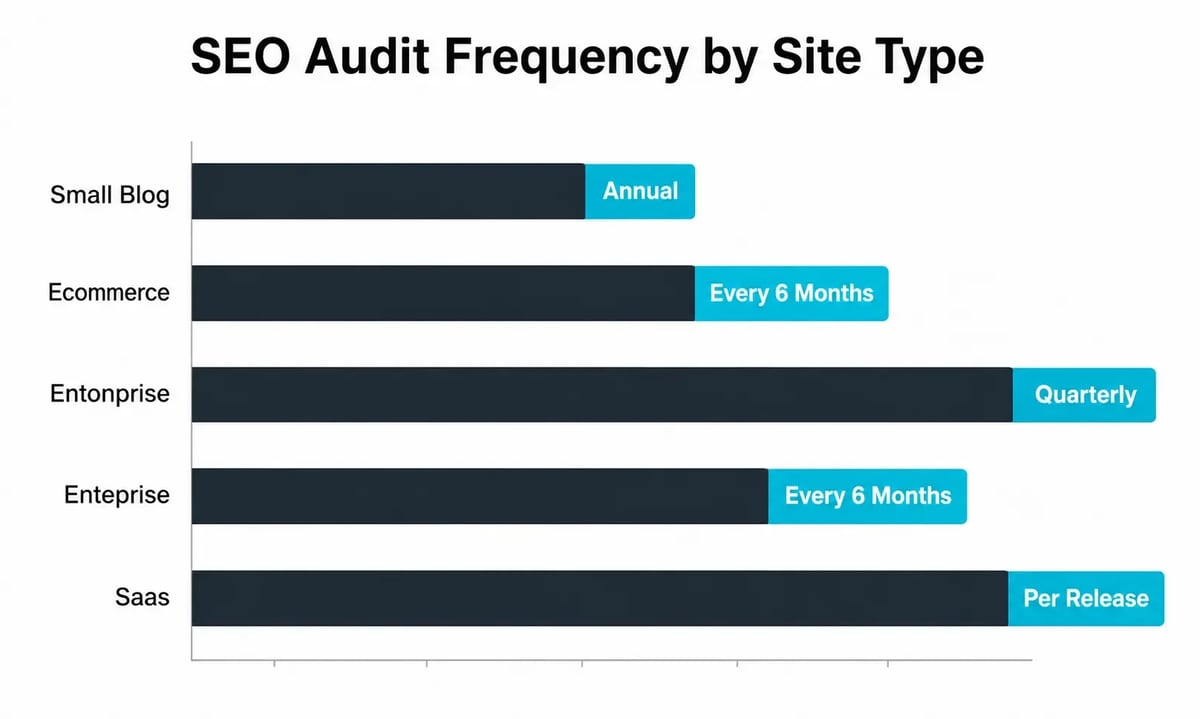
The honest answer to "how often should you do an SEO audit" doesn't fit a single number. It scales with site complexity, traffic volume, and how often the site itself changes. The breakdown below comes from how teams running audits at this scale actually structure their calendars, and lines up with what major audit tools and SEO agencies recommend for enterprise and ecommerce clients.
| Site Type | Comprehensive Audit | Focused Check-ins |
|---|---|---|
| Small blog / content site | Once a year | Quarterly performance reviews |
| Ecommerce store | Every 6 months | Quarterly reviews on key templates |
| Large enterprise site | Quarterly | Monthly spot checks |
| SaaS / product site | Each major release | Quarterly technical health checks |
If you are looking to hire an SEO audit service to perform these audits for you, looking out for what to choose and what to avoid is important. Read our guide on how to choose an SEO audit service.
Small Blogs and Content Sites
If you're running a small blog or content site with a stable set of pages, you can get away with a full audit once a year and lighter quarterly reviews of traffic, indexation, and the top-performing URLs. The risk surface is smaller because your site grows in predictable increments, and you're not chasing thousands of product URLs or international versions.
The exception: if Google lands a core update that hits your niche, drop everything and audit. Content sites are exposed to information-gain scoring more than almost any other site type, and a year of accumulated post redundancy can flip from harmless to harmful overnight.
Ecommerce Stores
Ecommerce sites need a faster rhythm. Product catalogs add and remove URLs constantly, faceted navigation creates crawl waste, and any change to a product template can ripple across thousands of pages. A bi-annual comprehensive audit covers the deep technical review, and quarterly focused reviews on the money pages, category templates, and product schema do the rest.
One thing to watch: platform migrations, replatforms, and major theme changes are routine in ecommerce. Each one is a self-imposed ranking risk. Treat the audit as part of the launch checklist, not something you remember to do a quarter later.
Large Enterprise Sites
Enterprise sites run on a different clock. Quarterly comprehensive audits are the baseline, and monthly spot checks on crawl efficiency, index coverage, and Core Web Vitals are the safety net. The volume of pages, the number of teams touching the site, and the speed at which issues compound make anything slower comfortable for the team and expensive for the business.
Spot checks don't need to be full audits. Pull a week of Search Console data, look at the delta since last month, and check whether any teams have shipped changes that affected crawl or indexation. Catching a five-page regression early is a 30-minute fix. Catching it six months later is a quarter of rebuilding.
SaaS and Product Sites
For SaaS and product sites, audit cadence tracks the release calendar. Every major release should run a focused technical audit before and after shipping, with a full quarterly audit covering the foundations: schema, page speed, programmatic SEO outputs, and the landing pages that drive signups or demo requests.
Your product pages and feature pages are SEO assets, not just marketing copy. Audits verify that new features ship without breaking structured data, that documentation pages stay indexable, and that pricing or positioning changes don't orphan URLs with backlinks.
How To Run An SEO Audit At Correct Time
Calendar audits answer "how often." Events answer "when." Most teams end up running audits because something forced them to. Here's what should pull an audit forward, regardless of where you are in your planned cadence.
Organic Traffic Drops Without Explanation
If organic sessions drop more than 10-15% week-over-week and you can't immediately point to a known cause like a seasonality shift or a code release, that's an audit trigger. The drop itself is a signal, not a diagnosis. The audit figures out whether the cause is technical (indexation, crawl, rendering), content (lost rankings on key queries), or external (a competitor jump, an algorithm update).
Don't wait for a quarterly audit to understand a traffic drop. The longer the underlying issue runs, the longer the recovery takes, and the more compounding damage hits the URLs that were already underperforming.
Google Algorithm Updates
Every confirmed core update, spam update, or Helpful Content refresh is a trigger. You don't have to audit the entire site, but you should audit the queries and pages that moved significantly during the rollout window. The March 2026 update was a useful reminder: 55% of sites saw ranking shifts, and most of those sites didn't know they were exposed until the rankings moved.
A good rule: identify the pages that gained or lost the most impressions in the two weeks after an update, audit those specifically, and only widen the audit if you find a pattern.
Site Redesigns, Migrations, and Replatforms
Any redesign, domain move, CMS swap, or template overhaul should run an audit before, during, and after launch. Before-launch audits catch issues that would otherwise embed into the new build. After-launch audits verify that redirects, metadata, and schema made the transition intact.
The cost of skipping this is well documented. A single line of code left in the wrong place during a launch can drop a site from the index entirely. Even small failures compound. For team leads, the audit is the seatbelt: it doesn't make the launch slower, it makes the recovery optional instead of mandatory.
Manual Actions and Search Console Warnings
If Google sends a manual action notification, a security warning, or a notable index coverage alert, that's not a trigger to think about, it's a trigger to act. Manual actions won't resolve themselves, and the audit is what defines the fix plan and the reconsideration request.
Major Content or Product Launches
Launching a new product line, opening a new market, or publishing a major content hub each carry their own SEO risk. New URL structures, new template types, and new internal linking patterns all need to be audited before they ship, not after the search console flags start arriving.
Seasonal Spikes
If your site depends on a seasonal window (Black Friday, holiday retail, a conference you sell around), run an audit in the weeks leading up to it. The opportunity cost of a technical issue during peak traffic is high, and the audit is cheap by comparison.
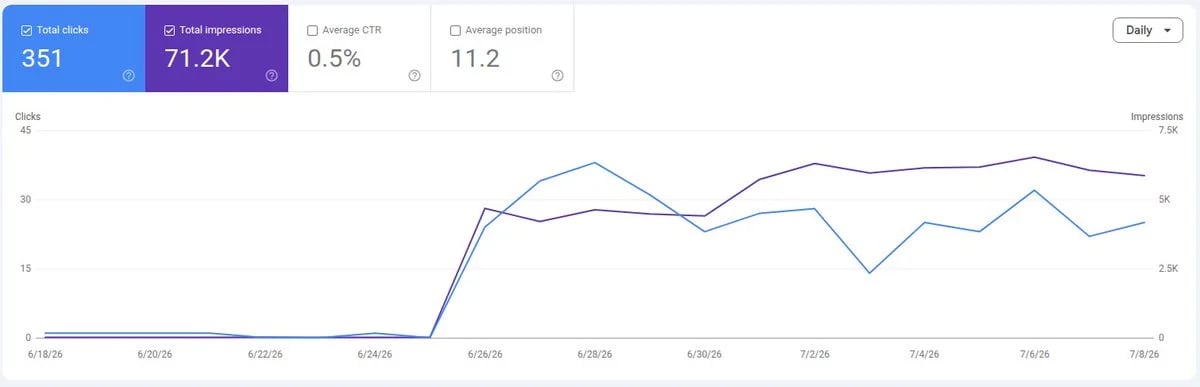
Why you Need an SEO Audit Right Now
Audit frequency is mostly calendar work, but some signals say "don't wait." If any of these are true, your next scheduled audit should be now.
- Organic traffic is declining over multiple months without a clear cause
- You launched a redesign, migration, or major template change in the last 90 days and haven't audited since
- A Google algorithm update shipped recently and rankings moved for your priority pages
- Index coverage in Search Console shows rising errors or excluded URLs you didn't expect
- Page speed or Core Web Vitals have regressed based on field data, not just lab tests
- You're publishing content but traffic to older posts is flat or declining across the board
- You've added or expanded a content category, product line, or market without a corresponding audit
- You haven't done a full audit in over a year regardless of what else has changed
If you checked two or more of these, the cadence discussion is academic. Run the audit.
Building a Sustainable SEO Audit Cadence
The teams that get audits right don't run them as one-off projects. They build a rhythm that combines heavy audits on a known schedule with light monitoring on an ongoing basis.
Pick a baseline cadence from the table above. That sets your comprehensive audit rhythm. For most sites, it's between one and four times a year.
Layer in continuous monitoring. Tools like Search Console, your analytics platform, and a rank tracker should run continuously. They don't replace audits, but they tell you when an audit is needed outside the planned schedule.
Reserve the heavy audits for the points where they matter most. Pre-launch, post-launch, post-update, and post-traffic-drop. The audit cost is real, so spend it where the stakes are highest.
Document every audit's findings and fix history. Six months from now, you want to know what was flagged last time and whether it was actually fixed. That's how you stop repeating the same technical debt.
Keep the audit scope proportional to the change. A traffic drop needs a focused audit on the affected pages and queries. A site migration needs a full pre- and post-launch review. A new product launch needs a tight audit on the new URL patterns. Don't run a full audit when a focused one will do, and don't run a focused audit when a full one is what's actually needed.
How often should you do an SEO audit? Often enough that small problems don't get the chance to grow. Use the table as your baseline, let the triggers pull audits forward, and treat the audit as a regular part of how your site stays healthy, not a once-a-year obligation.
Ready to move from cadence to execution? Start with our SEO audit checklist to walk through what the audit should cover, or browse our guides to set up the automated monitoring that keeps your audit cadence honest.