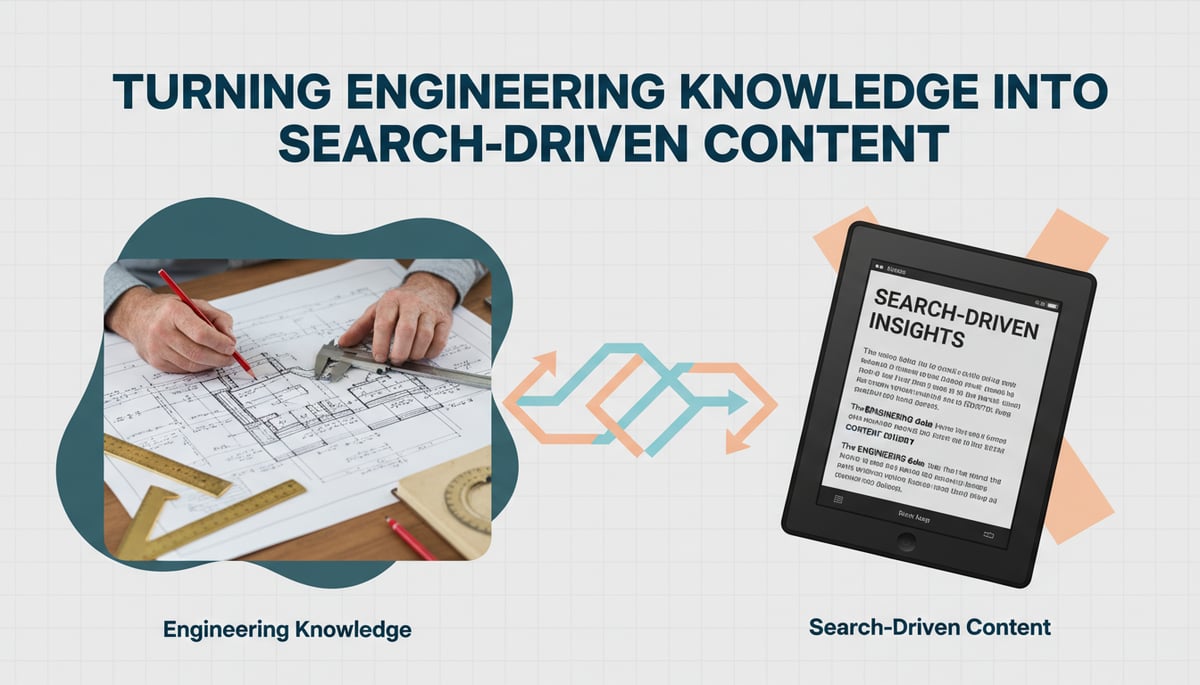
Turning Engineering Knowledge into Search-Driven Content
'Many engineering firms possess deep technical expertise but struggle to translate it into marketing content that attracts and converts non-technical decision-makers. The traditional reliance on word-of-mouth and trade shows is no longer sufficient in a competitive digital landscape. One firm, by shifting its messaging to focus on client outcomes rather than technical processes, increased

A firm, an engineering outfit just like yours, recently revamped its messaging. Instead of focusing solely on technical specifications, they highlighted the tangible benefits and outcomes clients received from their work. The result? Their closed-won value soared by 38% in a single year. Thirty-eight percent! That's a significant boost to the bottom line, demonstrating a clear path to growth.
The numbers are undeniable. Your team possesses profound expertise; engineers on your staff could likely build a rocket to Mars. But if your communication still sounds like you're pitching to fellow engineers, you're missing a critical opportunity. If you're still talking like you're pitching to other engineers, you're missing out on serious business.
The traditional avenues for client acquisition are evolving rapidly. Relying solely on trade shows or word-of-mouth is no longer sufficient. In today's dynamic digital landscape, your prospective buyers are actively online, searching for solutions to their problems, not intricate spec sheets. If your firm's expertise isn't visible where they're looking, that invaluable knowledge becomes wasted intellectual capital.
So, how do you transition from being the industry's best-kept secret to a recognized leader? How do you transform internal know-how into compelling, trust-building search-driven content? Content that resonates with your audience, educates them effectively, and ultimately motivates them to engage? That's precisely what we're going to explore.
Brief: From Technical Experts to Trusted Advisors
Remember those conferences? They suffered a significant decline and haven't truly recovered since. This renders your traditional business development strategies largely obsolete. Data from Similarweb (2024) further underscores the dramatic drop in lead generation effectiveness from such events. Yet, here's the crucial insight: your engineering expertise remains incredibly valuable. The challenge lies in how you articulate it.
Consider the example of a forensic engineering firm. They shifted from a negative marketing ROI actually losing money on their efforts to achieving a 2x ROI in their first year. This transformation wasn't about detailing mechanical intricacies. Instead, their messaging centered on providing "peace of mind" for insurance adjusters and legal professionals. This strategic refocus is precisely what a firm like Marketri facilitates. By emphasizing 'peace of mind,' they helped a cold chain engineering firm see a 38% increase in closed-won value.
To replicate this success, you must understand what your target clients actually search for heir problems, not your industry jargon. Then, you build your content strategy around those insights. Forget vanity sponsorships; the objective is qualified leads and, ultimately, revenue. This approach is a proven framework, designed to convert your deep technical knowledge into tangible sales and real financial returns. Because your expertise is currency. You just need to learn how to spend it right.
Why Your Technical Expertise Isn't Attracting Clients
We understand your capabilities; you're likely an exceptional engineer who builds and fixes complex systems, comprehending specifications down to the smallest component. But consider who you're truly selling to. It's often not another engineer. More frequently, the individual controlling the budget may not differentiate a torque wrench from a toaster oven.
A VP at a major pharmaceutical company, for instance, isn't looking for a doctoral dissertation on the perfect cold chain engineering setup. They don't care about the intricate specifics of your CAD program. Yet, many firms mistakenly expect their highly skilled engineers to magically become content marketing strategists a critical misstep.
So, what does resonate with them? Their job security. Their bonuses. Avoiding litigation. Board satisfaction. Risk mitigation. Regulatory compliance. They seek outcomes, assurance, and a partner who simplifies their challenges. Engineering companies often sell their services to non-engineers, revealing a fundamental disconnect when communication remains overly technical.

Many firms persist in using jargon, like a broken record, then wonder why lead generation is stagnant or non-existent. When your marketing content reads like a data sheet disguised as a blog post, it alienates the very decision-makers who hold the budget. Marketri's data showed a cold chain firm that by shifting their messaging from technical details to 'peace of mind,' their closed-won value increased by 38%.
Deploying your top engineer to content duty without a clear strategy is an inefficient use of both capital and invaluable time. If the decision-maker for your engineering services is a non-engineer, your communication must adapt to their language. You need to move beyond technical deep dives and speak to the concerns of your non-engineer decision-makers he insurance adjusters, the lawyers. They don't need to know the 'how'; they need the 'what it solves'. Because if your content isn't talking about their problems, you're just talking to yourself. And that won't ever bring in the business.
Building the Foundation: An Audience-Centric Keyword Strategy
You've established that your clients aren't speaking in technical terms. The next step is to uncover what language they are using what they're actively searching for. This isn't guesswork; it's a strategic keyword approach, often involving more nuanced terms than you might initially assume.
The challenge with broad, generic keywords like "engineering firm" is the intense competition. You'll either face an uphill battle you're unlikely to win or incur prohibitive costs trying. The solution lies in long-tail keywords specific phrases people type when confronted with a particular problem. Think "sustainable civil engineering for brownfield sites" or "best structural engineering firm for small projects." These are more specific, typically less competitive, and indicate higher intent.
This strategy is data-backed: approximately fifty percent of all search queries contain four words or more. This represents a vast segment of potential clients searching for precisely what you offer, rather than a generic "engineering" service.
Tools like SEMrush, Ahrefs, or even Google Keyword Planner (for a more traditional approach) become indispensable. Beyond search volume, the critical factor is intent. Is the user seeking information ("what is cold chain engineering")? Are they comparing services ("best flood control engineers NYC")? Or are they ready to procure ("emergency bridge repair services")? Your content must align with their exact stage in the buyer's journey, or you risk wasting both their time and yours.
Your engineers' technical expertise remains vital, of course. Their role isn't necessarily to draft entire articles, but to act as crucial fact-checkers, injecting authority and ensuring that the solutions you promise are genuinely viable, not just marketing fluff. Their input ensures your expertise truly shines through.
Analyze your competitors: what are they ranking for? More importantly, what are they overlooking? There are always gaps in the market opportunities for you to establish dominance. This isn't about intuition; it's about identifying the precise language your clients use, the problems they articulate, and building your entire content strategy on that solid foundation. Because if you don't speak their search language, you won't ever show up on their radar. Period.
From Technical Specs to Compelling Content: A Creation Framework
You possess all the necessary specs, schematics, and calculations that's commendable. However, simply presenting this raw data on a page will likely go unread. It becomes mere noise, a digital compendium of information only meaningful to you. The key is to craft a compelling narrative, because clients don't merely purchase "solutions"; they buy relief from their problems.
First, pivot away from talking exclusively about your services. No one truly cares about your advanced crane until their old one malfunctions mid-lift. Frame all your content around their actual pain points what keeps them awake at night, what risks concern them most. Then, explicitly demonstrate how you resolve those issues. The cold chain engineering firm, for instance, didn't just list technical specs; they illustrated how their system drastically reduced spoilage. This impactful approach led to a remarkable 38% jump in closed-won value and a 42% increase in sales leads, because they effectively communicated value.
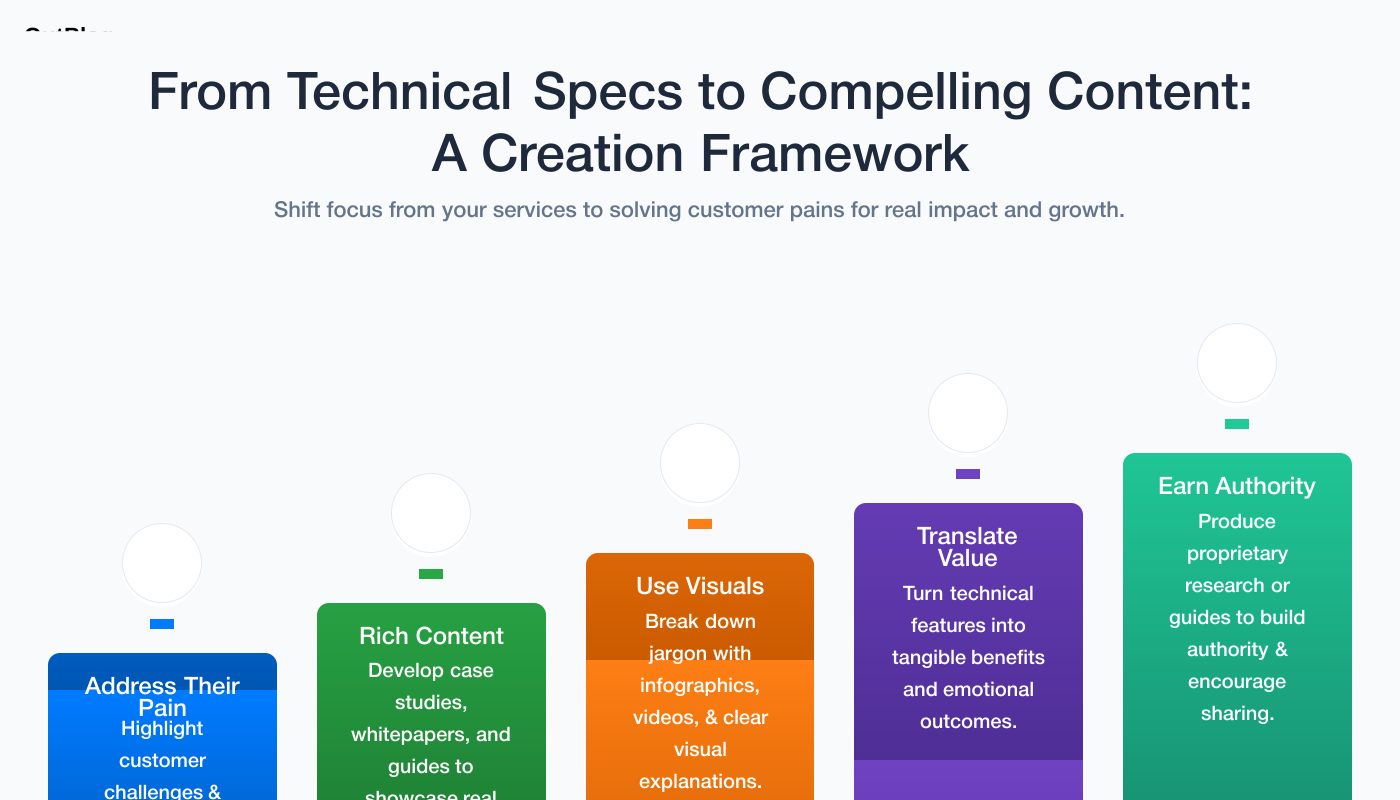
Your content needs substance. Beyond superficial blog posts, invest in comprehensive case studies, in-depth whitepapers, and authoritative guides. These demonstrate genuine expertise in action, far beyond a glossy brochure. When addressing complex subjects, such as an innovative structural integrity test, avoid overwhelming readers with jargon. Utilize visuals infographics, short videos anything that simplifies complex information. Engineers grasp the technicalities, but the executive signing the check needs a clear, digestible explanation.
Crucially, you must translate technical features into tangible benefits. If you offer a highly efficient transportation plan, don't just say "efficient logistics." Articulate that it means "peace of mind" or "regulatory compliance," helping your clients sleep better. This mirrors successful campaigns that lead with comfort or benefit, then support it with scientific proof. People invariably buy based on emotion and perceived value.
Finally, create content that others want to share. Not just generic articles about future trends, but comprehensive guides or proprietary research. Produce something so valuable and useful that other industry professionals will organically link to it, enhancing their own credibility. This is how genuine authority is built: you don't solicit links; you earn them. And that's how your firm truly gains visibility in a crowded marketplace. It's not about what you do, but what you solve.
Optimizing for Discovery: Technical SEO in an AI-Driven World
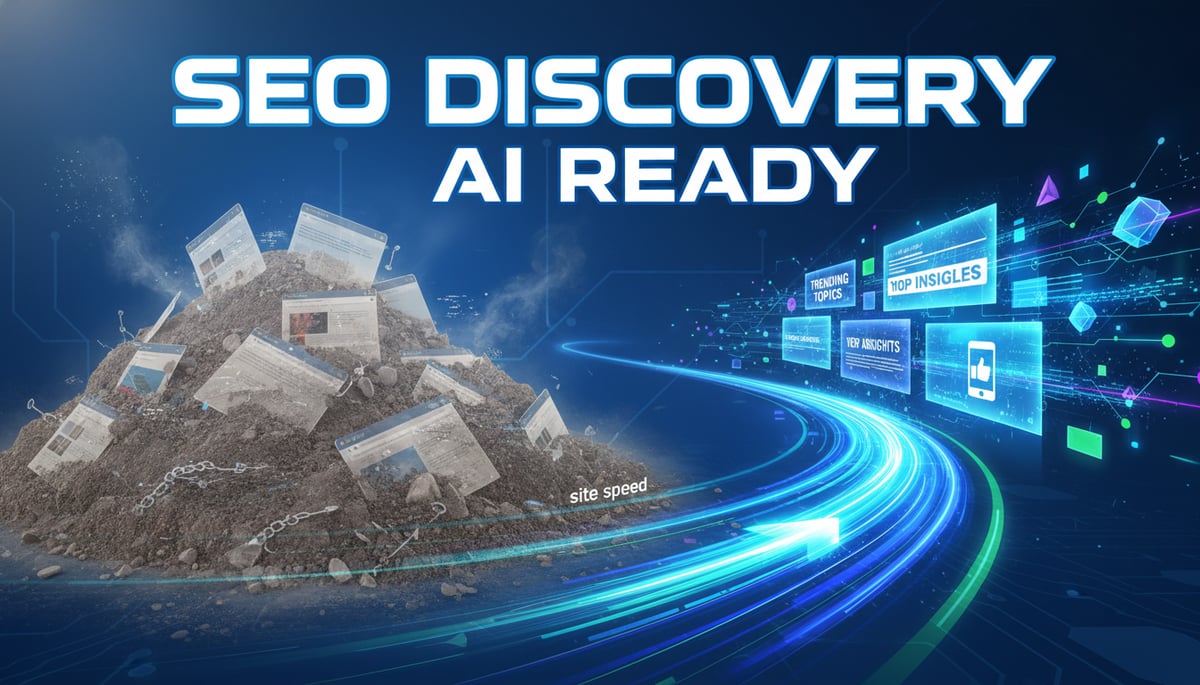
Even with exceptional content, if search engines or AI chatbots can't find or process it, it remains effectively invisible digital white noise. All your hard work risks being wasted. This isn't a peripheral concern; it's fundamental to your firm's online survival.
Start with the essentials, however mundane they may seem. Your carefully selected keywords must be incorporated into your page titles, headings (H1s, H2s), and meta descriptions. Avoid keyword stuffing; instead, integrate them naturally and logically. Search engines still prioritize these elements, and neglecting them makes it harder for Google to understand and rank your content effectively.
Next, address critical technical factors like site speed and mobile-friendliness. These are paramount, especially when dealing with large files common in engineering, such as detailed drawings. A slow or unresponsive website quickly leads to visitor abandonment, which negatively impacts your search rankings. Ensure your site loads quickly and functions flawlessly on mobile devices. Furthermore, maintain a clean and logical URL structure; convoluted URLs confuse both search bots and human users.
The advent of AI introduces new considerations. Large Language Models (LLMs) and AI Overviews demand clear, distinct semantic units. This means structuring your content with concise paragraphs, prominent headings, and generous use of white space. AI algorithms process information in clean, manageable chunks; dense, unbroken walls of text are often overlooked or misinterpreted. Notably, 82% of AI Overviews draw information from pages two or more clicks from the homepage, emphasizing the need for a well-organized site architecture from top to bottom.
Moreover, AI systems highly value original content, proprietary data, and unique insights derived from your projects. If you possess exclusive data points, compelling project outcomes, or unusual observations, feature them prominently. This distinctiveness will differentiate your content and make it more likely for AI to cite. Similarweb (2024) data reinforces the importance of originality, describing it as 'Relevance Engineering,' a fusion of content and AI that is here to stay. If your site ain't dialed in, your content stays buried.
Building Authority: Link Building and Local Presence
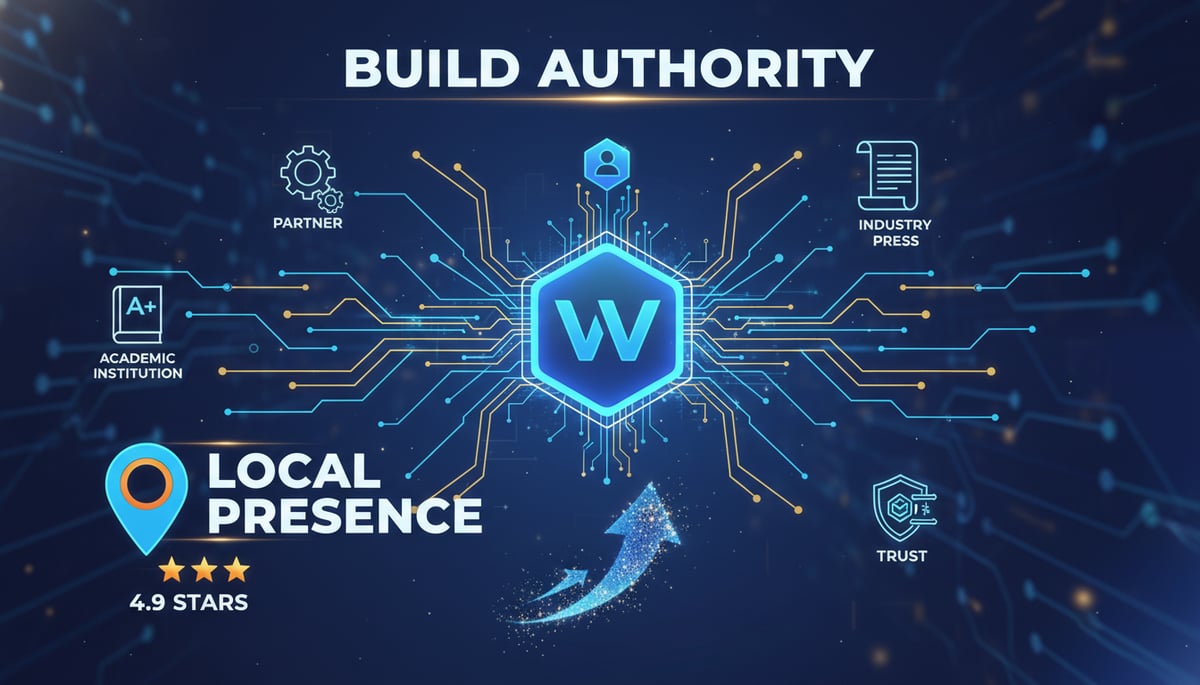
With your website optimized and your content compelling, the next step is to elevate your firm's standing. You need to expand your reach, earn respect, and establish genuine authority. This necessitates other reputable entities acknowledging and referencing your work, not just your firm promoting itself.
Begin by identifying strategic partners within your industry respected organizations whose endorsement carries weight. A link from a prominent industry player acts as a powerful vote of confidence, which Google's algorithms duly register. Actively seek these high-quality backlinks to establish your firm as a thought leader.
Next, pursue guest posting opportunities on authoritative engineering blogs that attract significant readership. Share your specialized expertise, but offer new, valuable insights beyond generic articles. While a backlink is a beneficial outcome, the primary goal is to increase your firm's visibility and demonstrate your profound knowledge.
For a truly impactful approach, consider co-authoring research papers with universities or other leading firms. Engaging in legitimate, collaborative research is a powerful way to build undeniable credibility and command respect within the industry. While demanding, the long-term returns on such efforts are substantial.
For locally focused firms, optimizing your Google My Business (GMB) profile is absolutely critical. This is how you appear in local search results, ensuring that clients searching for a forensic engineer in their specific area find your firm. Ensure every detail is accurate, encourage client reviews, and actively respond to them, as both potential clients and Google consider these crucial trust signals.
Finally, broaden your local presence by listing your firm in industry-specific and local business directories. Maintaining consistent Name, Address, and Phone number (NAP) information across all platforms is paramount. Inconsistencies confuse search engines and can diminish your local search visibility. Every possible signal should reinforce your firm's presence and legitimacy. Authority isn't given, it's damn well earned.
Stop operating under the illusion that your engineering firm is solely selling technical specifications. You are in the business of solving significant, often expensive, problems for your clients. Yet, if your online content continues to read like an instruction manual intended for other engineers, you are undeniably leaving revenue on the table and allowing competitors to capture market share.
This isn't merely about applying a superficial polish to existing white papers. It demands a fundamental strategic shift. What you know must become what your potential clients find. And what they read must resonate with their language and concerns, not just yours. The ultimate goal is to be discovered, trusted, and, ultimately, retained.
Here s the undeniable truth you must embrace:
- You must stop discussing your internal processes and instead articulate your value within the customer's world. This requires meticulous research into what they actively search for, rather than assuming what they should search for. Audience-centric keywords are not optional; they are the direct pathway to their business.
- Content is far more than words on a page. It's a meticulously structured argument, a trust-building mechanism, a digital handshake. You need a robust framework to transform raw technical brilliance into engaging narratives that educate without condescension.
- And never underestimate the critical importance of technical SEO. Whether operating in an AI-driven landscape or not, Google still needs to efficiently crawl and comprehend your website's content. A clean site architecture and rapid page loading speeds are not mere enhancements; they are foundational requirements for online visibility.
The bottom line? The market isn't static, waiting for you to adapt. It's dynamic, and your astute competitors are already embracing these strategies.
So, what will be your next step? Will you continue with outdated methods, wondering why new client inquiries remain elusive? Or will you strategically deploy your firm's immense expertise where it truly matters out there, where your future clients are actively seeking solutions? You possess the knowledge. You've got the knowledge. Now go make it discoverable. And if you're serious about scaling this discovery without the usual operational burdens, consider how a tool like OutblogAI could propel this blueprint into overdrive. Manual effort, after all, belongs to yesterday's playbook.