The Digital Handshake: How Wellness Blogs Build Trust Before the First Appointment
With 80% of internet users searching for health topics online, your wellness practice is being evaluated long before a potential client ever contacts you. In a digital landscape filled with misinformation, a strategic blog is not just content—it's your most valuable tool for building credibility. This article breaks down how to create a blog that acts as a digital handshake, cutting through the noise with expertise and empathy to convert anxious online searchers into confident, long-term clients by establishing trust as the foundation of the relationship.


Eighty percent. That's not a statistic to overlook; it's a direct reflection of client behavior. Eighty percent of all internet users are actively seeking health information online. Your ideal clients are already there, searching for answers, solutions, and guidance.
Yet, what they often encounter is a chaotic digital landscape—a wild west of misinformation, unverified claims, and outright deception. Before prospective clients even consider booking an appointment with your wellness practice, they are rigorously evaluating your credibility.
How do you navigate this cacophony? How do you establish yourself as the singular, trusted voice amidst the noise? The answer lies in building authentic trust, extending what we term the digital handshake.
This isn't about expensive advertising campaigns or glossy brochures. It's profoundly about your blog. We will explore how to transform your blog into your most potent asset for converting hesitant searchers into confident, long-term clients. It all begins and ends with trust.
TL;DR
Clients are constantly searching online, seeking authentic, human connection – not automated responses. Your role is to become that trusted resource; anything less risks irrelevance. This trust is critical because Google's algorithm prioritizes E-E-A-T (Experience, Expertise, Authoritativeness, Trustworthiness), demanding content built on a robust foundation of credibility.
To achieve this, focus on three core pillars: Educate without unnecessary jargon. Empathize by sharing relatable stories, not just data. And empower your audience with actionable, practical advice, free from superficial fluff. Avoid common pitfalls like inconsistent publishing schedules or attempting to appeal to a vast, undifferentiated audience. Such approaches are unsustainable and counterproductive.
Instead, concentrate on fostering genuine connections, translating that hard-earned trust into tangible action, such as streamlined booking processes and compelling social proof. This blog strategy is a marathon, not a sprint. It's a relationship you cultivate, not merely a fleeting marketing stunt.
Brief: Why Your Blog is Your New Front Door
Are you still struggling to attract and earn the trust of prospective clients? The digital landscape has fundamentally shifted. A staggering 80% of internet users—approximately 93 million Americans—are actively seeking health information online. This reality positions your digital presence as the primary point of contact, making it your essential front door.

However, the objective isn't merely to sell your services. It's about cultivating something far more profound: trust. In this crowded digital arena, trust is the only true currency. As one Reddit user poignantly stated, "I needed help and I didn't know how to get it... I didn't think anyone would help or care." This sentiment of desperation is widespread, and your blog is uniquely positioned to address it, serving as their indispensable guide.
This guide provides a strategic blueprint, moving beyond indiscriminate content publishing to transform your blog into a powerful client-acquisition engine. To attract your ideal clients, you must consistently demonstrate your expertise, understanding, and genuine commitment to solving their challenges. Data from sources like Similarweb (2024) consistently reinforces this shift towards authentic engagement. You must prove your value, repeatedly, long before they ever consider contacting you.
Your blog transcends mere content; it operates as an ultimate trust factory, building credibility for you around the clock.
The Modern Patient's Journey: From Search Bar to Your Waitlist
The modern patient's journey begins not in a waiting room, but in a search bar. Faced with a deluge of health information online from sources like WebMD, they initiate their quest by typing symptoms, questions, or desired outcomes into Google. This initial search phase is critical; it’s where they form their first impressions of potential wellness providers. They’re not just looking for information; they’re looking for reassurance, clarity, and a sense of connection.
Their path is often winding, moving from general inquiries to more specific needs, cross-referencing sources, and seeking validation from multiple touchpoints. A well-crafted blog intercepts this journey at various stages, offering valuable insights, demystifying complex topics, and providing actionable advice. Each piece of content serves as a breadcrumb, guiding them away from unreliable sources and towards your reputable practice.
As they engage with your blog, they move from anonymous searchers to informed prospects. They begin to recognize your voice, appreciate your expertise, and feel a burgeoning sense of trust. This continuous engagement—reading a blog post, downloading a guide, watching a short video—is the gradual conversion of passive interest into active intent. It transforms a digital query into a tangible desire to connect with your specific solution.
By mapping your content to each stage of their evolving needs, you seamlessly guide patients from initial curiosity to becoming confident clients on your waitlist.
The Foundation of Trust: Applying the E-E-A-T Framework to Wellness

In the competitive realm of online health information, Google’s E-E-A-T (Experience, Expertise, Authoritativeness, Trustworthiness) framework is not just an SEO guideline; it's the bedrock of your digital credibility. For wellness practices, demonstrating E-E-A-T is paramount to cutting through the noise and establishing authentic trust with your audience.
- Experience: Showcase your practical, hands-on experience. This means sharing case studies (anonymized, of course), real-world applications of your methods, and narratives that highlight your direct involvement in client transformations. It's not just what you know, but what you’ve done.
- Expertise: Prove your deep knowledge in your specialized area. Your blog should be a repository of well-researched, accurate, and insightful articles. Cite relevant studies, discuss nuanced concepts, and present a sophisticated understanding that sets you apart from generalists.
- Authoritativeness: Establish yourself as a leading voice in your niche. This involves earning mentions, backlinks, and recognition from other reputable sources. Consistently producing high-quality content that others reference solidifies your position as an authority.
- Trustworthiness: This is the culmination of the other three. Be transparent, accurate, ethical, and consistent in your messaging. Provide clear disclaimers, maintain a professional online presence, and always prioritize the well-being and privacy of your audience.
Failing to adhere to E-E-A-T principles can result in lower search rankings and, more importantly, a significant erosion of patient trust. Conversely, a deliberate application of this framework positions your blog as an indispensable and reliable resource.
Embracing the E-E-A-T framework isn't just about pleasing algorithms; it's about systematically building the unwavering confidence your wellness clients crave.
Content That Connects: The Three Pillars of a Trustworthy Blog
To forge genuine connections with your audience, your blog content must stand firmly on three foundational pillars: educate, empathize, and empower. These elements, working in concert, transform casual readers into dedicated clients by addressing their needs on multiple levels.
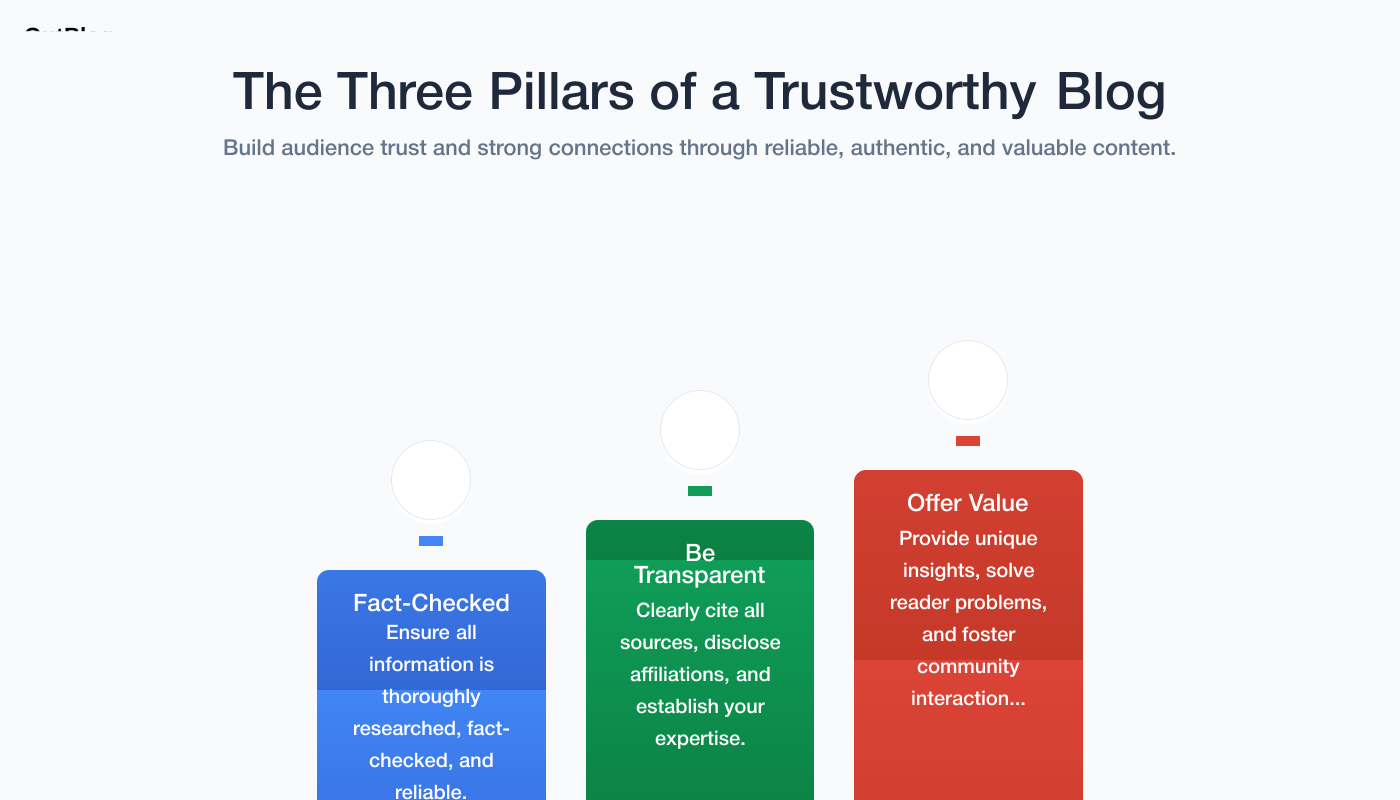
- Educate Without Jargon: Your audience is seeking clarity, not complexity. Break down intricate health concepts into digestible, understandable language. Explain why certain approaches work, how conditions develop, and what the underlying science suggests, all without resorting to inaccessible professional jargon. The goal is to inform, demystify, and build understanding, positioning you as a knowledgeable guide.
- Empathize Through Storytelling: Data and facts are important, but human connection is built on shared experience. Tell stories—client success stories (with consent and anonymity), personal anecdotes (where appropriate), or common patient struggles. Show that you understand their pain points, fears, and aspirations. This emotional resonance builds rapport and assures them that you truly "get it."
- Empower With Actionable Advice: Readers don't just want information; they want solutions. Every blog post should ideally offer practical, implementable steps or strategies they can use immediately. Whether it’s a simple mindfulness exercise, a dietary tip, or guidance on navigating a particular challenge, empower them to take control of their health journey. This demonstrates your value and instills a sense of capability.
When these three pillars are consistently present in your content, your blog transcends being merely informative to become a trusted companion on your audience's wellness journey.
By consistently educating, empathizing, and empowering your readers, your blog transforms into a magnetic force for client attraction.
From Reader to Client: Converting Trust into Action
You've invested your effort into crafting compelling blog content, successfully building trust. That's a significant accomplishment. However, a common misstep occurs at the crucial next stage: converting that trust into action. Many practices inadvertently introduce friction, creating a convoluted path that deters a highly engaged reader, causing them to disengage. Your carefully cultivated trust is fragile; do not undermine it now.
Your content has resonated, fostering a connection and convincing them that you understand their needs. Yet, this resonance alone won't prompt them to embark on a quest to become a client. The transition must be seamless, intuitive, and frictionless. Any perceived sales pressure at this point can unravel the entire foundation you've meticulously constructed.
Here’s how to effectively bridge the gap from engaged reader to committed client:
- Define The Next Step Clearly. With their attention secured, gently guide them to the next logical action. Avoid aggressive banners. Instead, offer a clear, inviting prompt like "Ready for a personalized consultation?" or "Explore how our approach can help you." This invitation should be visible and unambiguous.
- Streamlined Booking. In 2024, clients expect effortless booking. Data, such as that from Zenoti, reveals businesses leveraging integrated solutions like "Reserve with Google" see a 15% increase in new client acquisition. Eliminate lengthy forms; prioritize simple, one-click scheduling.
- Amplify Social Proof. After consuming your valuable content, prospects seek validation from their peers. Showcase authentic testimonials and case studies prominently across your website and social media. The positive experiences of others provide the critical final nudge many individuals need.
- Visible Contact Information. As WriterAccess consistently emphasizes, obscuring your contact details is a critical error. Ensure your phone number, email, and location are easily accessible on every relevant page. A motivated prospect should never have to search for a way to connect; if they do, they are likely already moving on.
Your content constructs the bridge of trust. Your conversion strategy must, in turn, provide a clear, smooth, and effortless landing strip. It's not about high-pressure sales; it's about a simple, intuitive path to engagement. Provide an undeniably clear and easy path for your audience to take the next step.
Frequently Asked Questions
What is the ideal publishing frequency?
This is a frequent question. The key is not volume, but consistency. Publishing one or two thoroughly researched, high-quality posts per month is far more effective than an inconsistent burst of five half-baked articles followed by a long hiatus. This disciplined approach ensures you remain a reliable and constant presence for your audience.
Do I need to be a professional writer?
Absolutely not. Your primary goal isn't to be a literary giant, but a compassionate and effective helper. If you can articulate complex ideas clearly and empathetically to a client in person, you possess the essential skills to write a compelling blog post. Adopt a conversational, one-on-one tone. Authenticity resonates far more powerfully than polished, impersonal prose, a sentiment echoed by resources like Therapistsitetoolbox.com.
What if my posts don't get immediate traction?
Building an audience and gaining organic visibility on Google is a gradual process. Every post you publish should be viewed as a long-term asset, an evergreen resource that continues to attract and inform potential clients for months, even years. As Jesscreatives.com rightly points out, each blog post is a lasting investment. The most important step is to simply publish and maintain momentum. For those looking to streamline this process, tools like OutblogAI can help maintain consistency.
Stop overthinking it. The essence of an effective blog is to genuinely help your audience.
If you’ve reached this point, you understand that your blog is far more than a digital pamphlet. It’s a strategic imperative.
Your wellness blog is no longer optional. It serves as your critical digital handshake, often the very first impression you make. In a digital environment saturated with information—and, candidly, considerable misinformation—you must either distinguish yourself as a credible authority or risk being overlooked. Individuals aren't merely searching for answers; they are actively seeking someone they can trust, a guide who speaks authentically without condescension or jargon. That guide is you, or it unequivocally should be.
When vulnerable individuals search for help online (and they are, persistently), they seek stability, not a sales pitch. They need to perceive your expertise, feel your empathy, and know you are more than just another name on a list. Your blog builds that indispensable bridge, or you risk losing them entirely.
Consider these unequivocal truths:
- Your blog is a continuous, quiet conversation that establishes credibility and cuts through superficial noise long before any direct contact.
- Beyond marketing fluff, authenticity is paramount. Demonstrating your experience, proving your authority, and embodying the E-E-A-T principles is about showcasing genuine excellence in your field.
- Trust manifests through tangible actions: clear, actionable advice, relatable narratives, and an intuitive, straightforward path for clients to engage further.
This endeavor is not about fleeting flashiness; it’s about unwavering, consistent utility.
The time for contemplation is over. Take action. Begin writing, or establish a sustainable process to ensure high-quality, consistent content without overwhelming yourself. Your future clients are actively seeking the trustworthy voice your blog can become.