'Driving Adoption: The Role of Technical Content in Open Source and DevTool Success'
In 2024, AI-related tools captured 48% of all developer tool investments, creating a hyper-competitive landscape. In this environment, success hinges on more than just code quality; it requires community validation, user education, and trust. High-quality technical content is no longer just marketing—it's a critical engine for discoverability, adoption, and sustainable growth. This article breaks down how technical blogs and tutorials serve as a fundamental growth lever for both emerging open-source projects and established developer tool companies, providing a strategic blueprint for building a loyal and engaged developer audience.

Forty-eight percent. That's how much of all dev tool investment poured into AI-related projects last year. Consider that for a moment: half. While your wallet might feel the pinch, your mind should reel at the implications.
This isn't just a market anymore; it's an outright feeding frenzy. In this maelstrom – this absolute chaos of new tools, frameworks, and projects emerging faster than you can blink – how do you possibly stand out? How do you actually get developers to adopt your solution?
Let's be clear: good code? That's merely the cost of admission now. Always has been, yes, but today? It's utterly insufficient. You could possess the most brilliant open-source library or the slickest new dev tool on the planet, but if no one understands it, trusts it, or can even find it … you're just a whisper in a hurricane.
The true differentiator, the genuine engine for adoption and growth in this hyper-competitive landscape, isn't some ephemeral marketing spiel. It ’s the meticulously crafted how-to guide, the tutorials that genuinely work, the deep dives that unequivocally demonstrate your expertise. It's high-quality technical content.
This goes far beyond mere SEO (though, obviously, it helps). This is about forging trust, proactively educating your future users, and making your project so effortlessly approachable that it practically integrates itself. That's how you capture hearts and minds. That ’s how you cultivate a community. And that, my friends, is how you not only survive, but thrive.
In today's hyper-competitive dev tool market, exceptional technical content isn't a luxury – it's the fundamental engine for adoption, trust, and survival.
TL;DR
In the rapidly expanding, AI-driven developer tool landscape, merely having good code is no longer enough; content has become the critical driver for adoption. Developers demand trust, transparency, and clear guidance, which high-quality technical content provides, leading to community validation, scalable onboarding, and a defensible market position.
Ultimately, content transforms passive users into active advocates, making it the bedrock of growth and differentiation in the dev tool ecosystem.
Brief: Why Content is the New Compiler for Growth
We're witnessing a seismic shift in how developer tools gain traction. The traditional marketing playbook is obsolete, replaced by an ecosystem where authenticity and utility reign supreme. Just as a compiler translates human-readable code into executable programs, content now translates the complex value of your dev tool into developer understanding and, crucially, adoption. It ’s not just about informing; it ’s about enabling action and sparking genuine engagement.
Effective content serves as the essential interpreter, transforming intricate features into accessible solutions that drive widespread developer adoption and community growth.
The New Validation Metric: From Code Commits to Community Content
Forget chasing vanity metrics and those glossy presentations about your brilliant code. Because today, if developers aren't actively discussing your project, if they aren't starring your repo, you're essentially invisible. That's the unvarnished truth of this frenetic dev-tool landscape. Your code? It ’s merely the foundation. But the community? That's your true investor deck.
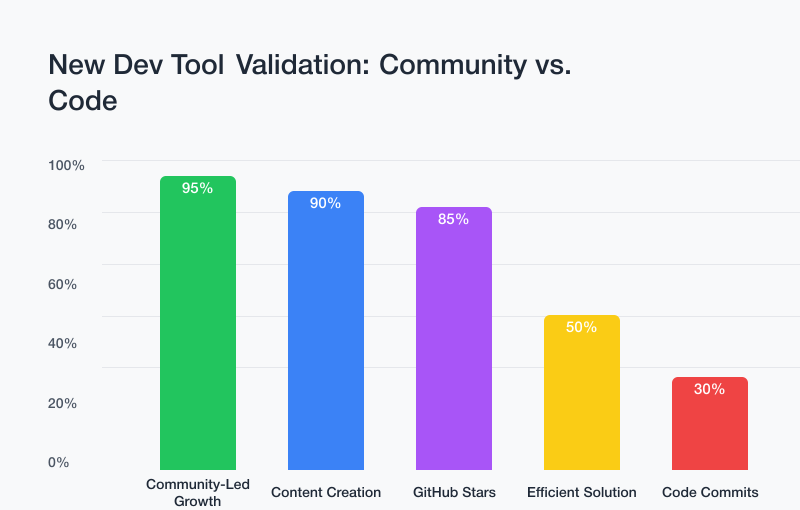
And investors? They're far from naive. They actively monitor GitHub. Those stars, you see, are the new due diligence – tangible proof that someone, anyone, genuinely cares about your project (or at least bothered to click the button). This significantly de-risks their decision before they commit substantial capital to your startup. This isn't just hype; it's the current reality of the game.
Consider Zed Industries, a leading open-source startup project of 2024, boasting an impressive star count. How did they achieve this? Not just by writing exceptional code, which is table stakes. They embraced open-source, certainly, but they also communicated tirelessly. They generated content, articulated their mission, detailed their architecture, and clearly explained the benefits. This transparency didn't just encourage developers to try the tool; it compelled them to publicly endorse it, culminating in a significant wave of validation.
Here's the crux: you can build a magnificent tool, but if no one grasps its significance, its superiority, or why they should abandon their established workflow for your new, more efficient solution, what's the point? Blogs and articles are no longer mere marketing fluff (they never truly were). They are the engine that propels developer adoption, igniting the initial buzz and fostering viral traction. Without this content, how can anyone even discover you, let alone champion your cause?
This isn't an anomaly; it's a fundamental paradigm shift. We're moving from top-down sales and corporate jargon to authentic, community-led growth, driven by peer recommendation and trust. Content is the spark that lights this fire. Chainguard, for example, achieved a $3.5 billion valuation. Do you think they did that silently? Absolutely not. They extensively discussed supply chain security, building immense industry trust through their content. Similarly, Anysphere, valued at an astounding $29.3 billion, scaled through viral adoption – a phenomenon that begins with developers conversing about what they read and see. Even Similarweb (2024) data underscores the critical role of digital presence in signaling market impact.
So, yes, your code is undeniably important. But today, the visibility and raw validation derived from community buzz, ignited by honest content, is equally – and often more – valuable. Because if you cannot compellingly articulate your vision, no one will listen, and your ambitious projects will remain undiscovered.
Content as a Scalable Onboarding and Support Engine
Imagine a world where every new user doesn't demand a dedicated hand-holding session, and every common problem doesn't swamp your support inbox. That's the power of strategic content. Your documentation, tutorials, FAQs, and troubleshooting guides aren't just static text; they are your most scalable, always-on onboarding and support team. They empower developers to self-serve, to find answers at 2 AM without waiting for an email reply, and to seamlessly integrate your tool into their workflow. This dramatically reduces your operational overhead, frees up your engineers from repetitive support tasks, and ensures a consistently positive user experience, regardless of how fast your user base grows.
By providing comprehensive, accessible technical content, you transform onboarding and support from a bottleneck into a powerful, self-sustaining growth engine.
Building a Defensible Moat with Community and Trust
Everyone ’s relentlessly chasing clicks, endlessly pushing content, trying to game some elusive algorithm. You see it every single day. But let me tell you, that's all just ephemeral noise. Because the real long game? It's not merely about creating content; it's about painstakingly building a genuine community. And that, unequivocally, is your sole, truly defensible moat – the kind you cannot simply buy or mimic.

So many open-source projects fundamentally misunderstand this. They believe if the code is stellar, users will instinctively flock. Not anymore. Not in this saturated environment. You must engage with them. You must guide them. And that unequivocally means content – not the slick, generic marketing collateral, but authentic, high-value information. Consider GitLab, a publicly traded company, not some garage startup. They serve over 100,000 organizations, as reported by Similarweb (2024). How did they achieve this scale? Their content effectively bridged the gap, connecting free users to paid features, demonstrating why they should remain invested and eventually upgrade. It's a remarkably simple yet widely overlooked strategy.
This isn't some trivial PR exercise; it's a profound strategic imperative. Content that genuinely spotlights community contributions – the real, passionate individuals driving the project forward, not just corporate personnel – is invaluable. It sends a clear message: "Hey, you can be an integral part of this." You must transparently communicate your roadmap, without hidden agendas, and provide unambiguous contribution guidelines. GitHub ’s Octoverse (2024) data consistently confirms that clear guides are a pivotal factor in attracting first-time contributors. So, if you want developers to join your ecosystem, you must make it effortless, and that demands direct, no-nonsense content that transforms a passive user into an active participant.
Furthermore, consider security-critical projects like Sigstore (adopted by giants like Google and Yahoo) and Chainguard. Do you genuinely believe people blindly trust them with their most sensitive systems? Absolutely not. They demand proof. They require transparency. And how do you cultivate that? Through blogs, case studies, and authentic narratives that showcase how you ’re solving critical problems, rather than just peddling a product. The OpenSSF (2024) heavily emphasizes such case studies, underscoring the industry's recognition that trust must be earned, not merely presumed. You must narrate your story plainly and honestly for people to truly believe in your mission.
Here ’s the crucial insight: this community-centric approach, meticulously built upon authentic, human-centric content, ignites a powerful, self-reinforcing engine. Increased engagement leads to more feedback, which in turn fosters better code, resulting in more people enthusiastically championing your project. They evolve into your advocates, your invaluable, unpaid sales force. This process allows you to construct a formidable moat around your project (or company) – something incredibly difficult for any competitor to simply replicate. True loyalty cannot be purchased. Therefore, a thriving community cultivated through transparent, high-quality content is your most potent and defensible asset, ensuring long-term resilience and sustained growth.
A Content Blueprint for Developer Tool Growth
Alright, pay attention. You think building groundbreaking developer tools is challenging? Try convincing anyone to actually integrate and use them. Most content strategies are an utter mess, akin to aimlessly throwing darts in the dark. Yet, the industry titans – GitLab, VS Code, Django – they understand. They haven't just built products; they've meticulously crafted entire ecosystems. This approach to content isn't magic; it's about precision, about following a well-defined map – their map. Because a developer's journey, from initial curiosity ("what's this thing?") to indispensable reliance ("I can't live without it"), is far from linear. It's winding, complex, and unpredictable. And your content? It must navigate that exact same journey. That's how you convert casual observers into fervent advocates. You must meticulously align your content with the developer's journey, or your message will simply dissolve into the digital ether.
This journey, critically, breaks down into distinct pillars, each serving as a strategic stepping stone with a specific objective. Fail to address each stage, and you risk losing them. You wouldn't propose a long-term commitment to someone who just landed on your documentation for the first time, would you? Instead, you build momentum deliberately, strategically. That is the core of effective developer-tool content.
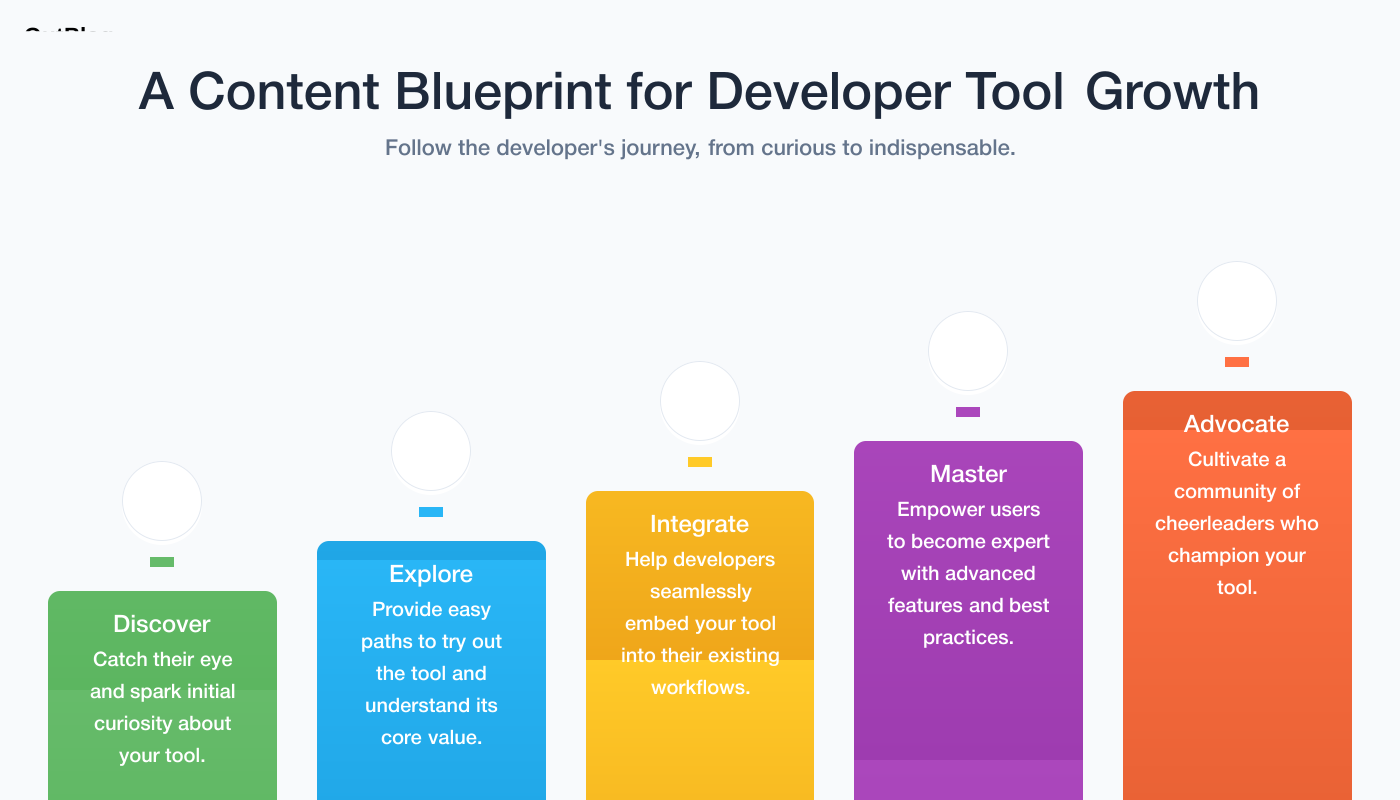
1. Awareness: "What's This Noise?"
The initial hurdle? Developers don't even know you exist, nor do they inherently care. Your imperative is to cut through the noise, not by vociferously marketing your features – nobody cares about those yet. Instead, speak directly to their pain points: that persistent bug, the agonizingly slow build, the tangled dependency nightmare. Subtly suggest that perhaps, just perhaps, a superior solution exists. This might manifest as an invaluable forum post, a blog elucidating a complex concept, or a standalone utility that simply works. Your presence should be felt in their natural digital habitats, without immediately demanding anything in return. It's about planting the seed, gently guiding them to acknowledge your existence. As Similarweb (2024) data consistently demonstrates, if you lack visibility, you're effectively non-existent. The foundational objective is simple: achieve visibility – that's the first, crucial battle.
2. Consideration: "Could This Actually Fix My Mess?"
Okay, they've noticed. Perhaps they even clicked through. Now they're actively investigating, silently posing the question, "So, what exactly does this do?" This is your opportunity to articulate specifics, but still, without a hard sell. Provide them with the precise information required for comparison and comprehension. Envision comprehensive tutorials, deep dives into granular use cases. JetBrains, for instance, masterfully executes this; their blog is replete with the kind of meticulous technical walk-throughs that preemptively answer "how does it work?" questions. Your mandate is to demonstrate, not merely narrate. This process intrinsically builds trust. Otherwise, you're just another ephemeral blip on their overflowing radar. At this critical stage, your content must show, not just tell – period.
3. Decision: "Should I Actually Use This?"
By this point, they're serious. They've thoroughly "kicked the tires," perhaps even meticulously explored your GitHub repository. Yet, they require that final impetus, that conclusive reassurance. This is precisely what you provide. The OpenSSF's website exemplifies this with its focus on real-world narratives and compelling case studies – irrefutable proof that others, facing similar challenges, successfully made the transition and reaped the benefits. Crucially, you need to offer effortless on-ramps: streamlined quickstart guides and perhaps even an exemplary <mark class="hl">[README.md](https://medium.com/@kc_clintone/the-ultimate-guide-to-writing-a-great-readme-md-for-your-project-3d49c2023357)</mark> that transforms the initial setup into an absolute breeze (as GitHub's Octoverse report consistently highlights the critical importance of superior documentation). Because if the barrier to entry is too high, they will simply vanish. Make it intuitive. Make it obvious. To secure their commitment, offer undeniably clear paths with absolutely zero friction.
4. Advocacy: "Okay, I Love This. How Do I Help?"
They're onboard. They're actively using your tool, perhaps even profoundly loving it. But your engagement cannot cease there. Your next strategic objective is to transform them into your most fervent evangelists, your dedicated army. This necessitates equipping them with the right tools: comprehensive contribution guides, detailed instructions on how to extend or build atop your platform, and profound, advanced deep dives into its intricacies. Establish vibrant community forums where they can collaboratively assist one another. Because when an individual cherishes your product enough to openly champion it, or even contribute to its development, that is pure, unadulterated gold. This organic growth mechanism is precisely how projects like Django continuously expand, evolving beyond mere products into genuine movements. Therefore, integrate them intimately into your journey. Your ultimate goal isn't just to acquire users, but to cultivate a loyal legion of apostles.
Frequently Asked Questions
How do we measure the ROI of technical content?
Abandon the traditional "return on investment" (ROI) metrics you might be accustomed to; that legacy marketing framework is largely irrelevant here. Instead, meticulously track tangible product metrics: observe GitHub star growth, monitor new contributor sign-ups, measure reductions in support queries (a direct indicator of clear explanations), and assess the quality of leads for any enterprise offerings. These are not merely clicks and impressions; the true ROI of technical content manifests as verifiable product and community wins, directly impacting adoption and operational efficiency.
Should our engineers be writing content?
Absolutely. Involve your engineers directly. Their authentic voices confer unparalleled credibility. However, resist the urge to simply hand them a blank page and expect miracles. Provide robust support: pair them with a skilled editor who can refine their prose, offer clear templates, and, crucially, incentivize their contributions. Some platforms like OutblogAI are designed to facilitate this collaboration. Their inherent authenticity will consistently outperform any marketing jargon, fostering profound trust within the developer community. Empowering engineers to create content, with proper support and recognition, is paramount for building genuine authority and trust.
What's the difference between docs and blogs?
Consider documentation as your exhaustive manual: it's reference material – comprehensive, rigorously structured, and often formal, primarily addressing the "What does this do?" question. A blog, conversely, acts as your dynamic tour guide: it's contextual, narrative-driven, and often imbued with opinion, answering "How and why should I use this to solve my specific problem?" You unequivocally need both, because one meticulously details the mechanics, while the other compellingly illustrates the value and application. Documentation clarifies the 'what,' while blog content illuminates the 'how' and 'why,' making both indispensable for complete developer engagement.
Let's discard the corporate-speak about "synergies" and "holistic ecosystems." This isn't theoretical rocket science; it's simply arduous work if you neglect the foundational principles. The accelerating AI hype-train hasn't rendered clear explanations obsolete; on the contrary, it has made them absolutely indispensable. If you genuinely want developers to even consider your project, let alone integrate it, you must meticulously guide them. Otherwise, they will swiftly move on.
Here ’s the unvarnished truth:
- Your code may be exceptional, but high-quality technical content is what validates it, earning the street credibility and community buzz that secures investor confidence and user adoption. Genuine GitHub stars are a direct result of real-world clarity.
- Content serves as your most cost-effective and scalable onboarding and support mechanism. Developers prefer self-sufficiency over sifting through forums or enduring sales calls; provide them with actionable tutorials and insightful blog posts they can utilize immediately.
- This transcends mere marketing fluff; it meticulously cultivates trust. That trust, in a crowded market where competitors constantly mimic features, is your most resilient moat. Community engagement and reliable information are the only truly sticky assets.
The bottom line remains: exceptional technology sells itself, but only if its value and functionality are crystal clear to its audience, a task made simpler by modern content creation platforms. The intensely competitive, AI-native development world demands unambiguous explanations now more than ever.
So, what are you waiting for? Stop merely tinkering. Start writing.
In this relentless tech landscape, transforming complex innovation into clear, digestible content is not just a strategy – it is the ultimate differentiator and catalyst for unwavering adoption.