AI-assisted publishing does not fail because a draft contains a comma in the wrong place. It fails when a workflow produces a page nobody has properly owned, checked, or improved.
That is what we mean by low quality AI content. It is not a reliable synonym for “written by a model.” It is content that reaches publication without enough evidence, judgment, specificity, or accountability to deserve a reader’s attention.
Google’s position is more precise than the usual debate suggests. Google does not ban AI-assisted content. Its guidance says generative AI can help with research and structure, but generating many pages without adding value may violate the spam policy on scaled content abuse. Google tells publishers to focus on accuracy, quality, and relevance, and to create content primarily to help people, not to manipulate rankings. See Google’s guidance on generative AI content, Creating helpful, reliable, people-first content, and the spam policies.
So the practical question is not “Can a detector tell that AI was used?” The practical question is “What failed between the brief and publication?”

A working definition of AI slop
We use AI slop to describe content that is produced or published at scale with little meaningful editorial contribution. It may be grammatically clean. It may contain the target keyword. It may even look polished at a glance.
It still fails when it does not do the work a reader came for.
A useful test is:
AI slop is a page with more generated language than verified value.
That value can come from original analysis, accurate reporting, first-hand experience, a clear point of view, useful examples, or a decision a reader can act on. The source does not matter as much as the editorial work that turns information into something trustworthy and useful.
This is why punctuation cleanup is not an audit. Replacing “delve” with “explore” can make a draft less repetitive. It cannot add evidence, correct a false claim, or give a generic recommendation a real operating context.
It is also why AI detection is not a release gate. A detector result does not establish whether a claim is true, whether the page satisfies intent, or whether your organization stands behind the advice. A human-written page can be thin and inaccurate. An AI-assisted page can be carefully researched, edited, attributed, and useful.
Our position is simple: structure first, automation second. We use automation to accelerate a defined process. We do not use it to replace the process.
The 12 signs, ordered by consequence
Start at the top. The first signals can make a page unsafe or misleading. The later signals often make it forgettable, inefficient, or commercially useless. Any one of the first four should stop publication until resolved.
1. A material claim has no evidence
The draft states a fact about a product, policy, market, health outcome, legal rule, performance result, or current event, but nobody can point to the source or the first-hand record behind it.
This is the highest-consequence failure because fluency can make unsupported claims sound settled. Mark the sentence, identify the evidence required, and either verify it or remove the claim.
2. The evidence does not support the sentence
A citation exists, but it supports a narrower, older, different, or more qualified point than the draft makes. This is citation decoration, not citation quality.
Read the source beside the claim. Check the date, population, definition, scope, and limitations. If the sentence overreaches, rewrite the sentence to match the source.
3. The draft invents details to close a gap
A made-up statistic, customer result, quotation, feature, study finding, expert credential, or scenario has entered the copy. The detail may feel plausible because it completes the paragraph neatly.
Plausibility is not evidence. Delete invented details. If the point matters, assign a source or an owner who can supply a real example.
4. Nobody owns the page
There is no named reviewer for factual accuracy, no subject-matter owner, and no person accountable for the final decision to publish.
“AI generated it” is not an accountability model. Neither is “the writer looked it over.” Assign a person, a review scope, and a sign-off record.
5. The page answers a keyword instead of a decision
The outline is organized around phrases rather than the reader’s job. It explains a term but does not help the reader choose, compare, troubleshoot, calculate, or act.
A target query is an entry point. Write down what a successful reader should know or do by the end, then remove sections that do not serve that outcome.
6. Every recommendation is generic
The draft says to “focus on quality,” “use best practices,” or “optimize your strategy” without showing what that means in the reader’s situation.
Specificity requires conditions, examples, thresholds, steps, trade-offs, or a reason for the recommendation. If advice could be pasted unchanged into ten unrelated industries, it is probably unfinished.
7. The page restates the obvious without adding anything
The content is a smooth summary of common knowledge. It does not include an original observation, a documented workflow, a useful synthesis, or a perspective your organization has earned.
Google’s people-first guidance asks whether content provides original information, reporting, research, or analysis. That is a better test than asking whether the prose sounds original.
8. The draft borrows authority it has not earned
It implies first-hand testing, customer experience, professional expertise, or internal data that the team does not possess. A confident tone cannot substitute for provenance.
Say what you did, what you observed, and what you did not test. Clear limits are stronger than borrowed authority.
9. The structure is coherent sentence by sentence but not as a page
Sections repeat the same point. Definitions arrive after recommendations. Examples do not match the rule. The conclusion introduces a new idea. The reader has to reconstruct the argument.
Read only the headings. Then read the first and last sentence of each section. If the logic is not visible in that compressed view, revise the structure before polishing the paragraphs.
10. Search alignment is reduced to keyword placement
The keyword appears in the title, headings, and body, but the page misses the format, depth, freshness, or subquestions implied by the query.
Search alignment is not repetition. It is a fit between the query, the page’s promise, the information supplied, and the next action available to the reader.
11. The reader has no credible next action
The page ends with a summary rather than a decision. There is no checklist, calculation, workflow, comparison, download, consultation, or clear next step that follows naturally from the content.
A call to action cannot rescue a page with no useful outcome. First make the page actionable. Then connect the action to the reader’s context.
12. The draft hides how it was made when context matters
Google says that explaining who created content, how it was produced, and why it exists can help readers understand it. Not every page needs a process note, but a page based substantially on automation should not imply a kind of first-hand work that did not happen. See Google’s Who, How, and Why guidance.
Disclosure is not a quality substitute. It is context. The quality still comes from the evidence, editorial decisions, and usefulness of the page.
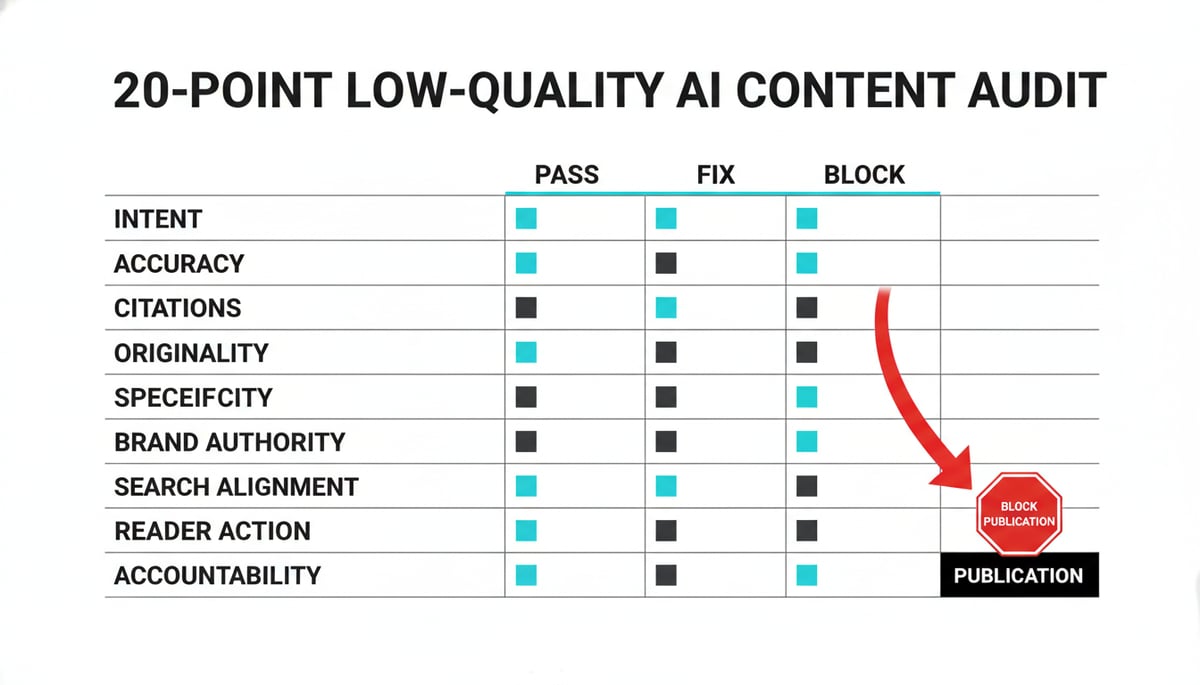
The copyable 20-point low quality AI content audit
Copy this into your review document. Score each item Pass, Fix, or Block. A Pass means you can point to the relevant sentence, source, example, or owner. “It sounds right” does not count.
Intent
1. We can state the reader’s primary question or decision in one sentence.
2. The page gives the reader a complete answer or a clear boundary for what it does not cover.
Accuracy
3. Every material factual claim has been checked against a current, appropriate source or first-hand record.
4. Numbers, dates, names, product details, and qualifications match the evidence exactly.
Citations
5. Each citation is placed beside the claim it supports.
6. We have checked that the source actually supports the claim, including its scope and limitations.
Originality
7. The page contributes original analysis, reporting, experience, synthesis, or a clearly stated point of view.
8. We removed sections that merely paraphrase sources or repeat the same idea in new wording.
Specificity
9. Recommendations include concrete steps, conditions, examples, trade-offs, or decision criteria.
10. At least one useful detail comes from the audience’s actual context, workflow, or problem.
Coherence
11. Each section advances the main argument and does not duplicate another section.
12. Definitions, evidence, examples, and recommendations appear in an order a first-time reader can follow.
Brand authority
13. We distinguish what we know from what we infer, generalize, or have not tested.
14. The byline, reviewer, process note, and claims of experience accurately represent who stands behind the page.
Search alignment
15. The title and opening promise match the query and the page’s actual scope.
16. We cover the useful subquestions and format implied by intent without forcing keywords into the copy.
Reader action
17. The reader can take a specific next step using the page itself.
18. The CTA follows from the reader’s problem and does not interrupt the answer with an unrelated sales pitch.
Accountability
19. A named person has approved factual accuracy and material claims.
20. A named person has made the final publish decision, with the audit and unresolved limitations recorded.
Automatic blocking rule
If item 3 or item 4 fails for a material claim, block publication automatically. Do not average the failure away with nineteen passes. Do not ask a detector to settle it. Do not publish with a note to “review later.”
Move the claim into one of three states: verified, rewritten as a qualified statement, or removed. Then rerun the audit. The same block applies if a citation cannot be retrieved, if a source conflicts with the claim, or if a supposed first-hand example cannot be proven.
This rule is intentionally strict. A page can be thin and still be improved. A page that presents false information as fact has a different problem.
Three before-and-after examples
These are illustrative examples, not customer results or published case studies. They show the editorial change, not a cosmetic rewrite. The improved version earns its confidence by narrowing the claim, adding a condition, or giving the reader an action.
Example 1: Generic SEO advice
Before:
High-quality content is essential for SEO success. To improve your rankings, create valuable, relevant, and engaging content that meets user intent.
After:
Before drafting, write the decision the page must support: “Should our team publish this AI-assisted draft?” Then build the article around the evidence needed to answer it. For this audit, that means checking claims, sources, originality, and ownership before discussing wording.
What changed: The rewrite replaces circular advice with a defined decision and an operational sequence. It does not promise a ranking outcome.
Example 2: Unsupported product claim
Before:
Our platform eliminates hallucinations and guarantees accurate, high-performing articles.
After:
We use research, brand context, and a review step to reduce the risk of unsupported claims. That does not make factual review optional, and we do not guarantee rankings or perfect accuracy. Material claims still need an appropriate source or an accountable reviewer.
What changed: The rewrite removes an absolute promise, explains the workflow, and states the limit. That is more credible and more useful to a buyer evaluating risk.
Example 3: Search-first structure
Before:
AI content is a powerful solution for businesses. In this guide, we will explore AI content, AI content benefits, AI content tools, and AI content best practices.
After:
If your team already has an AI-assisted draft, the immediate job is not to make it sound less like AI. The job is to decide whether it is accurate, useful, distinctive, and owned by someone who can defend it. Use the audit below to make that decision before publication.
What changed: The rewrite leads with the reader’s situation, makes the job explicit, and removes keyword-led promises that the article does not need to repeat.
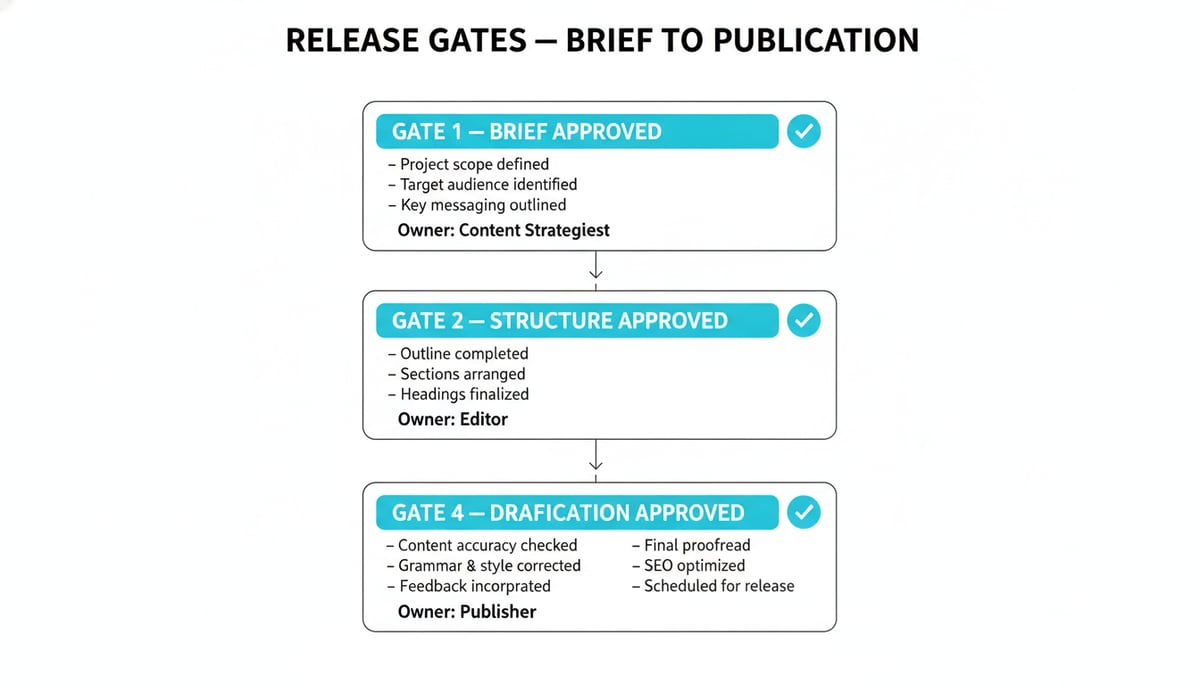
Four release gates from brief to publication
A reliable workflow catches different failures at different points. Do not wait until the final copy review to discover that the page had no defensible purpose.
Gate 1: Brief approved
The brief must specify the audience, primary decision, search intent, page promise, evidence requirements, original contribution, and intended reader action.
Reject the brief if the only rationale is “this keyword has volume” or “we need more posts.” Google’s guidance frames the “why” around helping people, not producing pages primarily to attract search visits. The brief should make that why visible.
Gate 2: Research and structure approved
Before prose, map the claims the page will make and the sources or first-hand inputs required to support them. Separate verified facts, interpretation, examples, and open questions.
Then approve the outline. Check that the sections follow the reader’s decision rather than a list of related phrases. This is where we apply structure first, automation second. A faster draft cannot repair an unapproved argument.
Gate 3: Draft reviewed
The writer or system can produce a draft after the structure is approved. A named reviewer then checks the 20 points, with particular attention to accuracy, citations, originality, specificity, and brand authority.
Run the automatic block before line editing. If evidence fails, stop. Do not spend an hour polishing a page that cannot safely make its central claim.
Gate 4: Publication approved
The final owner confirms the page’s title, metadata, links, examples, disclosures where appropriate, author information, reader action, and unresolved limitations. The audit record stays with the brief.
Only then should the page move into the CMS. Publication is a decision, not the last click in an automated sequence.
What this means for AI-assisted publishing
AI can help teams research, organize, draft, and repurpose. It can also make a weak workflow much faster. That is the uncomfortable part: automation scales the process you give it, including missing evidence, vague briefs, repeated ideas, and unclear ownership.
We do not treat content quality as a punctuation layer added after generation. We treat it as a set of decisions made before, during, and after the draft exists.
For founders, that means asking who can defend the page. For SEO leads, it means separating search alignment from keyword repetition. For content teams and agencies, it means making the brief, source trail, review state, and final owner visible across every client or brand workflow.
No audit can guarantee rankings. No AI detector can certify value. No tool can turn an unsupported claim into a true one.
A structured process can make those limits visible before publication. That is the standard we build around at OutBlog: structure first, automation second.
Start with the OutBlog Content Brief Generator. Enter a topic, audience, and tone to create a structured brief with intent, headings, key message, keywords, and CTA. Give the draft a defensible starting point before automation takes over.