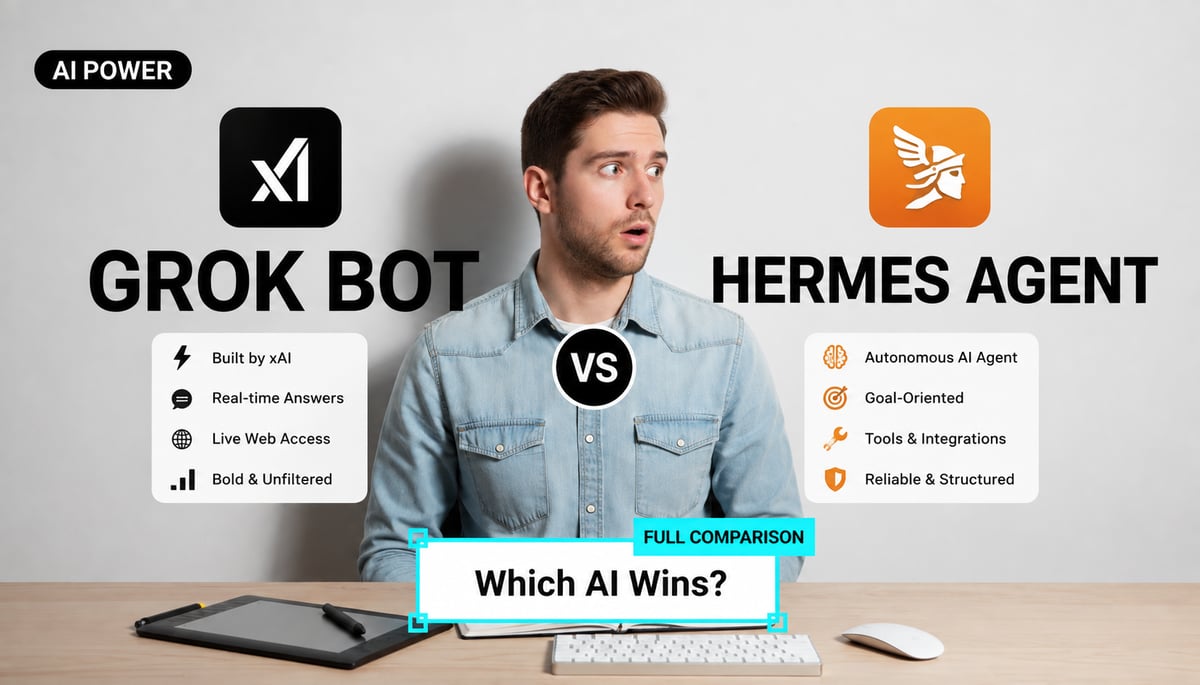
Grok Bot and Hermes Agent solve the same problem in almost opposite ways. Both let you create persistent agents that can use tools, remember previous work, run scheduled jobs, and hand work to other agents. Grok Bot gives you the computer and hides most of the machinery. Hermes gives you the machinery.
That difference decides nearly everything: what you pay for, which models you can use, where your data lives, and who has to fix the system when something stops working.
If you want an agent team running with the least setup, Grok Bot is the easier choice. If you care more about model choice, self-hosting, and inspecting every layer, Hermes is the more interesting one. If your work is mostly one-off coding, research, or writing, start with one agent. A fleet will usually add cost and coordination before it adds value.
The useful comparison
| What matters | Grok Bot | Hermes Agent |
|---|---|---|
| Setup | Managed service | Software you install and operate |
| Models | Chosen by the product | Chosen by you |
| Where it runs | A managed cloud computer | Local machine, Docker, SSH, or a supported cloud backend |
| Background work | Included | Requires an always-on machine or hosted backend |
| Multi-agent setup | Built into the app | Built into Bot Mode |
| Bot separation | Separate conversations on one shared computer | Separate profiles; command isolation depends on the backend |
| Main cost | Subscription plus possible on-demand usage | Model usage, infrastructure, and your time |
| Best fit | Someone buying convenience | Someone who wants control and can operate it |
This is not a benchmark of which model writes better code. Grok Bot does not let you pick its model, while Hermes can run many different models, so a head-to-head output test would mostly compare whichever models happened to be serving the requests. The fair comparison is the operating model around them.
Grok Bot is a service; Hermes is a system
Grok Bot launched in beta in August 2026. Each user gets a persistent Linux computer in the cloud. Bots can work in its browser, terminal, and files, continue after the laptop is closed, message one another, and turn repeated work into routines.
The pitch is easy to understand: talk to a Bot as if you were handing work to a colleague. You do not provision a server, choose a terminal backend, or keep a gateway process alive.
Hermes Agent is an MIT-licensed agent runtime from Nous Research. Its Bot Mode turns profiles into named agents with their own role, model, memory, skills, and chat history. They can run routines, talk in groups, and message one another. Hermes can also sit behind messaging apps, so the agent can live on a server while you talk to it from somewhere else.
The extra freedom is real. So is the extra work. With Hermes, you decide which model provider to use, where commands execute, which credentials are available, how updates happen, and what stays running when you log out.
Grok Bot is something you subscribe to. Hermes is something you operate.
Price is not as simple as free versus paid
The cheapest listed individual Cursor plan that includes Grok Bot is Pro Plus at $60 per month. Ultra costs $200 per month. Cursor's self-serve Teams plans are $40 per user for Standard and $120 for Premium, and both currently include Grok Bot access. Individual SuperGrok Plus and Heavy subscriptions can also grant access when linked to a Cursor account. Regular Cursor Pro does not include it.
The subscription is an entry price, not a promise of unlimited work. Included Grok Bot usage resets weekly. If that allowance runs out, work can continue through shared on-demand spend when it is enabled. The trial is also usage-based, with a seven-day window, so one large run can consume most or all of it.
Hermes itself has no license fee. You still pay for whatever sits around it: model API calls, a hosted service, a VPS, or the hardware and electricity for a local model. You can make it very cheap, but only by making deliberate choices about models and infrastructure.
There is no honest universal total for either product. A browser-heavy research routine and a short daily summary do not consume the same amount of compute. Hermes also has a cost that never appears on an invoice: the time spent configuring, updating, monitoring, and repairing it.
That is why "Hermes is free" and "Grok Bot is $60" are both incomplete answers.
Setup: the installer is not the whole job
Grok Bot has the simpler first hour. Install the app, sign in with an eligible account, create a Bot, and give it a small task. The cloud computer is already there, and the work can continue when your local machine is off.
There are two important constraints. First, Grok Bot has no model picker. Model selection and failover are managed by the product. Second, the desktop app currently supports macOS and Windows, not Linux.
Hermes offers a one-line installer and desktop installers for macOS and Windows. The official installation guide says the installer handles Python, Node.js, the virtual environment, browser tooling, and provider setup.
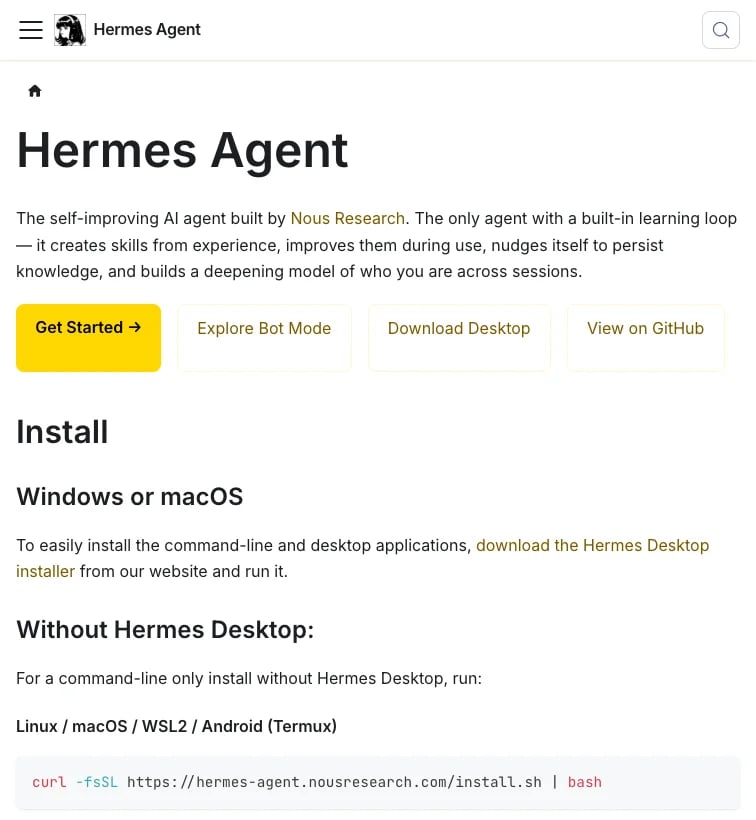
The command is short. The decisions that follow it are where the real setup lives.
A clean install can be quick. A useful setup takes longer because you still have to choose a provider, verify tool calls, decide where shell commands run, and configure any messaging gateway. A hands-on setup guide from CrewClaw recommends setting aside an unhurried evening rather than expecting a coffee-break setup. For most people, that is a better expectation.
Some environments add their own friction. A May 2026 issue documented a Debian service-user installation hanging during the Playwright step. That issue is now closed, and the current docs include a non-sudo installation path plus a --skip-browser option. It is a useful example of the kind of edge case self-hosters meet, not proof that every Hermes installation is painful.
Put simply, Grok Bot removes most infrastructure decisions. Hermes lets you make them.
The shared-computer detail matters
All Grok Bots belonging to one user share the same cloud computer. They have separate conversations and roles, but the computer's files, browser sessions, logins, and command-line credentials are available across the Bot roster.
This is useful. A research Bot can save a file and a writing Bot can pick it up without an export step. It is also why Grok Bot's own security guide says not to use separate Bots as a security boundary.
In practical terms, do not sign a Finance Bot into an account that a Sales Bot must never reach. Deleting a Bot is not enough either. The documentation says shared files and browser sessions can remain after the Bot profile is deleted. Log out of services, remove sensitive files, and revoke connectors at the source.
Hermes starts from a different model, but it does not make security disappear. A Bot is a profile with its own configuration, memory, skills, and history. New Bots can still share an OAuth or token pool with the main profile by default. More importantly, the default local terminal backend runs commands directly on your machine with no operating-system isolation.
Hermes can run commands inside Docker, on a remote host over SSH, or in supported cloud sandboxes. Those options can create a stronger execution boundary, but you have to configure them and decide which files or secrets cross it.
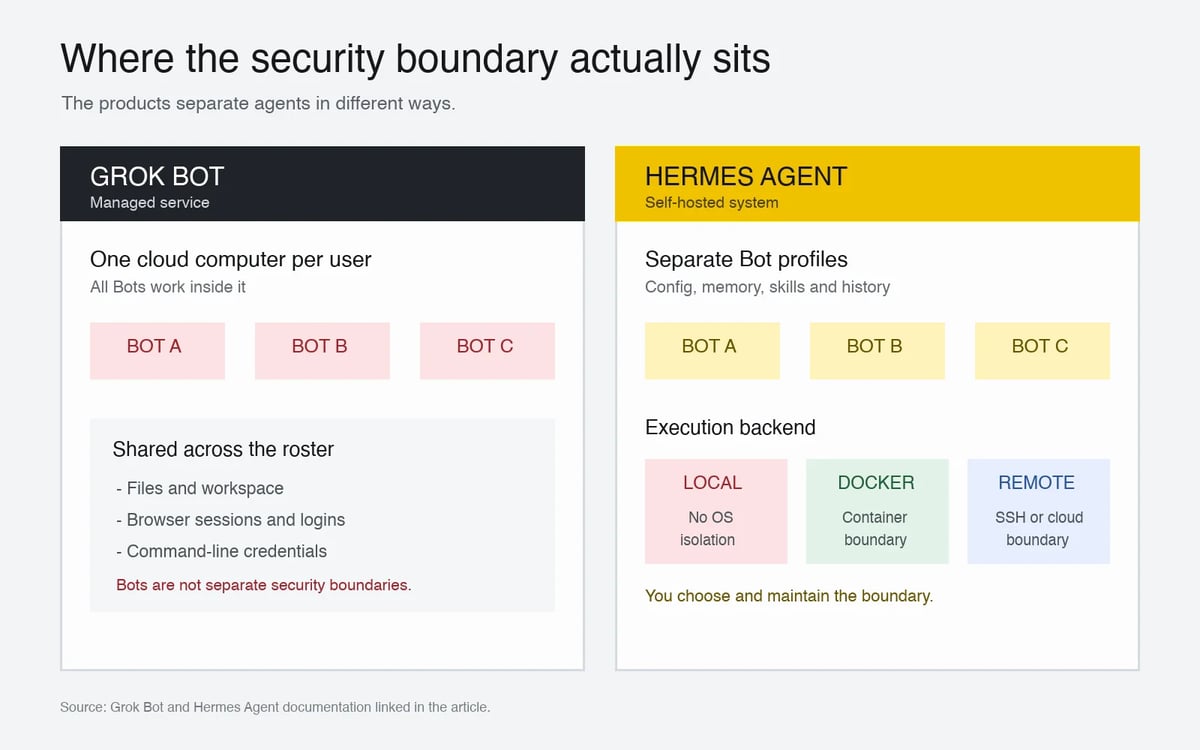
Grok Bot manages one shared computer per user. Hermes separates profiles, while execution isolation depends on the backend you choose.
So the security choice is not "cloud versus safe." It is one managed computer with a clearly documented shared boundary versus a system whose boundary is largely your responsibility.
Automation is where small mistakes become expensive
Both products can save a successful workflow and run it again. That is the feature that makes them more useful than a disposable chat session, and more dangerous.
Grok Bot separates reusable instructions, called skills, from scheduled or event-triggered routines. Its docs recommend proving a task once, adding validation and approval rules, and only then scheduling it. One detail deserves a bright marker: a routine test performs real work. It may browse websites, change files, and call connected tools. "Test" does not mean simulation.
Hermes treats skills as procedural memory. The agent can create or update skill files when it learns a workflow, recovers from an error, or receives a correction. Because those files are readable, you can inspect what it plans to reuse.
By default, Hermes allows the agent to write those skills directly. If that is too trusting, turn on skills.write_approval. Changes are then staged for review instead of landing immediately.
That approval switch is not a minor preference. An agent can learn the wrong lesson from a task that appeared to work. Reusable memory is valuable only when bad procedures are easy to spot, reject, and repair.
Neither product escapes browser automation
Grok Bot is polished, but it still operates websites from a data center computer. Sites can block that traffic, request a CAPTCHA, or require a fresh login. The product documentation tells the Bot to hand those cases back to the user. A managed browser saves setup; it does not make the web predictable.
Hermes makes failures easier to inspect because the code, configuration, and issue tracker are visible. It also gives you more places to look when something fails: provider choice, context limits, browser dependencies, gateway processes, permissions, and the selected execution backend.
That leads to a useful rule for both products. Do not judge reliability by one successful demo. A routine is ready for real work when it has narrow permissions, a clear output, bounded retries, visible failure reporting, and approval before it sends, publishes, buys, deletes, or changes production data.
Do you need several agents?
This question should come before the product choice.
Multi-agent systems are good at work that can genuinely split into independent lanes. Researching ten markets, checking several data sources, or monitoring many accounts can benefit from parallel workers. One agent can coordinate while specialists return small, defined results.
The cost rises quickly. In Anthropic's account of its multi-agent research system, multi-agent runs used about 15 times as many tokens as ordinary chats. The same team found that most coding tasks have fewer truly parallel parts than broad research tasks, and that agents still struggle with live coordination.
For one bug fix, one article, or one customer report, a second agent may spend more time restating context than doing useful work. Anthropic's broader agent-building guidance is the right default: begin with the simplest system that works, then add complexity only when the result improves in a way you can measure.
Before adding another Bot, ask three questions:
- Can the work split into independent parts that run at the same time?
- Does each part have a clear deliverable and a way to check it?
- Is the faster or broader result worth the extra usage and supervision?
If any answer is no, keep one agent.
Who should pick Grok Bot?
Pick Grok Bot when you have a recurring workflow across websites and tools, want it running quickly, and are comfortable with Cursor managing the computer and the models. It makes particular sense if an eligible Cursor plan is already part of your budget.
The compromise is control. You cannot select the model, every Bot shares one computer, and heavy use can spill into on-demand billing. Teams with strict rules around subprocessors, data location, or credential separation need to examine those constraints before anyone starts signing Bots into company systems.
Who should pick Hermes?
Pick Hermes when choosing the model and execution environment is part of the requirement. It is a better fit for a technical operator who wants local or self-hosted state, inspectable skill files, multiple providers, and the option to isolate commands in containers or remote systems.
The compromise is ownership. The flexibility does not maintain itself. Someone has to understand the configuration, keep dependencies current, manage secrets, watch the gateway, back up state, and investigate failures.
My recommendation
Start with the workflow, not the fleet.
Choose one recurring job with a clear finish line. Run it with one agent several times. Keep the agent in draft-only mode at first. Note where it fails, what it costs, and which steps still need judgment. Once that version is dependable, you will know whether you need a managed service, a self-hosted system, or simply a better single-agent routine.
If convenience is the deciding factor, Grok Bot wins. If control is the deciding factor, Hermes wins. If you cannot yet name the work that needs to run in parallel, neither multi-agent setup has earned its place.