What is technical SEO
Technical SEO is the practice of optimizing your website's infrastructure so search engines can find, crawl, understand, and index your pages efficiently. It covers the behind-the-scenes work, including site speed, structured data, mobile-friendliness, security, and sitemaps, that determines whether your content has any chance of ranking. Without it, even the best-written page stays invisible. With it, every other SEO effort has a foundation to build on.
What Is Technical SEO and Why It Matters in 2026
If you have spent any time learning about search optimization, you have probably heard the term used like a checklist item: "Do your technical SEO." That framing undersells what it actually is.
Technical SEO is the layer of work that decides whether search engines can even see your site. It is not about keywords, backlinks, or content quality. Those matter, but only once a search engine has successfully crawled your page, parsed it, stored it in its index, and judged it eligible to appear in results. Technical SEO is what gets you through that gate.
In 2026, that gate has gotten tighter. Google's Core Web Vitals are now confirmed ranking signals. Mobile-first indexing is the default, so Google evaluates your mobile version first. AI-powered search features, including AI Overviews and conversational results, pull from structured, machine-readable pages. Sites with weak technical foundations are less likely to be cited, surfaced, or ranked at all.
That is why technical SEO has stopped being a developer afterthought. It is now the price of admission for organic visibility.
Technical SEO Meaning: The Foundation Layer
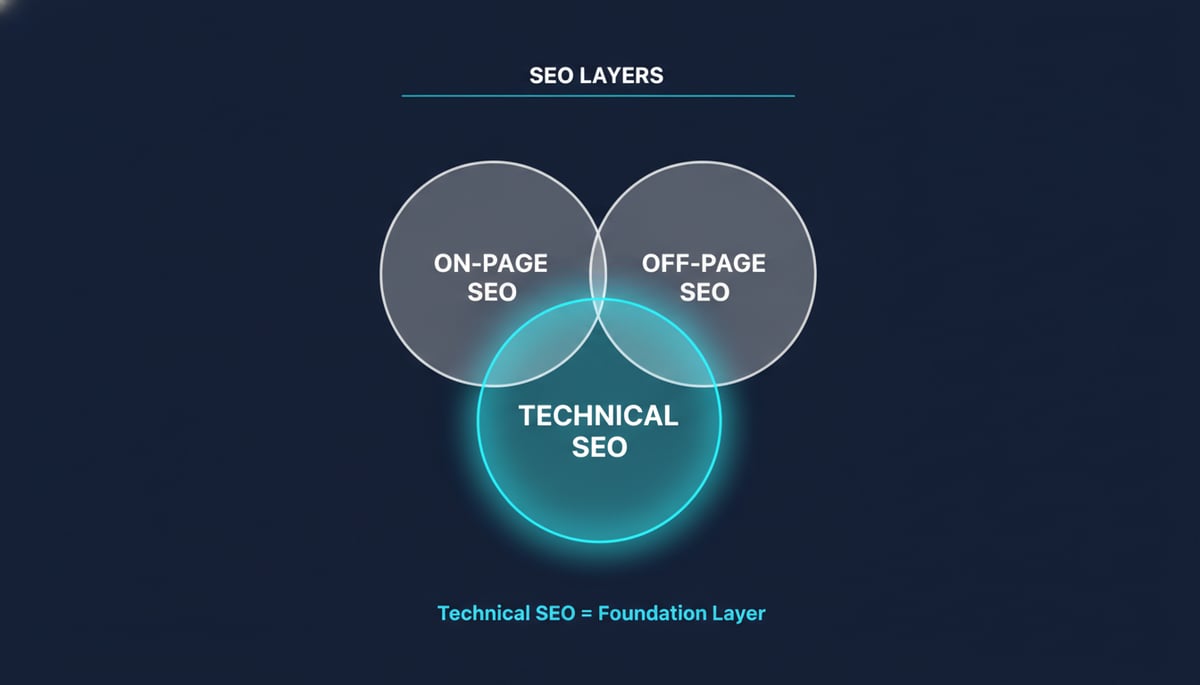
To put technical SEO meaning in plain terms, think of SEO as a three-part system.
On-page SEO covers what is on each page: the headlines, body copy, images, internal links, and metadata that match a user's search intent. Off-page SEO covers signals from outside your site: backlinks, brand mentions, reviews, and the authority you build over time. Technical SEO is everything that lets those two layers exist in a form search engines can actually read.
The relationship matters. On-page and off-page efforts can be world-class and still fail if your site returns 500 errors, blocks search engines in your robots.txt, or loads slowly enough that users bounce before the page renders. Conversely, a technically perfect site with thin content will never rank either. The three layers stack. Technical SEO is the bottom layer.
This is also why we treat it as foundational at OutBlogAI. Our content engine is built on the assumption that the site it publishes to has already cleared the basic technical bar: it is crawlable, indexable, mobile-friendly, and fast enough for both users and crawlers. Skip that work and the publishing schedule becomes decoration.
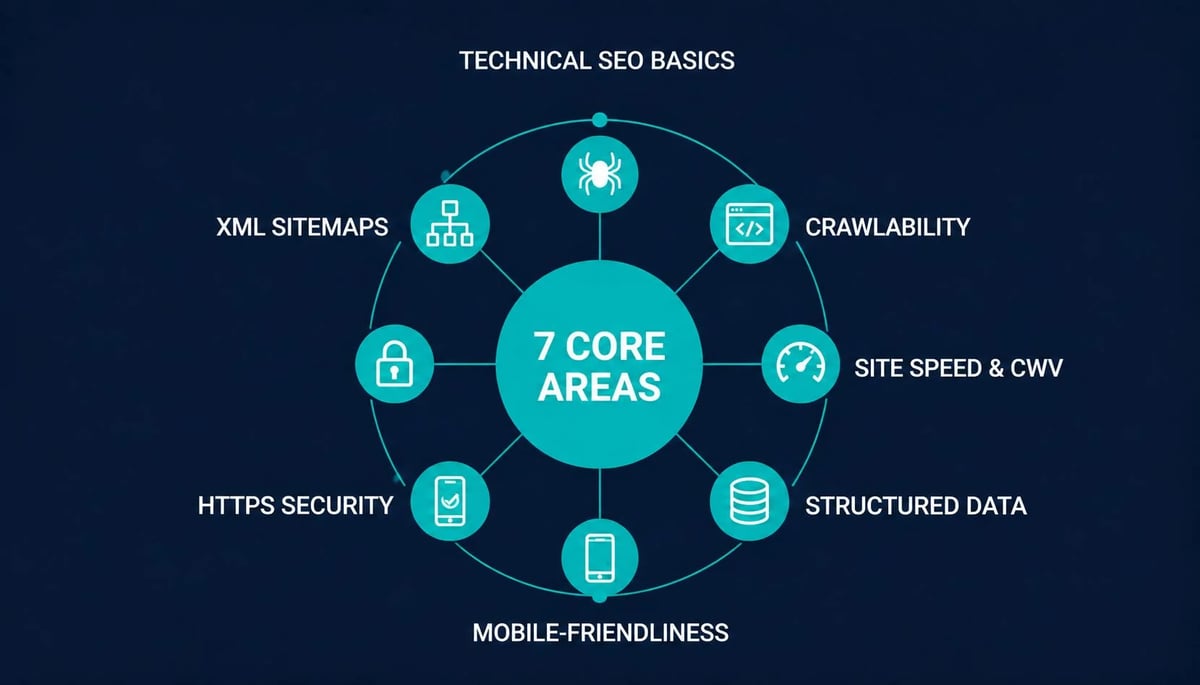
Technical SEO Basics: The 7 Core Areas
When people ask about technical SEO basics, they usually expect a long checklist. The actual scope is more focused. There are seven areas that matter most. Each one influences whether your pages make it through Google's pipeline.
Crawlability
Crawlability is whether search engine bots can reach your pages in the first place. Google uses automated programs called crawlers (Googlebot is the most important one) that follow links across the web. If a page has no internal links pointing to it, is blocked by your robots.txt file, or sits behind a login wall, the crawler will never find it.
The most common crawlability problems are accidental. A misconfigured robots.txt that blocks your entire CSS folder, a staging environment that gets indexed, or a site migration that leaves orphaned pages with no internal links. Each one quietly removes pages from your potential search traffic.
Indexability
Crawlability and indexability are related but not the same thing. A page can be crawled (the bot found it) but not indexed (Google decided not to store it in its database). Indexed pages are the ones eligible to appear in search results.
Indexability issues usually trace back to directives. A noindex meta tag on a page you actually want ranking. Canonical tags pointing to the wrong URL. Duplicate content that confuses Google about which version to keep. Each of these sends a signal to keep a page out of the index, and search engines listen.
Site Speed and Core Web Vitals
Site speed used to be a "nice to have." It is not anymore. Google has confirmed that Core Web Vitals are ranking signals, and in 2026 the three metrics that matter are:
- Largest Contentful Paint (LCP): how fast the largest visible element loads. Good is under 2.5 seconds.
- Interaction to Next Paint (INP): how quickly the page responds to clicks and taps. Good is under 200 milliseconds.
- Cumulative Layout Shift (CLS): how much the page jumps around while loading. Good is under 0.1.
Pass all three at the 75th percentile of real user traffic and you have a measurable ranking advantage. Fail any one of them, and you compete at a disadvantage against sites that pass. According to recent CrUX data summarized by Digital Applied's 2026 Core Web Vitals report, only 57% of origin sites currently pass the INP threshold. The bar is real, and most sites are not clearing it.
Structured Data
Structured data is code you add to a page (usually in JSON-LD format) that explicitly tells search engines what your content is. A recipe page tells Google the ingredients, cook time, and nutrition info. A product page tells Google the price, availability, and reviews. An article tells Google the headline, author, and publish date.
This is what makes rich results possible (star ratings, FAQ dropdowns, product cards) and it is what AI-powered search engines lean on most heavily. If your content is not machine-readable in this way, you are asking the algorithm to guess.
Mobile-Friendliness
Google now indexes the mobile version of your site first. That means whatever your mobile experience looks like is what gets evaluated for ranking. Pages that are hard to tap, force horizontal scrolling, use fonts too small to read, or place interactive elements too close together are penalized at the index level, not just at the user level.
Mobile-friendliness is not a separate optimization. In 2026, it is the baseline.
Security (HTTPS)
HTTPS has been a confirmed ranking signal since 2014 and that has not changed. Sites still serving pages over plain HTTP carry a small but persistent disadvantage, plus a browser-level warning that drives users away before they ever see your content.
Security also extends beyond the certificate itself. Mixed content (HTTPS page loading HTTP resources), outdated TLS versions, and exposed admin panels all create trust issues that show up indirectly in how search engines treat your site.
XML Sitemaps
An XML sitemap is a file that lists the pages you want search engines to know about. It does not guarantee indexing, but it gives Google a clean map of your site structure and a way to prioritize what to crawl.
For small sites, sitemaps are helpful. For large sites with thousands of URLs, they are essential. Submit your sitemap through Google Search Console and keep it updated automatically as you publish.
Technical SEO vs On-Page SEO vs Off-Page SEO
The clearest way to understand the boundaries is to compare the three side by side. Here is how they break down.
| Area | What It Covers | Who Owns It | Example Work |
|---|---|---|---|
| Technical SEO | Site infrastructure, crawlability, speed, security | Developers, technical marketers | Fixing robots.txt, improving Core Web Vitals, adding structured data |
| On-Page SEO | Content, keywords, HTML elements on each page | Content marketers, writers | Writing title tags, optimizing headings, matching search intent |
| Off-Page SEO | External signals, authority, reputation | PR, link builders, brand marketers | Earning backlinks, digital PR, brand mentions |
Technical SEO vs on-page SEO comes down to a simple question: are you optimizing what is on the page, or are you optimizing the page itself? On-page SEO makes a page more relevant to a query. Technical SEO makes a page more accessible to the system that delivers results.
Off-page SEO sits outside both. It is what other sites say about you through links, mentions, and brand signals. You cannot control it directly, but you can build the kind of content and reputation that earns it over time.
All three matter. But technical SEO comes first, because none of the other two work on a page that Google cannot reach.
Technical SEO Examples: An Analogy That Makes It Click
Technical SEO examples are easier to remember when you anchor them to something physical. Here is one that works.
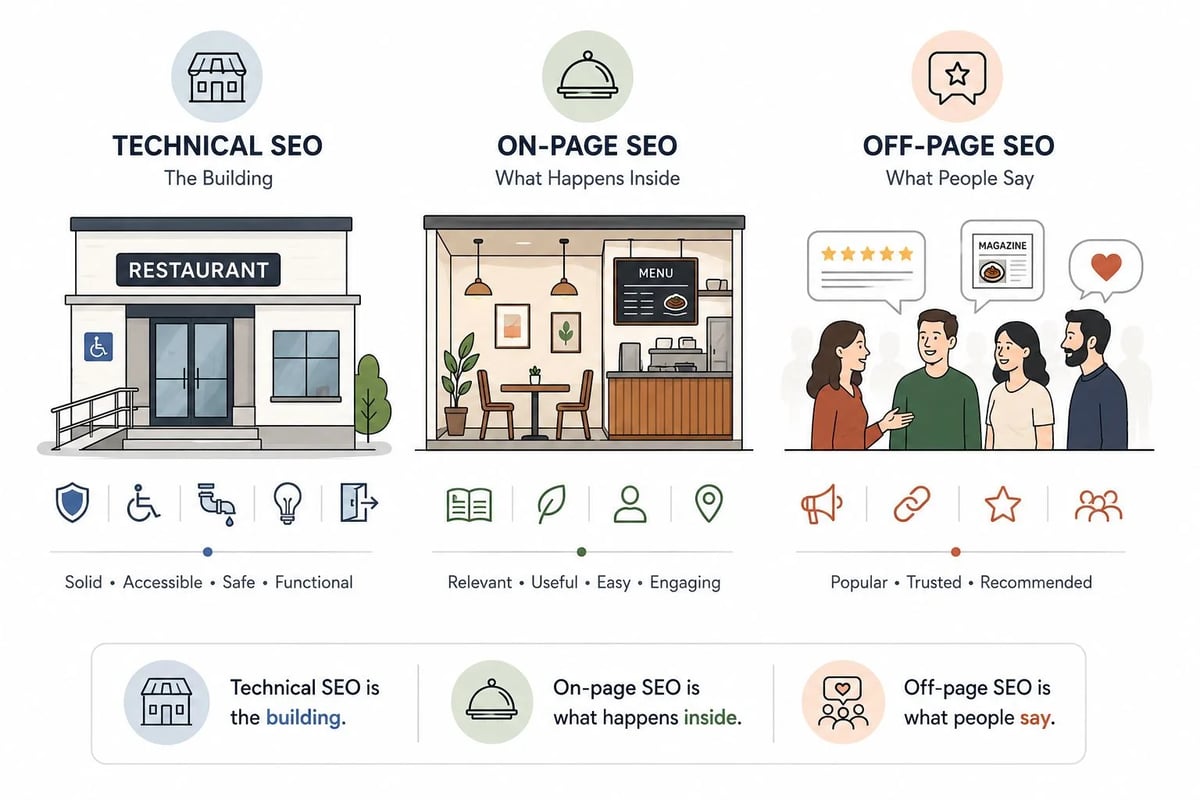
Imagine you own a restaurant in a busy neighborhood. On-page SEO is your menu, your decor, the quality of your food, and how clearly the menu describes each dish. Off-page SEO is your reputation: the reviews, the word of mouth, the magazine features, the way regulars talk about you to friends.
Technical SEO is the building itself.
Is the foundation solid? Are the doors wide enough for everyone to get in, including people in wheelchairs? Is the kitchen plumbing working, or does the sink back up during dinner service? Is the lighting wired safely, or does the breaker trip every time someone plugs in the espresso machine? Are the exits clearly marked, in case of an emergency?
You can serve the best food in the city. You can have a glowing review in every major publication. None of it matters if customers cannot physically walk through the door, or if health inspectors keep shutting you down for structural violations.
Technical SEO is the building. On-page SEO is what happens inside it. Off-page SEO is what people say about it after they leave.
What's Next: From Definition to Action
You now have a working definition of technical SEO, a clear breakdown of the seven areas that matter, and a side-by-side comparison of how it fits with on-page and off-page work. The next move is putting that knowledge to work.
For most sites, the practical first step is running a technical SEO audit to see which of these areas actually have problems on your site, and how serious they are. From there, two questions usually come up: how often you should re-run that audit, and whether to handle the work yourself or bring in help.
We will cover all three in upcoming guides. The technical SEO audit checklist will walk you through what to test yourself, step by step. The guide on choosing a technical SEO audit service will help you decide when to bring in outside help and what to look for. And the breakdown on how often to run a technical SEO audit will keep the gains you make today from quietly disappearing six months from now.
Pick the next step that matches where you are right now. The rest will follow.