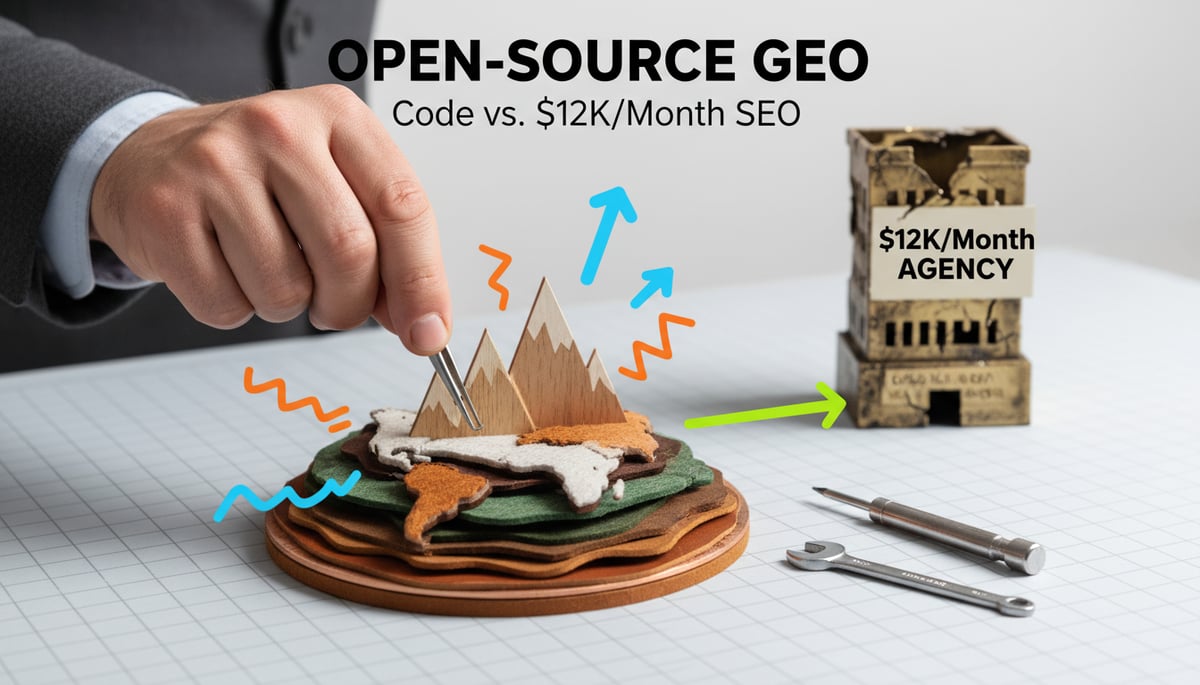
Generative Engine Optimization in 2026: The Open-Source Tools That Just Killed the $12K Monthly GEO Retainer
Look, I’m going to shoot straight with you.
A couple years back, if your team wanted to get serious about AI search, you basically had two options. Either fumble through it yourself or hand over ten to fifteen grand a month to an agency for “Generative Engine Optimization.” They’d crawl your site, spit out an llms.txt file, run some audits, and send you a slick PDF every thirty days.
Those retainers are starting to feel pretty ridiculous right now.
Because a handful of free, open-source tools have gotten damn good. They crawl your whole site, build clean llms.txt files, score how likely AI models are to actually cite your pages, and flag the structural stuff that trips up the bots. I’ve been running these on real client projects for the last few months, and honestly? They handle the boring technical work better than most junior consultants ever did.
But here’s the part the agencies won’t like: this doesn’t mean humans are obsolete. It just means the game has changed. The tools take care of the grunt work. The strategy, the storytelling, the actual brand positioning? That still needs sharp people who understand your business.
I’ve tested this hybrid approach with mid-sized SaaS companies and B2B brands. The ones who automate the basics and keep their best minds on the high-level stuff are seeing stronger AI visibility and way lower costs. Let me walk you through what actually works in 2026.
TL;DR
GEO is no longer optional. It’s about making sure ChatGPT, Perplexity, Claude, and Google’s AI summaries actually understand and cite your content instead of hallucinating or ignoring it. The llms.txt file is a simple Markdown roadmap that points AI crawlers to your most important pages. Open-source tools now generate that file and run full audits in minutes. Use them for the technical foundation. Save your senior team for creative strategy and trust-building. The combo is what’s separating the leaders from everyone else right now.

Why GEO Actually Matters Right Now (And Why Most Teams Are Still Sleeping on It)
Traditional SEO got us clicks and rankings. Fair enough. But these days a huge chunk of discovery happens through AI answers. Someone asks a question and the model pulls together a summary. If your pages aren’t structured so the AI trusts them and cites them cleanly, you’re basically invisible.
I saw this firsthand with one client last quarter. Their organic traffic from AI referrals tanked because competitors had cleaner headings, better E-E-A-T signals, and actual data tables the models could parse. We fixed the basics in a single sprint and the citations started showing up again. It wasn’t magic. It was just paying attention to how the new engines read content.
It’s not about chasing every shiny AI trend. It’s about making sure your core assets are easy for both humans and machines to understand.

What GEO Really Is (And What It Isn’t)
GEO builds on solid SEO foundations but adds one critical layer: AI comprehension.
You want pages that are:
- Scannable as hell (short paragraphs, clear headings, bullet points, tables)
- Packed with real proof (original research, expert quotes, specific numbers)
- Structured with schema so models can grab facts fast
- Written in straightforward language that cuts down on hallucinations
The shift is simple. Stop obsessing over rank position. Start obsessing over whether the AI feels confident enough to quote you.
llms.txt – Useful Future-Proofing, Not Magic
Drop a plain Markdown file at yoursite.com/llms.txt and you’re giving AI crawlers a short, curated list of your most important pages with brief descriptions.
It’s not a sitemap. It’s not robots.txt. It’s a friendly note that says “these are the pages we stand behind.”
John Mueller at Google has been consistent: as of 2026 the big AI services still aren’t heavily using llms.txt. It’s not a ranking signal. But it takes five minutes to set up and costs nothing. Most forward-thinking teams I know treat it as cheap insurance.
Here’s how the three files stack up in real life:

The Open-Source Tools That Are Actually Changing the Game
This part still surprises me.
Tools like Firecrawl’s llmstxt-generator, aircodelabs, and a couple of Apify actors can crawl your entire domain and output a proper llms.txt in minutes. Some even throw in a basic citation-readiness score and highlight missing FAQs or weak structure.
It feels exactly like when Lighthouse made performance audits accessible to everyone. Suddenly you don’t need a specialist billing you hourly just to run a crawl.
For teams with any technical chops, these integrate straight into your workflow. The old model of paying big money for basic technical audits is getting squeezed hard.
A Practical GEO Audit You Can Run Yourself This Week
Here’s the exact five-step process I give clients who want to take ownership:
- Pick your canonical pages — Sit down and list the 10-20 pages that truly define your business. About, Services, pillar content, flagship articles. Be brutal. Leave the thin stuff out.
- Generate the llms.txt — Feed your sitemap into one of the free tools, review the output, and push it live at root.
- Score your content for AI readability — Check every key page for TL;DRs at the top, logical headings, real data tables, and proper schema.
- Hunt the gaps — Run a few test queries on Perplexity or ChatGPT about your industry. Notice what competitors are answering that you’re not. Fill those holes.
- Refresh and watch — Update the file every quarter. Keep an eye on server logs for actual AI crawler hits.

Most teams finish this in a morning and already start seeing improvements.
Where Human Strategy Still Wins (And Why Agencies Aren’t Dead)
The tools crush the repetitive technical tasks. No question.
But they can’t do this:
- Turn vague business goals into a story people actually remember
- Read the room on competitive positioning
- Build the kind of emotional trust that makes customers choose you
- Experiment with fresh content formats that cut through the noise
The smartest setups I’ve seen combine both. Tools handle the foundation. Senior talent focuses on the stuff that actually differentiates.
Quick Math on Where This Is Heading
Industry numbers show the GEO services market growing fast—from roughly $886 million in 2024 toward $2.85 billion by 2028. Open-source adoption among larger companies is accelerating. If the current pace holds, most enterprises will handle the technical side in-house by 2030.
For a group of 1,000 mid-to-large companies still paying heavy agency fees, shifting 80% of the technical work to free tools could free up over $100 million a year collectively. That’s not hype. It’s straightforward compound growth.
The teams moving now get the cost advantage and the speed advantage as AI search keeps evolving.
A Few Quick FAQs from Real Conversations I’ve Had
Is llms.txt basically a sitemap?
Nope. Sitemaps dump every URL. llms.txt is deliberately picky—the pages you want AI to understand best.
Does Google actually use llms.txt today?
John Mueller says no real benefit yet for Google Search or AI Overviews. Still smart future-proofing.
Will these tools kill GEO agencies?
Only the ones whose main value was running basic crawls and generating files. The strategic ones who help with positioning and creative work are more valuable than ever.
Should I bother with llms.txt right now?
If you’re running a serious brand or enterprise site, yes. It takes almost no time and puts you ahead of most competitors.
Fastest win I can grab today?
Generate and deploy an llms.txt file this afternoon, then look at your top five pages for structure. You’ll spot quick wins.
Bottom line: Stop paying premium prices for things a good script can knock out in minutes. Automate the technical baseline with open-source tools. Then pour your best people into the creative and strategic work that no code can fake.
That’s the combination that actually wins in this AI-first world. The teams doing it right are pulling ahead fast. The rest are still writing big checks for yesterday’s problems.