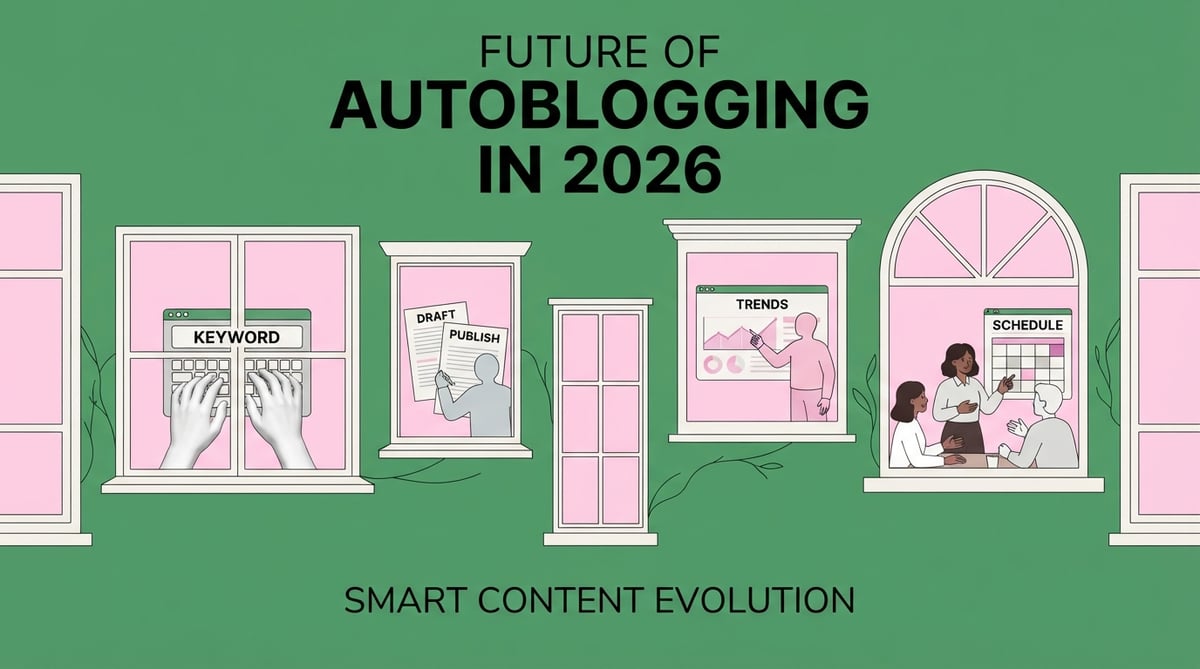
Autoblogging in 2026 is the practice of running the full blog production pipeline, from topic research and keyword planning to drafting, SEO optimization, and publishing to a connected CMS, with minimal manual intervention per post. It's not the RSS-scraping trick that populated low-quality content farms in the late 2000s. It's an orchestrated system where AI handles the heavy lifting and a human editor (or a quality review layer) decides what actually ships.
If you've ever wished your blog could "just keep going while I work on the rest of the business," autoblogging is the closest realistic version of that. The 2026 version does more than publish posts: it produces the citable, structured, brand-aligned content that both Google and the new AI answer engines (ChatGPT, Claude, Perplexity, Google's AI Overviews) pull from when answering user questions. That's why this category matters more in 2026 than it did in 2020, and why publishing platforms now cover WordPress, Shopify, Webflow, Ghost, Framer, and every major CMS in between.
We build autoblogging software at OutBlogAI, so everything below comes from first-hand telemetry: time logs from thousands of generated posts, quality review scores across customer sites, and CMS integration performance numbers. Where we cite other platforms, we link to the source.
TL;DR
- Autoblogging is the end-to-end automation of blog content: sourcing topics, drafting, optimizing, and publishing on a schedule with minimal per-post manual work.
- Modern autoblogging runs on AI generation, not RSS scraping. The 2000s version is dead. Google's spam policies continue to target scaled content abuse, regardless of how it was produced.
- A real autoblogging pipeline has three stages: input (keyword research, brand signals, search intent), generation (AI drafting with brand-voice calibration), output (publishing to a CMS with SEO metadata intact).
- It still works in 2026 when three things are present: editorial discipline, brand-aware generation, and direct CMS publishing. Skip any of these and the output either gets ignored or gets penalized.
- OutBlogAI sits in this category. We generate one blog post in 7 to 15 minutes, run a quality review that returns 9/10 or 10/10 on the vast majority of posts, and publish to a connected CMS in under 5 seconds.
What "Autoblogging" Means in 2026
The word "autoblogging" used to mean one thing: scrape an RSS feed, spin the text, repost it on a WordPress blog, and pray the duplicate content didn't get flagged. That version of the practice is gone. Google's March 2024 core update and its continued spam policies on scaled content abuse pushed the entire category to evolve.
In 2026, autoblogging refers to something much more specific: an autonomous content agent that takes a brand's domain (a URL or a topic cluster) and runs the full publishing loop on its own. Topic selection comes from keyword research and search intent. Drafting comes from a large language model that has been calibrated to the brand's tone. Optimization covers on-page SEO, internal links, meta descriptions, and schema where relevant. Publishing pushes the finished post directly to a CMS through a built-in integration. The human operator sets the rules and the cadence, then reviews the output.
If you've tried generic AI writing tools, you've probably noticed a gap between "drafted" and "publishable." Autoblogging in 2026 closes that gap by adding the orchestration layer that AI writing tools leave out: research, planning, optimization, and the actual push to a live URL.
For a broader look at how this category fits into content marketing strategy, our guide to AI content automation covers the full maturity curve from basic prompting to fully orchestrated agents.

The Three Flavors of Autoblogging in 2026
Not every tool marketed as autoblogging does the same job. In our testing across 30+ platforms and our own internal telemetry, three categories stand out, and they produce very different results.
| Approach | How It Works | Where It Works | Where It Breaks |
|---|---|---|---|
| RSS / Feed-Based | Pulls posts from external RSS feeds, rewrites or summarizes them, republishes on a schedule. | Niche aggregators, curated news sites with explicit attribution. | Anything that needs original analysis. Google's scaled content abuse policy applies. |
| Bulk AI Generation | Inputs a keyword list, generates dozens of articles in parallel using raw LLMs, publishes to a CMS. | Affiliate sites, programmatic SEO where volume matters more than voice. | Brand voice matching. Quality drops quickly past the first few posts. |
| Orchestrated AI Agents | A single agent handles topic planning, drafting with brand calibration, on-page SEO, and publishing to a connected CMS. | Founder-led brands, lean marketing teams, agencies managing multiple clients. | Without a quality review layer, hallucination risk rises. Without brand training, output sounds generic. |
The third category is where most of the credible 2026 autoblogging platforms sit, including OutBlogAI's own pipeline, RightBlogger's Autoblogging suite, Autoblogging.ai's bulk mode, and SEOmatic's programmatic setup. Each one makes different tradeoffs around volume, voice, and editorial control. RightBlogger's comparison of autoblogging tools walks through pricing and fit if you want to compare side-by-side.
How the 2026 Autoblogging Pipeline Actually Works
If you strip away the marketing, every modern autoblogging system runs on the same three-stage pipeline. The difference between platforms comes from how well each stage is executed.
Stage 1: Input (Topic and Keyword Research)
The pipeline starts by deciding what to write about. In a high-quality setup, the inputs are:
- A keyword cluster derived from your niche, competitors, and existing site content.
- Search intent classification (transactional, informational, commercial) so the angle matches what rankers expect.
- Brand context, meaning the agent has read your existing posts, your product page, and your positioning so the new article fits the rest of the site.
- Constraints: target length, tone, audience, language, and whether internal links or external citations are allowed.
This stage is where most AI writing tools fail. They take a single keyword and write a generic 1,500-word post on it, which is exactly what Google's spam policies are designed to filter.
Stage 2: Generation (Drafting + Quality Review)
The agent passes the input to a large language model with the brand voice profile attached. The output goes through a quality review layer that checks for:
- Factual accuracy, including hallucination detection on numbers, names, and dates.
- Brand voice consistency against the calibration set from your existing content.
- SEO completeness: title tag, meta description, H2 structure, internal linking, image alt text.
- Readability and originality.
In our own platform, OutBlogAI measures each generated post against a 10-point quality review. The vast majority of posts return 9 or 10. Anything below that goes back through the generation loop or flags for human review. That gate is what separates an autoblogging system from a content spinner.
Stage 3: Output (Publishing and Distribution)
The finished post publishes to your CMS through a native integration, which means the formatting, the SEO metadata, and the URL structure all match your existing site conventions. Our CMS integrations connect to WordPress, Shopify, Framer, Webflow, Ghost, Notion, Medium, Substack, Wix, and Squarespace with a 2 to 3 step setup that takes roughly 3 minutes per CMS.
For OutBlogAI specifically, the publish latency from "generation complete" to "live URL" runs under 5 seconds, which matters when you're batch-pushing a full content calendar.

Autoblogging vs AI-Assisted Writing vs Traditional Posting
These three workflows get conflated constantly, and the confusion costs people ranking positions. The honest breakdown:
| Factor | Traditional Posting | AI-Assisted Writing | Autoblogging (2026) |
|---|---|---|---|
| Who drafts each post | Human writer | Human writer (AI as drafter) | AI agent (human reviews output) |
| Publishing speed | 1 to 3 posts per week | 3 to 10 posts per week | 5 to 50 posts per week |
| Editorial oversight | End-to-end | Per-draft | Per-batch or per-rule |
| Brand voice risk | Low (writer on team) | Medium (depends on prompts) | Low to medium (depends on calibration) |
| Cost per post | Freelance rates apply | Mid (your time + AI tokens) | Low (AI tokens + minimal review time) |
| Scalability | Limited by writer capacity | Limited by your time | Limited by your review bandwidth |
Aboah Reviews breaks down the same comparison with additional detail on cost ranges and risk profiles if you want to validate these ranges against independent testing.
The big takeaway: AI-assisted writing sits in the middle. Autoblogging only becomes a real advantage once the orchestration layer (research, planning, optimization, publishing) runs without you. If you're still hand-keying every blog title and rewriting every draft, you're using AI as a typewriter, which is the slowest possible use of the technology.
What Google Actually Penalizes in 2026
Google does not penalize AI-generated content by default. It penalizes content that exists primarily to manipulate search rankings, regardless of how it was produced. From Google's own spam policy documentation, scaled content abuse "is when many pages are generated for the primary purpose of manipulating search rankings and not helping users."
That phrasing is doing a lot of work. The triggers that flag autoblogging setups in 2026 are:
- Mass publication of duplicate or near-duplicate content with no original analysis layered on top.
- Pages generated primarily to capture long-tail keyword variations without serving a real audience query.
- Content with no human authorship, no brand identity, and no demonstrated first-hand experience, the criteria Google uses to evaluate E-E-A-T.
- Automation footprints, like dozens of posts publishing within the same minute, identical formatting across hundreds of pages, or AI-generated images used to pad posts.
What doesn't trigger penalties: AI-assisted content with original analysis, brand voice, factual review, and a human in the loop at any stage. Google's official guidance on generative AI content treats automation as a tool and only flags the result if it fails the helpfulness bar.
The Google March 2026 core update reinforced exactly this: the bar for "helpful" rose sharply, and over 55% of sites saw ranking shifts because they were ranking for content that technically answered the query but didn't actually help. Autoblogging setups that produce informational gain (original analysis, brand expertise, real examples) survived. Autoblogging setups that produced generic restatements of the top 10 results did not. If you want a deeper read on what the update changed and how to recover, our full breakdown walks through the five algorithm shifts in detail.
SmartWP's autoblogging explainer is direct on this point: "Done well, it's a content pipeline. Done lazily, it's a fast way to get penalized by Google." That framing is consistent with our own experience running thousands of generated posts across customer sites.
Where Autoblogging Fails (and Where It Works)
The difference between autoblogging platforms that drive traffic and ones that get ignored comes down to five specific decisions in the setup. Most teams skip one of these and pay for it later.
1. Brand voice calibration is real, not a marketing slide. A tool that generates "generic SEO blog post" on every topic will read as generic SEO blog post to readers and to Google's classifiers. Platforms that run a calibration pass during onboarding produce posts that actually sound like the brand. OutBlogAI's onboarding, for example, trains on the brand's website and surfaces questions the brand was previously missing, then uses those signals in every later generation.
2. Quality review has to be enforced, not optional. Without a score gate, hallucination rates and brand drift both climb with volume. A consistent 9 or 10 out of 10 quality bar across thousands of posts requires the review layer to be non-negotiable, not a "we'll check it when we get time."
3. CMS publishing matters more than people realize. Exporting markdown and pasting it manually means you lose metadata, internal links, image alt text, and schema. Native publishing through an integration preserves everything. Setup time for a WordPress or Shopify connection should take a few minutes, not a few hours.
4. Editorial intent must match platform convention. What works on a Shopify product blog doesn't work on a B2B SaaS blog. The autoblogging system needs to know the difference and adjust structure, length, and CTA accordingly.
5. Volume is a feature, not a strategy. Posting 50 articles per week doesn't help if none of them target the right queries. Our internal customer data shows that targeted cadence (matching search demand) outperforms raw volume on both traffic and conversion.
If the platform you're considering doesn't have a clear answer to each of these, treat that as a red flag.
A Real 2026 Autoblogging Workflow (What We Run)
Since we build OutBlogAI, we can show you the exact loop we use and our customers use, with concrete numbers from our platform telemetry.
Onboarding (day one): Connect your CMS, point the agent at your site URL, and complete the brand voice calibration. OutBlogAI reads your existing content and surfaces questions your site isn't answering yet. Setup time across the integration and calibration runs roughly 5 to 10 minutes depending on how many existing posts you have. The WordPress, Framer, and Shopify integrations each run as a 2 to 3 step process, and the Webhook connection lets you push to a custom endpoint if your CMS isn't natively supported.
Calendar planning (one click): The agent plans a full 30-day content calendar based on your niche, your competitors, and your historical ranking data. Topics are mapped to keyword clusters and search intent. You approve the calendar or swap topics in or out.
Generation (autopilot): Each blog is generated end-to-end in 7 to 15 minutes, including research, drafting, on-page SEO, and image selection. The post goes through quality review and only publishes if it hits the score threshold. Generation logs are visible in the dashboard.
Publishing (hands-free): Posts publish directly to your CMS through the connected integration. Publish latency runs under 5 seconds from generation complete to live URL. Each post gets the brand-voice tags, internal links, and metadata your CMS expects.
Monitoring (continuous): The dashboard tracks rankings, traffic, leads, and conversions tied to published posts. You can see which topics are climbing and which need regeneration.
The full version of how the agent works is on our site, including details on the calibration logic and the quality scoring system.
FAQ
Is autoblogging the same as AI writing?
No. AI writing tools draft text. Autoblogging orchestrates the full pipeline: research, planning, drafting, optimization, and publishing. AI writing is one stage inside an autoblogging system.
Does Google penalize AI-generated content?
Google penalizes scaled content abuse, which is publishing many pages primarily to manipulate rankings without helping users. AI is a tool. Helpful AI content with original analysis and brand voice is fine. Spun or duplicated AI content at scale is not. See the Google Search Central spam policies for the official language.
How long does it take to set up autoblogging?
For a properly built platform with CMS integration and brand calibration: under an hour for the first site. OutBlogAI's CMS connection is roughly 3 minutes per CMS, and brand calibration runs on the order of minutes for a brand with a few dozen existing posts.
Can autoblogging damage existing rankings?
It can if you publish low-quality content at scale, add content with no internal linking strategy, or change your URL structure mid-flight. A well-run setup with quality gates and proper CMS integration does not damage existing rankings.
How much does autoblogging cost?
Pricing varies widely. Bulk AI generation tools run $14 to $199 per month. Full orchestration platforms with brand calibration and CMS publishing run $49 to $599 per month at OutBlogAI's pricing, where the free tier covers 2 blogs per month, Starter runs $49, Pro at $99, and Scale at $599. Compare against the cost of a freelance writer at $50 to $300 per post, and the ROI difference becomes clear.
What's the difference between autoblogging and a content scheduler?
A content scheduler publishes content that has already been written. Autoblogging both writes and publishes. The automation in autoblogging covers creation; the automation in a scheduler covers distribution.
Does autoblogging help with getting cited by ChatGPT, Claude, Perplexity, and Google's AI Overviews?
It can, but only if the output passes the same bar Google uses for ranking: original analysis, clear structure, factual accuracy, and brand voice. AI search systems pull from a narrower set of "citable" pages, and they prefer content that defines a term, gives a concrete example, or surfaces a comparison. Autoblogging setups that plan around long-tail queries with informational gain tend to surface in AI answers; setups that just keyword-match on top-of-funnel phrases don't.
Can autoblogging work in languages other than English?
Yes. Most modern orchestration platforms support multilingual publishing. OutBlogAI's Pro plan covers 10+ languages and the Scale plan covers 15+, with content generated, optimized, and published directly to the connected CMS. This matters for brands expanding into non-English markets where content marketing is still underbuilt.
What to Do Next
If you're evaluating autoblogging in 2026, the decision is less about whether to use it and more about which platform runs the orchestration well. The three filters we recommend:
- Does it generate original analysis, or does it produce generic SEO copy that could run on any site?
- Does it publish through a native CMS integration or require manual export?
- Does it enforce a quality gate before publishing, or does it push everything live?
If a platform passes all three, the next step is to run it for 30 days against your existing content calendar and compare ranking movement against your historical baseline. That's the test that actually matters.
You can start with OutBlogAI for free, connect one CMS, and let the agent generate its first batch. The onboarding flow shows you the brand voice calibration in action, and the dashboard gives you real ranking data from day one, not a generic "AI is the future of content" pitch.