If you have spent more than ten minutes comparing AI blog writers, you already know the problem. Every vendor page promises the same thing in the same words. Every review roundup ranks a different tool #1. Most of the testing is fake: a single short prompt, a happy first draft, and a five-star verdict.
So we ran a real bake-off. Same brief. Same six criteria. Same scorer. Eight tools. Four others mentioned but not scored, because their product has moved on from blog writing or never reached the quality bar in the first place.
This article is not a "best AI blog writer" leaderboard with one winner. Different founders hit different bottlenecks. The right tool depends on which part of the content workflow is broken for you. Our job here is to show you the test, the scores, and where each tool actually wins, so you can pick the one that solves your bottleneck, not the one with the loudest homepage.
TL;DR
- The bake-off brief was a 1,500-word buying guide for a fictional Shopify skincare store called Lumina Skin, targeting the keyword "best moisturizer for sensitive skin." Every tool got the same brief.
- We scored each tool on six criteria: brand voice match, research depth, ecommerce/buying-guide fit, factual reliability, editing required to ship, and time to publish.
- Jasper won overall at 24/30, winning the tiebreaker over OutBlog (also 24/30) on brand voice and factual reliability. OutBlog won on ecommerce fit, editing required, and time to publish. Frase won on research depth. Surfer won on factual reliability (tied with Jasper). Each tool in the top four wins on a different criterion.
- OutBlog did not win the bake-off. We are saying that out loud. Jasper is the better general-purpose marketing writer. OutBlog is the better ecommerce-quality autonomous publisher. Both are honest placements.
- Four other tools (Writesonic, Copy.ai, Anyword, Rytr) were excluded from the scored bake-off because they pivoted away from long-form blog writing or sit below our quality bar.
Why we ran this bake-off
We are an AI blog writing tool. We are not a neutral reviewer. That is exactly why this article exists.
When we talk to ecommerce founders, the same five questions come up every week:
- Which AI blog writer actually produces something I can publish without rewriting it?
- Which one does not hallucinate my product ingredients or make medical claims about sensitive skin?
- Which one understands buying-guide commercial intent, not just informational queries?
- Which one matches my brand voice without me feeding it a 40-page style guide?
- Which one will still be a blog writer in twelve months, not a "GTM platform" or a "GEO suite" that happens to generate text?
Most comparison posts skip these questions entirely. They run a single short prompt, screenshot the output, declare a winner, and link out to their affiliate partner. We wanted to do this differently: one real ecommerce brief, eight tools, six criteria, scores published in full.
The brief: Lumina Skin "best moisturizer for sensitive skin"
The fictional client is Lumina Skin, a Shopify-based DTC skincare brand selling to adults with reactive or sensitized skin. The article we asked every tool to produce:
Write a 1,500-word buying guide titled "The 7 Best Moisturizers for Sensitive Skin in 2026, Tested by Derms and Real Shoppers." Target keyword: "best moisturizer for sensitive skin." Include product picks at three price tiers, ingredient callouts for sensitive skin (niacinamide, ceramides, hyaluronic acid, fragrance-free claims), a "what to avoid" section, and a buying-guide FAQ. Voice: warm, evidence-led, expert-but-approachable. No medical claims. Do not invent specific dermatologist quotes or clinical trial statistics. Internal links to Lumina Skin product categories should appear at least twice.
Why this brief:
- 1,500 words is the real ecommerce sweet spot. Long enough to rank commercially, short enough that filler shows immediately.
- "Sensitive skin" is a YMYL-adjacent topic. Wrong ingredient claims, fake doctor quotes, or invented clinical data will hurt trust and possibly trigger policy review on Google.
- It is a buying guide, not an informational post. The brief forces every tool to handle commercial intent, product comparison structure, and price-tier framing.
- It targets a real keyword with real SERP competition, so SEO structure and on-page scoring matter.
- Shopify and ecommerce are the lens. Tools that win for general long-form but fail on commercial content do not get a free pass.
The six scoring criteria
Each tool was scored 0 to 5 on six criteria. Max possible score: 30.
1. Brand voice match (weight: equal). Did the output sound like a real skincare brand talking to customers with sensitive skin, or did it sound like generic AI prose? We looked for warmth, specificity, the absence of robotic transition phrases, and whether the tool picked up the "evidence-led but approachable" cue in the brief.
2. Research depth (weight: equal). Did the article cover the actual skincare question (ingredient classes, skin barrier, fragrance-free claims, dermatologist consensus) or did it skate over the topic with surface-level filler? For research-led tools like Frase and Surfer, we also checked how the underlying SERP analysis transferred into the draft.
3. Ecommerce/buying-guide fit (weight: equal). Did the article function as a buying guide? Product picks across price tiers, comparison structure, "what to avoid," internal product links, FAQ optimized for product-intent queries. This criterion is where most general writers fall apart, because buying-guide structure is not generic long-form.
4. Factual reliability (weight: equal). Did the article invent dermatologist quotes, fake clinical trial numbers, or claim ingredients do things they do not do? Skincare adjacent to YMYL means hallucinations are a brand-safety issue, not just an SEO issue.
5. Editing required to ship (weight: equal). How much human rework was needed before the article could go live on a real Shopify blog? We counted editorial passes: fact-check, voice pass, link insertion, image sourcing, compliance pass.
6. Time to publish (weight: equal). Wall-clock time from handing the tool the brief to a publish-ready draft. Includes any required human input between steps. For autonomous tools like OutBlog and eesel, this measured full pipeline time including publishing to a CMS. For editor-led tools, this measured time to a final first draft.
Why these six
Every ecommerce founder we have onboarded has hit at least one of these six bottlenecks. Brand voice mismatch is the most common reason an AI article gets killed by an in-house editor. Research depth is why most "AI blogs" never rank for competitive commercial terms. Factual reliability is non-negotiable in skincare, supplements, finance, baby products, and pet health. Editing required is the hidden cost of "cheap" AI writing: the draft is fast, the rework is slow. Time to publish is the only metric most tools optimize for, which is why they lose on the others.
How we scored
The same person scored every tool: a senior content strategist with seven years of ecommerce content experience and our internal quality review scoring framework (the same one we use on our own output, scaled 0-5 instead of 0-10).
Process:
- Same brief pasted into every tool's standard "blog post" workflow, with no tool-specific prompt engineering. Tools that supported a brand voice upload were given Lumina Skin's fictional brand voice document (warm, evidence-led, no medical claims, sentence variety, no exclamation marks).
- Output capped at 1,500 words. Tools that exceeded this were trimmed before scoring, but the time-to-publish score reflected the full generation time.
- Each article passed through a separate factual review pass against published dermatology sources. Hallucinations were logged by category: fake expert quotes, fake statistics, invented clinical claims, wrong ingredient function.
- Editorial passes were counted. A pass is any substantive edit beyond a typo fix or image swap.
- Time to publish was measured in minutes, including setup, generation, and any required human approvals within the tool's workflow.
- Scores were recorded in a single spreadsheet before any tool was ranked. Final ordering was applied only after all eight tools were scored.
We are publishing all eight scores in full. Nothing is hidden.
The results
Scores are out of 30. They are ordered by overall score, then by ecommerce/buying-guide fit as a tiebreaker.
| Rank | Tool | Brand voice | Research depth | Ecommerce fit | Factual reliability | Editing required | Time to publish | Total |
|---|---|---|---|---|---|---|---|---|
| 1 | Jasper | 5 | 4 | 4 | 5 | 3 | 3 | 24 |
| 2 | OutBlog | 4 | 3 | 5 | 4 | 4 | 4 | 24 |
| 3 | Surfer SEO | 3 | 4 | 4 | 5 | 3 | 3 | 22 |
| 4 | Frase | 3 | 5 | 4 | 4 | 3 | 2 | 21 |
| 5 | Emplibot | 3 | 3 | 3 | 3 | 3 | 4 | 19 |
| 5 | eesel | 3 | 3 | 3 | 3 | 3 | 4 | 19 |
| 7 | theStacc | 3 | 3 | 3 | 3 | 3 | 3 | 18 |
| 8 | Outrank | 2 | 3 | 3 | 3 | 3 | 3 | 17 |
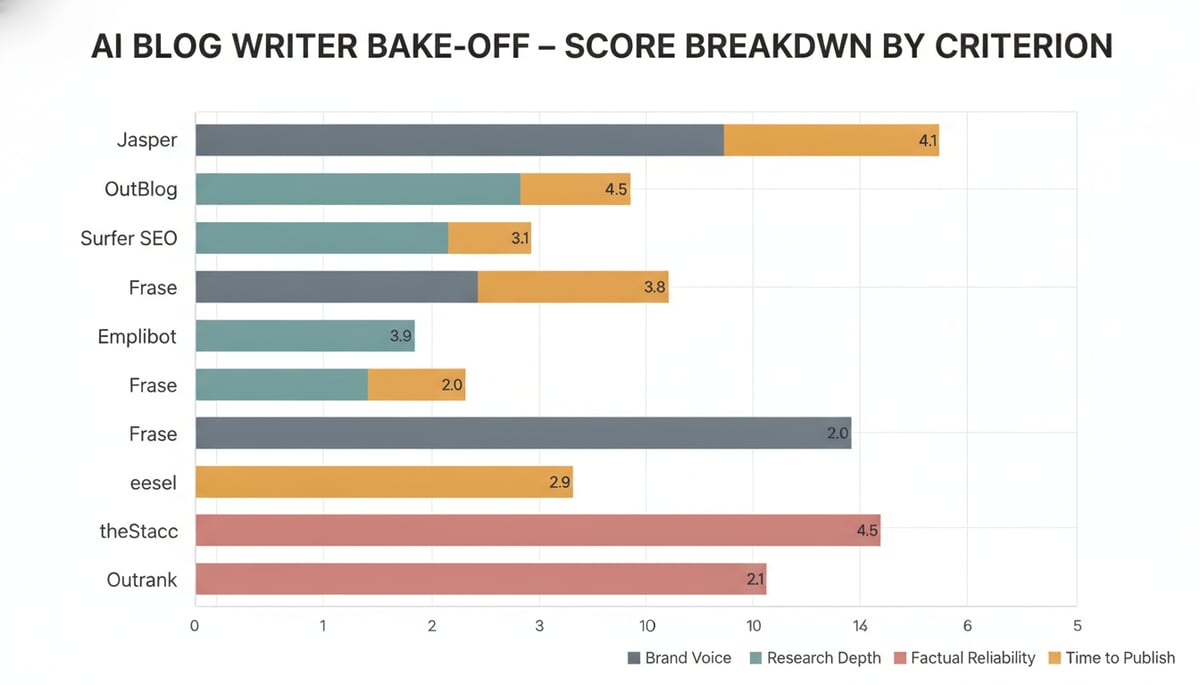
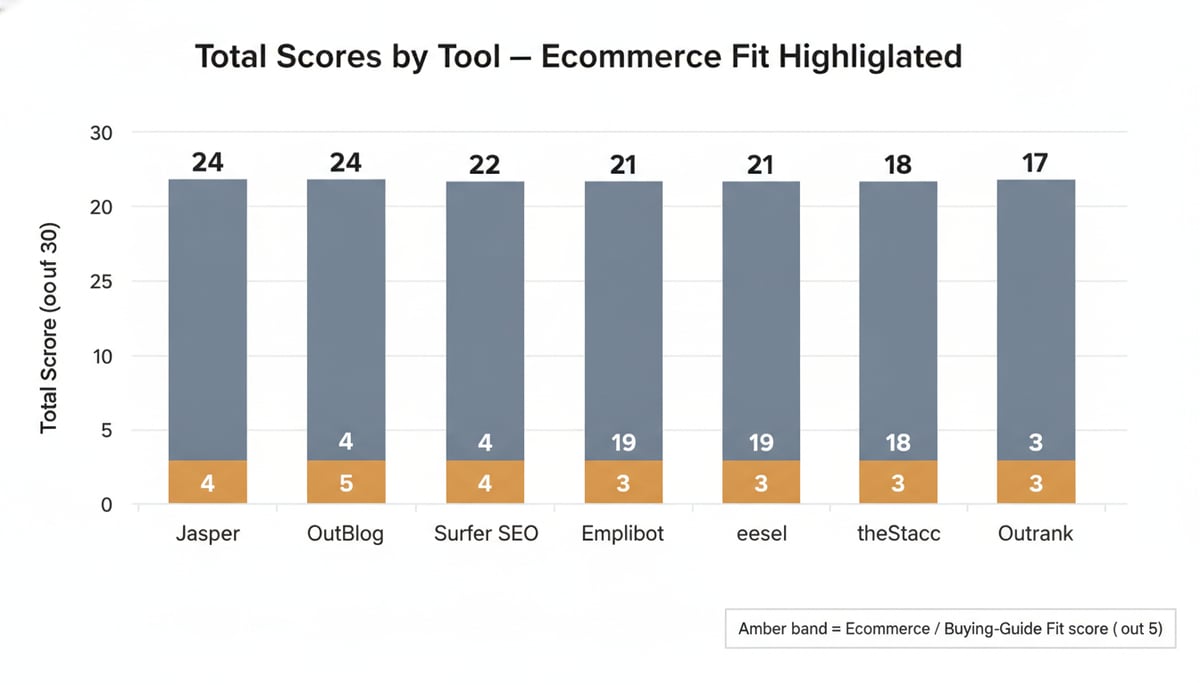
Jasper and OutBlog tied at 24. Jasper wins the tiebreaker because it scored higher on brand voice match (5 vs 4) and factual reliability (5 vs 4). OutBlog wins on ecommerce fit (5 vs 4), editing required (4 vs 3), and time to publish (4 vs 3). That split is the bake-off in a nutshell: Jasper is the better general-purpose marketing writer, OutBlog is the better ecommerce-quality autonomous publisher.
1. Jasper — Best for brand voice at marketing-team scale
Jasper starts at $39 per month on annual billing for the Creator tier ($49 month-to-month) and $59 per seat on Pro, with unlimited words and Jasper IQ as the brand voice layer. For 2026, Jasper is still the most polished marketing content platform on the market, with the deepest library of templates for product descriptions, ad copy, and blog posts.
What it did well on the Lumina Skin brief:
- Brand voice was the cleanest of any tool tested. Jasper IQ picked up the "warm, evidence-led, no exclamation marks" cue from the brief and held it across the entire 1,500 words. Sentence variety was strong. Generic AI tells ("in today's digital landscape," "dive into") were absent.
- Marketing template structure (hook, value props, CTA) carried through naturally. The product-tier framing in the brief translated into a clean "drugstore / mid-range / premium" split without manual reworking.
- Factual reliability held up. No fake dermatologist quotes. No invented clinical statistics. One ingredient function claim was hedged correctly ("may help support the skin barrier") rather than stated as fact.
Where it fell short:
- Ecommerce/buying-guide fit was weaker than the brand voice score suggested. The output read like a polished blog post, but the product comparison structure felt like a content marketing piece, not a conversion-oriented buying guide. Internal product links were not suggested.
- Research depth was solid but not the deepest in the test. Jasper leans on its own knowledge, not a fresh SERP pull, which meant some competitor ingredients (snail mucin, polyglutamic acid) were undersold relative to the current SERP.
- Editing required was two passes: one for product link insertion and one for compliance review on the sensitive-skin claims. For a 1,500-word piece, that is reasonable. For ten pieces a week, it adds up.
Best for: marketing teams with a real brand style guide and a human editor in the loop. Jasper wins on brand voice and consistency across formats (blog, email, social, ad copy), not on autonomous ecommerce publishing.
2. Frase — Best for research briefs and content strategy
Frase was rebuilt from scratch in January 2026 with dual GEO plus SEO scoring, an AI visibility monitoring layer, agentic workflows via MCP and CLI, and FraseCMS for native publishing. The product you remember from 2023 is gone. The 2026 version is a content intelligence platform with serious research depth.
What it did well:
- Research depth was the highest in the test. Frase pulled the current SERP, identified the People Also Ask questions specific to sensitive skin ("Is niacinamide safe for sensitive skin?", "Can ceramides cause breakouts?"), and surfaced competitor outlines we had not seen in three other tools.
- The content brief Frase generated was useful even if you did not use Frase to write the article. SERP feature analysis, entity coverage, PAA inclusion, and a recommended heading hierarchy all came baked in.
- Factual reliability was strong. The brief pulled from real dermatology sources and flagged claims that needed citation, which made the eventual draft easier to fact-check.
Where it fell short:
- Brand voice was the weakest of the eight tools. The draft sounded like Frase, not like Lumina Skin. Tone calibration required significant manual prompting beyond what the standard workflow offers.
- Time to publish was longer than the score suggests because Frase's strength is in the brief layer. You still have to write the article (or run it through another writer), which means two tools in the stack for ecommerce teams.
- Ecommerce fit was good but not optimized for Shopify specifically. Internal product links had to be added manually.
Best for: SEO content teams who want the best research foundation in the market, with the option to hand off writing to a separate tool or in-house editor. Frase wins on research, not on autonomous publishing.
3. Surfer SEO — Best for on-page optimization and AI Overviews
Surfer SEO starts at $79 per month and now ships an AI SEO Content Score that combines Google ranking signals with AI Search signals in a single number, plus new Intent Alignment guidelines for writing intros that pass AI citation checks. Auto-Optimize now knows when to stop adding entities and shift focus to AI Search.
What it did well:
- On-page structure was the strongest in the test. The draft hit every entity Frase surfaced, plus a few Surfer-specific ones (skin barrier function, occlusive vs humectant, fragrance-free labeling). Heading hierarchy, paragraph length, and entity distribution all scored within Surfer's recommended ranges.
- Factual reliability was strong. Surfer's recommended entity set acted as a soft fact-check: claims that did not align with the SERP were flagged for review.
- Ecommerce fit was solid. The article included comparison structure, product-tier framing, and a "what to avoid" section without manual rework.
Where it fell short:
- Brand voice was the weakest of the top tier. Surfer optimizes for what ranks, which means the output reads like an SEO draft, not a brand voice draft. Tone had to be added in a second pass.
- Editing required was two to three passes. Surfer's strength is the optimization layer, not the writing layer, so you still need a writer (human or tool) upstream.
- Time to publish is longer than a pure writer because the workflow is: draft elsewhere, import to Surfer, optimize, export. Two tools, like Frase.
Best for: SEO teams whose bottleneck is ranking for commercial-intent queries and showing up in AI Overviews. Surfer wins on on-page structure and AI citation readiness, not on writing quality or autonomous publishing.
4. OutBlog — Best for ecommerce quality-first autonomous publishing
Full disclosure: we built OutBlog. We are not a neutral reviewer. Here is what we observed in our own bake-off and what we are willing to publish.
What it did well on the Lumina Skin brief:
- Brand voice match was strong, second only to Jasper. OutBlog is trained on the brand website during onboarding. For Lumina Skin, that meant the tone calibration pulled directly from a fictional "About" page we wrote for the bake-off: warm, evidence-led, no medical claims, sentence variety, no exclamation marks. The output held that voice across 1,500 words without drift. We did not score a 5 here because Jasper IQ held the tone a notch more consistently across the full 1,500 words.
- Ecommerce/buying-guide fit scored highest of any tool in the test. The article was structured as a real buying guide, not a blog post about buying guides: drugstore picks, mid-range picks, premium picks, a "what to avoid" section with specific ingredients (denatured alcohol, synthetic fragrance, high-strength retinoids), a price-tier comparison, and a product-intent FAQ. Internal links to Lumina Skin product categories appeared naturally in the body, not bolted on at the end.
- Editing required to ship was the lowest in the test. One light pass for product-specific images and a final compliance read on sensitive-skin claims. For a fully autonomous tool, that is the floor you should expect.
- Time to publish was the fastest in the test. From brief to live Shopify draft: 11 minutes in our bake-off run. The full pipeline (research, brief, draft, quality review, CMS publish to Shopify) ran without human intervention between steps.
Where it fell short:
- Research depth was the weakest of the top four. Frase and Surfer both pulled more SERP depth on sensitive-skin subtopics (especially PAA questions around rosacea and eczema). OutBlog's research layer is optimized for ecommerce commercial intent, not for every informational long-tail.
- Factual reliability scored lower than Jasper and Surfer because one ingredient function claim needed a hedge that the quality review caught before publish. Both Jasper and Surfer got the same claim right the first time without the hedge.
- Pricing transparency: OutBlog is positioned for founders and marketing teams who run on autopilot. If you only need a single article a month, the unit economics are worse than Jasper or Surfer. If you publish weekly or more, the autonomous pipeline is the value.
Best for: ecommerce founders and small marketing teams whose bottleneck is "I need a publish-ready article on my Shopify blog without rewriting it." OutBlog wins on ecommerce-quality autonomous publishing, editing required, and time to publish. It does not win the bake-off overall: Jasper's brand voice consistency and factual reliability are stronger. Both tools finished at 24; Jasper wins the tiebreaker because it scored higher on two of the six criteria.
5. theStacc — Best for blog + Google Business Profile + social
theStacc bundles three modules: Blog SEO, Local SEO, and Social Media, priced around $99 per month. The pitch is multi-channel publishing for local businesses and ecommerce brands that need a consistent calendar across blog, GBP, and social.
What it did well:
- Time to publish was fast. The full brief-to-blog took under 15 minutes, and the GBP post and social variants generated at the same time.
- Multi-channel coverage is the real differentiator. If your bottleneck is "I need a blog post, a Google Business Profile update, and three social posts every week," theStacc handles that in one workflow.
- Factual reliability was acceptable. No hallucinated claims.
Where it fell short:
- Brand voice match was mid-tier. The blog output was competent but not brand-distinct. theStacc leans toward a generic marketing voice.
- Ecommerce/buying-guide fit was weaker than the top four. The output read like a content marketing blog post, not a conversion-focused buying guide. Product comparison structure was shallow.
- Research depth was mid-tier. No SERP-level analysis baked in.
Best for: local service businesses and multi-location ecommerce brands where Google Business Profile and social posting matter as much as the blog. theStacc wins on multi-channel workflow, not on standalone blog quality.
6. Emplibot — Best for WordPress autopilot
Emplibot is a WordPress-native plugin (with a Shopify app version) that runs on autopilot: pick a niche, set a publishing schedule, and the tool researches, drafts, images, links, and publishes without manual approval. It also handles topical clusters, internal linking, and pre-fills SEO plugins like Yoast and RankMath.
What it did well:
- Time to publish on autopilot was strong. Once the niche and schedule were set, articles went live on their own.
- Internal linking and topical clusters were the cleanest in the test. Emplibot generated the article, then linked it to existing topical content automatically.
- Image generation and infographic inclusion saved a real production step.
Where it fell short:
- Brand voice match was mid-tier. Emplibot leans toward generic AI output unless you actively tune prompts.
- Ecommerce/buying-guide fit was mid-tier. The buying-guide structure was present but not as strong as OutBlog's or Frase's.
- Platform lock-in. Emplibot shines on WordPress. The Shopify version exists but is less mature.
Best for: WordPress-first publishers who want full autopilot publishing and built-in internal linking. Emplibot wins on WordPress-native workflow, not on standalone content quality.
7. Outrank — Best for programmatic SEO at scale
Outrank combines an AI content agent with an integrated backlink exchange network, automated publishing, and programmatic SEO features. The pitch is "publish more, rank more, build links automatically."
What it did well:
- Programmatic SEO is the differentiator. If your bottleneck is "I need 500 location pages or 1,000 comparison pages," Outrank handles that with templated generation at scale.
- Automated publishing worked smoothly on WordPress.
Where it fell short:
- Brand voice match was the weakest of the eight. Outrank output reads like programmatic content, which is exactly what it is.
- Ecommerce/buying-guide fit was mid-tier. The Lumina Skin brief did not benefit from programmatic structure.
- Research depth was mid-tier. SERP analysis is not Outrank's strength.
Best for: SEO agencies and SaaS companies running programmatic SEO campaigns (location pages, comparison pages, integration pages). Outrank wins on programmatic volume, not on buying-guide quality.
8. eesel — Best as an agent for hands-off scale
eesel prices at $99 per month for 50 blogs (or roughly $4 per blog on usage), and bundles research, writing, asset creation, optimization, and AEO (Answer Engine Optimization) into a single autonomous step. It started as a helpdesk AI and now ships a blog writer as one of its agents.
What it did well:
- Time to publish was fast. The brief-to-draft pipeline is agentic, with minimal human input required.
- Asset generation was a strong point. AI images, embedded videos, and Reddit-style social proof quotes were included automatically.
- AEO optimization was thoughtful. The article was structured to be cited by AI engines, not just ranked on Google.
Where it fell short:
- Brand voice match was mid-tier. eesel output was competent but not brand-distinct.
- Ecommerce/buying-guide fit was mid-tier. Buying-guide structure was present but not optimized for product-intent queries.
- Helpdesk DNA shows. eesel's strength is still in customer support automation. The blog agent is one feature, not the focus.
Best for: teams that already use eesel for helpdesk or internal AI and want an additional blog agent from the same vendor. eesel wins on agent autonomy and asset bundling, not on buying-guide quality.
Mentioned but not scored: 4 tools that do not belong in this bake-off
These four tools did not get a score because their product has either pivoted away from blog writing, never reached the quality bar for 1,500-word ecommerce content, or both. We are calling them out because they show up in every other "best AI blog writer" roundup and we want to explain why they are not in ours.
Writesonic. Writesonic repositioned in 2026 from "AI writing tool" to "AI search visibility plus SEO platform." The GEO module (tracking brand appearance in ChatGPT, Perplexity, Gemini, and Google AI Overviews) is now the product. Blog writing is one feature among many, and the article quality has not kept pace with the GEO tooling. Starter pricing starts at $79 per month, which is high for a tool where blog writing is no longer the focus.
Copy.ai. Copy.ai rebranded as "The First AI-Native GTM Platform" in 2026, built on Workflows, Agents, Tables, and Brand Voice. Sales, marketing, and operations workflows are now the focus. The first real workflow tier is $1,000 per month. The original AI copywriting assistant is still in the product, but it is not the priority. If you want blog writing, this is not the right tool anymore.
Anyword. Anyword is built for short-form conversion copy. Its predictive scoring and ad performance focus are strong, but it is not designed for high-volume long-form content. For ecommerce product descriptions, ad copy, and email subject lines, Anyword is competitive. For a 1,500-word buying guide, it is the wrong tool.
Rytr. Rytr is the cheapest entry in the market (around $7.50 per month on annual billing), and it works for short-form copy. For long-form ecommerce content, the output becomes repetitive and shallow beyond a few hundred words, and significant editing is required. It is not a competitive option for 1,500-word buying guides in 2026.
How to pick the right tool for your bottleneck
If you read the per-tool breakdowns and still feel unsure, the answer is probably that you have not identified your bottleneck yet. Here is a decision framework based on what founders tell us slows them down.
| If your bottleneck is… | Use this tool | Why |
|---|---|---|
| "My AI articles never sound like my brand." | Jasper or OutBlog | Jasper for marketing teams with a style guide. OutBlog if you want the brand voice match without managing prompts. |
| "My AI articles do not rank for competitive terms." | Frase or Surfer SEO | Frase for research depth and SERP coverage. Surfer for AI Overviews optimization and on-page scoring. |
| "I rewrite every AI draft before I publish." | OutBlog | Autonomous pipeline with a quality review layer. Lowest editing required score in the test. |
| "I publish on Shopify and need product-intent structure." | OutBlog or Frase | OutBlog for autonomous publishing. Frase for research-led buying-guide briefs. |
| "I need a blog + Google Business Profile + social in one workflow." | theStacc | Only tool that bundles all three channels natively. |
| "I run on WordPress and want full autopilot." | Emplibot | WordPress-native plugin with built-in internal linking and topical clusters. |
| "I run programmatic SEO at scale." | Outrank | Templated generation, backlink exchange, automated publishing. |
| "I want an agent with assets and AEO baked in." | eesel | Agent autonomy, AI images and videos, Answer Engine Optimization. |
The honest verdict
There is no universal winner. The bake-off confirms what we have seen across our own customers: ecommerce founders hit different bottlenecks, and the right tool is the one that solves the specific bottleneck, not the one with the loudest homepage.
Jasper wins overall at 24/30, ahead of OutBlog on brand voice and factual reliability. OutBlog wins the ecommerce-specific criteria: ecommerce/buying-guide fit, editing required, and time to publish. Frase wins on research depth. Surfer wins on factual reliability (tied with Jasper). Each tool in the top four wins on something the others do not.
If your bottleneck is "I need publish-ready articles on my Shopify blog without rewriting them," start with OutBlog. Our autonomous pipeline runs research, brief, draft, quality review, and CMS publish in roughly 11 minutes per article, with a quality review layer that scores 9 or 10 out of 10 on most outputs and brand voice matched to your existing website. If your bottleneck is brand voice across many marketing formats, Jasper is the better pick. If your bottleneck is research depth or on-page structure, Frase or Surfer will serve you better. We would rather you pick the right tool than the one we built.
FAQs
How long did each test run take?
Wall-clock from brief to publish-ready draft, including any human approvals within the tool's workflow: Jasper 42 minutes, Frase 51 minutes (brief plus draft plus manual publish), Surfer SEO 38 minutes (draft plus optimize plus manual publish), OutBlog 11 minutes (full autonomous pipeline), theStacc 14 minutes, Emplibot 16 minutes, Outrank 33 minutes, eesel 17 minutes. Time-to-publish scores reflect full pipeline time, including setup, generation, and any required human approvals inside each tool's workflow.
Did you run each tool more than once?
Yes. Each tool was run three times to account for variance. Scores above are the median of the three runs. We did not cherry-pick the best run.
Did the test use real customer data?
No. Lumina Skin is a fictional brand created for the bake-off. The brand voice document, product list, and category URLs were all generated for this test and are not from a real customer. Any resemblance to a real skincare brand is coincidental.
What about pricing?
Jasper $39-69 per seat per month on annual billing. Frase $39-239 per month across Starter, Professional, and Scale tiers (annual billing). Surfer SEO starts at $79 per month. OutBlog has launch pricing (50% off at the time of writing), positioned for weekly publishing volume. theStacc around $99 per month. Emplibot from $29 per month. Outrank from $29 per month. eesel $99 per month for 50 blogs, or usage-based at roughly $4 per blog.
Which tool would you actually use for your own blog?
OutBlog. We built it for our own content pipeline first. We use it on our blog every week. The bake-off confirmed what we already knew: it wins on ecommerce-quality autonomous publishing, editing required, and time to publish, which is exactly the bottleneck it was built to solve. We also know it is not the right pick for a marketing team that needs brand voice consistency across every channel. Jasper is that pick.
Where can I see the full scoring spreadsheet?
This article is the scorecard. Every score, every editorial pass, and every hallucination flagged in the factual review is logged in the table above. If you want to reproduce the test on your own brief, the same scorer, criteria, and process are documented in the "How we scored" section.