GEO & SEO: How Generative AI Complements Your Search Strategy
Discover Generative Engine Optimization (GEO) and why it's not replacing traditional SEO. Learn how to integrate GEO into your marketing strategy to dominate AI search results, connect with high-intent users, and future-proof your brand's digital visibility.

The digital landscape is undergoing a significant transformation. As generative AI models increasingly shape search results into conversational summaries and direct answers, marketers and SEO professionals are asking a critical question: Is traditional Search Engine Optimization (SEO) becoming obsolete? The answer is no. Instead, the rise of AI presents a strategic need to evolve, not abandon, your core search strategy. This evolution demands a new layer of optimization.
This post introduces Generative Engine Optimization (GEO) as a complementary strategy designed to future-proof your brand’s digital visibility within the AI-driven search ecosystem. GEO is not about replacing the foundational principles of SEO; it is about extending and amplifying them. In fact, strong SEO performance, built on authority, relevance, and comprehensive content, directly enhances your prospects of being cited and prioritized in AI-generated responses.
Here, you will gain an understanding of what GEO entails, how it differs from and integrates with your existing SEO efforts, and the pillars required to embed it into your marketing strategy. We will clarify the shifting landscape from traditional links to dynamic AI conversations, demystify GEO’s core principles, and highlight why it complements SEO rather than replacing it. Our objective is to equip founders, marketing teams, and agencies with the insights to navigate this environment, influence AI search results, and connect with high-intent users.
TL;DR
AI-driven answers are reshaping the search landscape, demanding an evolution in digital strategy. To maintain visibility, businesses must look beyond traditional blue links.
Generative Engine Optimization (GEO) is the process of optimizing your content to be cited and referenced by AI engines like Google’s AI Overviews and ChatGPT. It is not a replacement for SEO but a critical amplification of it. Strong SEO performance directly enhances your GEO potential, as AI models prioritize authoritative, high-ranking sources. Research confirms this synergy, with one analysis finding that over 40% of AI citations are sourced from Google’s top 10 results (Writesonic 2025).
Here is a summary of the core principles:
- GEO Focus: Aims for brand and content inclusion in direct AI-generated answers.
- SEO Synergy: Leverages strong SEO performance to increase the likelihood of being featured in AI responses.
- Core Tactics: Involves creating authoritative, question-answering content, utilizing structured data, and building brand authority.
- Hybrid Strategy: Requires integrating GEO practices into existing SEO workflows to secure visibility across all search formats.
To secure future market leadership, businesses must adopt a hybrid approach that integrates GEO tactics into their core SEO strategy.
The Shifting Search Landscape: From Blue Links to AI Conversations
The established playbook for market visibility was once straightforward: dominate the search engine results page (SERP) and capture the click. That era of predictability is giving way to a new, conversational model that is reshaping how users interact with information.
The rise of generative AI has altered user search behavior, creating a landscape where direct, conversational answers are prioritized over traditional lists of links. Users are increasingly bypassing keyword-and-click cycles, instead posing complex questions to engines like Perplexity, ChatGPT, and Google's AI Overviews. These platforms are engineered not to present options but to synthesize a single, authoritative answer, effectively becoming the primary destination for information.
This paradigm shift transforms the core objective of digital strategy. The goal is no longer just to rank, but to be the trusted data source powering the AI's response. This is not a distant trend; it is a present reality demanding strategic adaptation. Projections from Built In (2025) underscore the scale of this disruption, with platforms like ChatGPT already processing tens of millions of queries daily and reshaping user expectations for instant, comprehensive answers.
The strategic implications become clear when comparing the two paradigms directly. The focus shifts from visibility in a list to authority within a definitive answer.
| Dimension | Traditional Search Paradigm (SEO) | Generative Engine Paradigm (GEO) |
|---|---|---|
| User Input | Keywords & short-tail phrases | Complex, conversational questions |
| Engine Goal | Provide a ranked list of relevant resources | Synthesize information into a direct, cited answer |
| Key Performance Indicator | Organic ranking, click-through rate (CTR) | Inclusion as a source, brand mention in output |
| Primary User Touchpoint | Clicking a blue link to visit a webpage | Reading the AI-generated summary directly |
This evolution demands more than incremental SEO adjustments; it requires a strategic pivot toward influencing AI models directly. Your new imperative is to ensure your brand's expertise becomes the foundational knowledge from which these generative engines construct their answers.
What Is Generative Engine Optimization (GEO)?
For decades, digital strategy revolved around a singular objective: dominating the search engine results page. A new strategic frontier is now emerging, where the goal is not just to be found, but to become the definitive source of truth for artificial intelligence.

Generative Engine Optimization (GEO) is the strategic process of optimizing your digital presence to be favorably featured, cited, and recommended by generative AI models. Unlike traditional SEO, which targets a list of links on a SERP, GEO targets the AI
’s underlying knowledge base. The objective is to influence how these models retrieve, synthesize, and present information, making your brand the authoritative answer for relevant user queries. Analysis from Netpeak (2025) confirms that GEO is centered on structuring content and building trust signals that large language models can interpret and prioritize.
| Aspect | Search Engine Optimization (SEO) | Generative Engine Optimization (GEO) |
|---|---|---|
| Primary Target | Search Engine Results Pages (SERPs) | AI-generated answers and summaries |
| Core Tactic | Keyword targeting, backlinking, technical health | Factual accuracy, structured data, topical authority |
| User Interaction | User clicks a link to visit a source website | User receives a direct, synthesized answer |
| Success Metric | Keyword rankings, organic traffic, conversions | Favorable brand mentions and citations in AI responses |
GEO is the strategic imperative to ensure your brand's voice and authority are amplified, not diluted, in the age of AI-driven discovery.
GEO vs. SEO: A Tale of Two Optimization Strategies
Digital strategy has long revolved around ranking on a search engine results page (SERP). Today, a new, more conversational paradigm is reshaping the landscape, demanding a different approach to optimization.
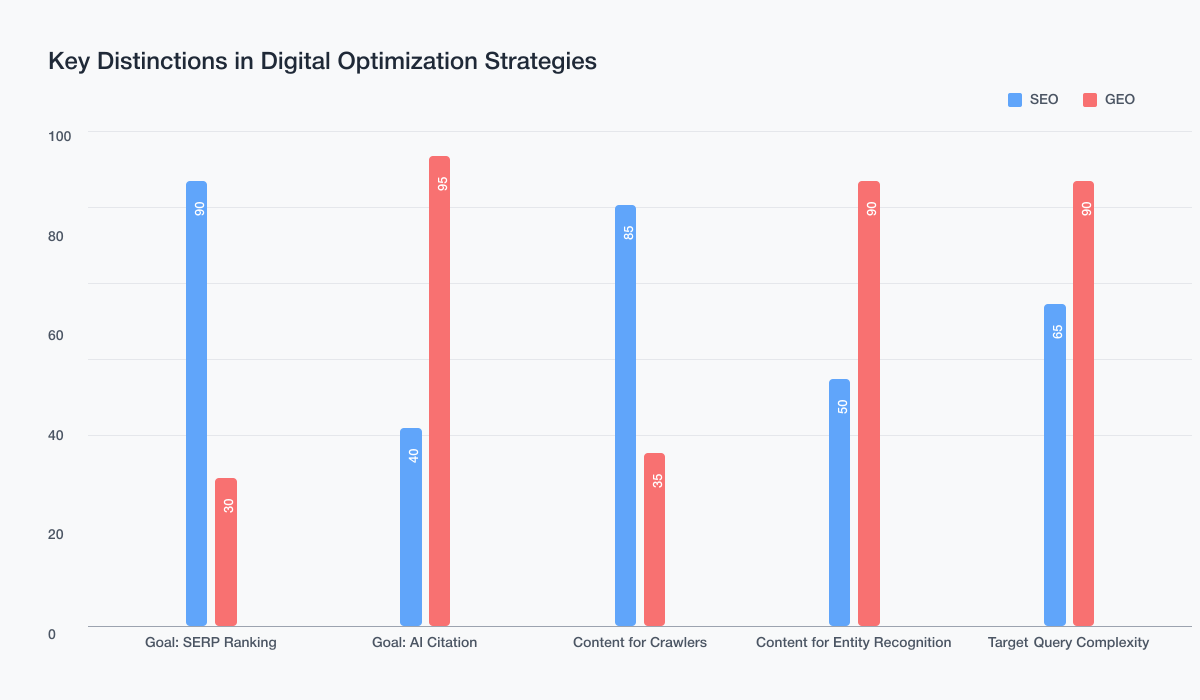
This evolution marks the distinction between Search Engine Optimization (SEO) and Generative Engine Optimization (GEO). While SEO is engineered to perform well in a ranked list, GEO is designed to embed your brand's authority directly into an AI's knowledge base. It is a shift from optimizing for visibility in a list to optimizing for citation within a dialogue. This strategic pivot is critical, as generative AI increasingly becomes the first point of contact for complex user queries.
Industry analysis validates this divergence, noting that the core mechanisms differ significantly. While traditional SEO relies on crawling and indexing, GEO depends on content ingestion into training datasets and sophisticated entity recognition, according to a 2025 report from Netpeak. Success is measured not just in clicks, but in direct influence.
| Dimension | Search Engine Optimization (SEO) | Generative Engine Optimization (GEO) |
|---|---|---|
| Primary Goal | Achieve top ranking on a SERP for target keywords. | Become a cited, authoritative source within an AI-generated answer. |
| Target Queries | Shorter-tail keywords and direct phrases (e.g., "best CRM software"). | Long-tail, conversational, and complex prompts (e.g., "What CRM is best for a B2B SaaS startup with a 5-person sales team?"). |
| Content Strategy | Content structured for crawlers and user readability, with integrated keywords and clear E-E-A-T signals. | Highly authoritative, fact-dense content that provides direct, unambiguous answers and is structured for entity recognition. |
| Success Metrics | Organic traffic, keyword rankings, click-through rate (CTR), conversions. | Brand mentions, share of voice in AI answers, sentiment analysis of citations, direct answer inclusion. |
| Primary Sources | A site's own domain authority, backlink profile, and on-page technical structure. | A vast and eclectic pool of data, including technical documentation, forums (Reddit, Quora), public datasets, and academic papers. |
The practical difference is profound. An SEO strategy targets the query 'best running shoes' by building a page that ranks for that term. A GEO strategy aims to become the source the AI trusts when asked, 'What are the most durable running shoes for a marathoner with flat feet?' The former seeks to present options; the latter seeks to be the definitive answer. This requires an amplification of your content's depth and factual accuracy. While SEO gets your brand on the list, GEO makes your brand the trusted recommendation. Integrating both is no longer an option but a strategic imperative for achieving comprehensive digital authority.
Why GEO Complements SEO, Not Replaces It
The rise of generative engines has prompted a strategic question: does this new landscape render traditional SEO obsolete? This perspective overlooks how these advanced AI systems operate and source their information.
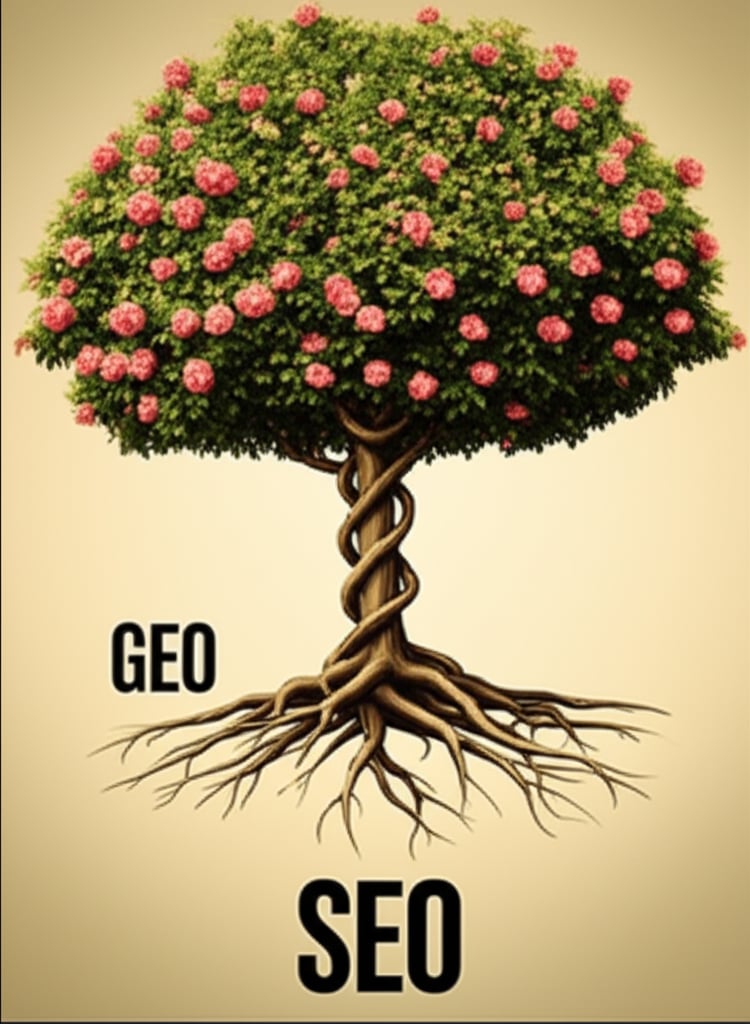
Generative Engine Optimization (GEO) is not an adversary to SEO but its direct descendant. AI models, particularly those using retrieval-augmented generation (RAG), rely on existing, authoritative web content to formulate answers. A strong SEO foundation—encompassing high domain authority, topical relevance, and quality backlinks—serves as the primary signal of trustworthiness, making your content a prime candidate for citation in AI-generated responses.
This symbiotic relationship is data-driven. Research from Digital Success (2024) reveals that a significant portion of AI citations, over 40%, are sourced directly from Google’s top 10 organic search results. This statistic confirms that achieving high rankings through proven SEO tactics is the most direct path to influencing generative engine outputs. Without a top-tier organic presence, your content is unlikely to be considered by the AI.
The disciplines work in tandem, each fulfilling a distinct but connected role in the user's journey to discovery.
| Discipline | Primary Function | Key Metrics | Strategic Role |
|---|---|---|---|
| SEO | Builds foundational authority and broad visibility. | Organic Traffic, Keyword Rankings, Backlinks, Domain Authority | Secures a position on the "shortlist" of credible sources. |
| GEO | Optimizes content to be selected as the definitive answer. | AI Citations, Featured Snippets, Share of AI Voice | Wins the "final interview" to be the chosen source in an AI response. |
Beyond authority, technical SEO becomes even more critical. Elements like structured data (Schema markup) provide a clear, machine-readable summary of your content, making it easier for AI crawlers to parse and integrate your information. Similarly, site speed and mobile-friendliness ensure that AI systems can access your content without friction, further improving your chances of being selected as a source. A successful digital strategy must be a hybrid where foundational SEO efforts create the authority necessary for GEO to amplify that presence. A robust and technically sound SEO strategy is the non-negotiable prerequisite for achieving meaningful visibility and authority in the age of generative search.
Core Pillars for Integrating GEO into Your SEO Strategy
Successfully integrating GEO requires a multi-faceted approach that enhances content authority, implements technical signposting, and expands your brand's digital footprint.
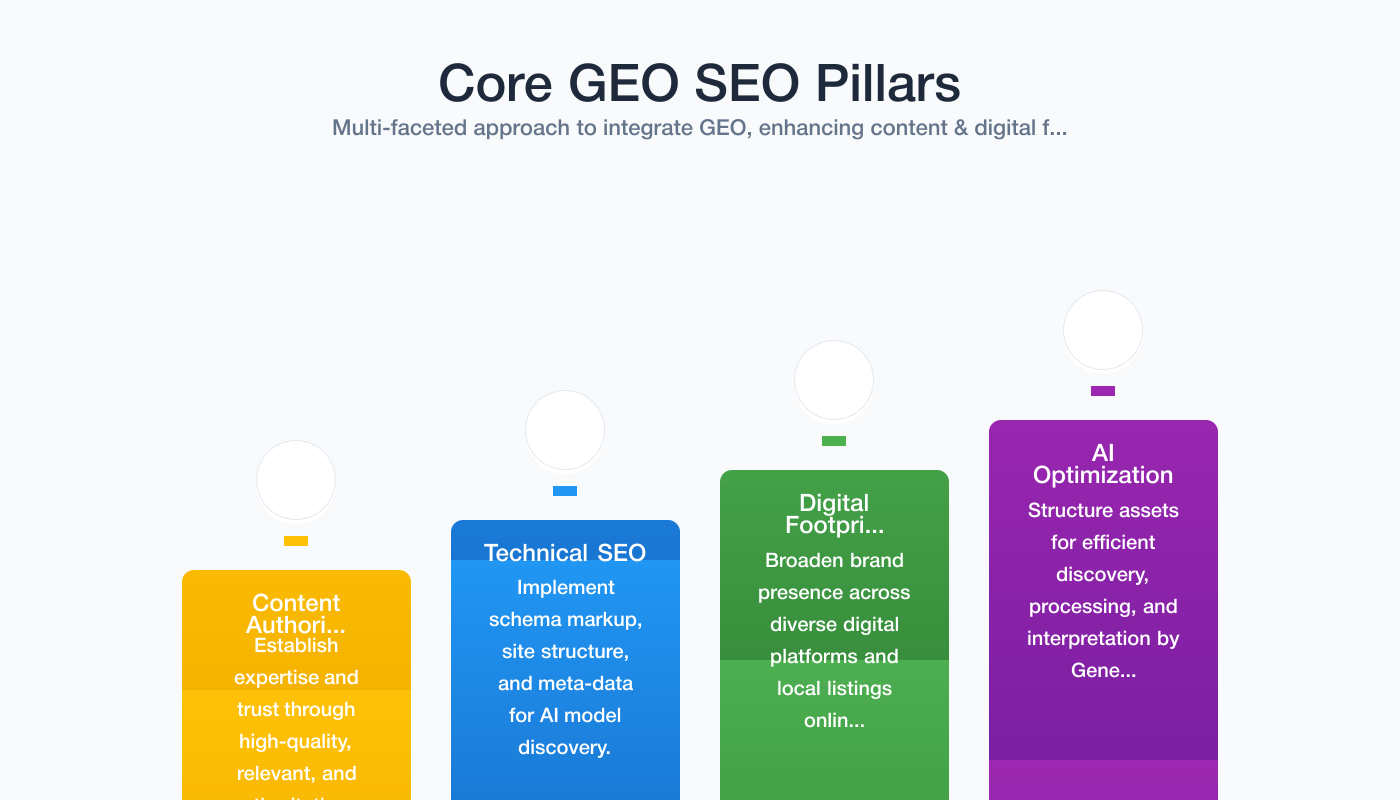
This strategic framework is built on indispensable pillars designed to optimize your assets for discovery and interpretation by generative AI. Each pillar addresses a unique aspect of how AI models learn, process, and prioritize information.
The Challenges and Future of an AI-Powered Search World
The integration of generative AI into search represents a fundamental shift, yet this transformation introduces significant complexities for marketing leaders. Navigating this new landscape requires a clear-eyed view of both the immediate hurdles and the long-term trajectory of AI-powered discovery.
While GEO is becoming indispensable, its current state presents notable challenges. The opaque nature of AI algorithms, coupled with fragmented attribution models, and a relentless pace of evolution, complicates the development of scalable strategies. This environment demands a pivot from predictable tactics to a more agile, experimental approach.
A primary obstacle is the inherent "black box" nature of large language models. Unlike traditional SEO, where ranking factors can be analyzed and understood to a degree, generative models often conceal the specific signals they use to synthesize answers and select sources. This lack of transparency, as noted in analysis by Netpeak (2025), makes it difficult to reverse-engineer success or build a replicable optimization framework. Marketers are left to test hypotheses without a clear feedback loop.
The challenge is compounded by a breakdown in traditional measurement. AI-generated answers often consolidate information from multiple sources without providing direct, clickable links, disrupting last-click attribution and making it difficult to quantify ROI from GEO efforts directly.
Note: When a generative engine becomes the primary source of an answer, pulling from your content without a direct referral, your brand gains visibility but loses a trackable conversion path. This forces a re-evaluation of performance metrics, shifting focus from direct traffic to broader indicators like brand mentions and share of voice within AI-generated results.
Furthermore, the models themselves are in a state of perpetual flux. An optimization that proves effective today may become obsolete after the next model update, demanding continuous monitoring and adaptation. Looking ahead, the search ecosystem will likely evolve toward greater specialization. Expect the rise of vertical LLMs trained on specific industry data, offering more precise answers. Concurrently, we anticipate the development of more advanced attribution tools and an amplified importance for multimodal content—video, audio, and structured data—as AI seeks richer information. Successfully navigating this new terrain requires a strategic shift from rigid best practices to a model of continuous experimentation and adaptation.
The evolution of search is a strategic opportunity. By understanding and implementing Generative Engine Optimization (GEO), your brand can secure visibility in the age of AI-powered conversations, complementing and amplifying your existing SEO investments.
Here are the critical takeaways for this new landscape:
- Generative Engine Optimization (GEO) is indispensable for achieving prominence in AI-generated answers and overviews, directly connecting with high-intent users.
- GEO does not replace SEO; it is its strategic evolution. A robust foundation of traditional SEO is the bedrock, improving your content's likelihood of being cited by AI.
- Successfully integrating GEO demands a multi-faceted approach: prioritize creating highly authoritative, query-specific content, implement structured data, and build brand mentions across the digital ecosystem.
The future of search demands a hybrid approach where SEO and GEO coalesce to form a unified strategy. This is about establishing market leadership and future-proofing your brand
’s digital presence. The pragmatic next step is to begin auditing your existing content with a GEO lens, focusing on content optimization for AI readability, structured data implementation, and brand authority. Streamlining this audit with platforms like OutblogAI can accelerate your adoption of a hybrid strategy. This proactive integration will ensure your brand remains at the forefront, visible and influential across all forms of search.