The SaaS Growth Engine: From 0 to 2.73M Organic Visitors in 13 Months
Uncover the repeatable SEO and content strategy a SaaS company used to scale from zero to 2.73 million monthly organic visitors in just 13 months. This case study breaks down the exact blueprint for exponential SaaS growth through content.


Achieving 2.73 million monthly organic visitors from a standing start in 13 months is a testament to a meticulously engineered growth strategy. While many narratives around rapid SaaS expansion focus on aggressive paid campaigns, this case study unveils a repeatable SEO and content blueprint that propelled a company to significant market visibility through organic search alone.

This is a precise dissection of how a lean team transformed zero web presence into a scalable growth engine. This introduction sets the stage for a deep dive into the exact methodologies that delivered such exponential results.
In the following sections, you will discover the core strategic pillar: building an authoritative online presence through the topic cluster model to establish genuine topical authority. We will break down each phase of this 13-month journey, from the foundational months (1-3) focused on strategic low-difficulty, high-intent BOFU keyword targeting, to the aggressive scaling of content velocity (months 4-9) that saw production soar from 12 to over 50 articles monthly. Finally, we'll examine how disciplined technical SEO, product-led content creation, and systematic internal linking converged to create a compounding growth effect, ultimately reaching an SEO tipping point in months 10-13. This case study deconstructs a proven framework for achieving significant organic growth and establishing market authority.
TL;DR
A SaaS company scaled from zero to 2.73 million monthly organic visitors in 13 months using a systematic content engine. This result was not luck; it was the outcome of a disciplined and scalable growth strategy.
The core strategy was to achieve topical authority through a phased content plan. By prioritizing user intent and systematically building out topic clusters, the company created a compounding growth flywheel that captured its niche. This model's effectiveness is well-documented; the Peanut App case study showed a similar content cluster strategy driving growth to 2.3 million monthly visitors in just 12 months (The F*ck SEO, 2023).
- Phase 1 (Months 1-3): Focused 60% of effort on low-difficulty (<30 KD), high-intent Bottom-of-Funnel (BOFU) keywords to secure early traction and revenue signals.
- Phase 2 (Months 4-8): Built comprehensive topic clusters around validated BOFU pillars, expanding into Middle-of-Funnel (MOFU) content to capture a wider audience.
- Phase 3 (Months 9-13): Scaled content production to over 50 articles per month, targeting broad Top-of-Funnel (TOFU) topics to establish market-wide authority.
A disciplined approach that builds topical authority from the bottom of the funnel upwards provides a direct path to category leadership in search.
The Core Strategy: Building a Moat with Topic Clusters
Many SaaS blogs operate as a collection of disconnected articles, each chasing a different keyword. This scattershot approach fails to build the deep expertise that search engines are programmed to reward.
The strategic cornerstone of this growth was the adoption of the topic cluster model. This model organizes content architecture around a central "pillar" page, which covers a broad topic, and multiple "cluster" pages that delve into related sub-topics. This structure transforms a blog from a random assortment of posts into an interconnected library, systematically signaling comprehensive topical authority to Google. It is a deliberate method for building a defensible information moat around core business topics.
The pillar page serves as the definitive hub for a high-value subject. It targets a broad, high-volume keyword and provides a comprehensive overview, linking out to the more detailed cluster articles. This page is designed to be the primary asset that accrues backlinks and authority over time.
Supporting the pillar are the cluster pages. Each one targets a specific, long-tail keyword related to the main topic, answering a niche question with significant depth. A robust cluster typically consists of 20-30 such articles, creating a web of content that demonstrates exhaustive coverage. The internal linking structure is the mechanism that binds this strategy together; every cluster page links up to the pillar, and the pillar links down to each relevant cluster, creating a closed, logical loop.
This model's effectiveness is well-documented. An analysis by Startup Voyager on HubSpot’s content strategy revealed the topic cluster model was fundamental to their success in ranking for hundreds of thousands of keywords. They systematically built authority by creating comprehensive clusters around core marketing and sales concepts, a strategy that has since become an industry standard.
To clarify the roles of each component, consider the following breakdown:
| Component | Keyword Focus | Content Scope | Primary Role |
|---|---|---|---|
| Pillar Page | Broad, high-volume (e.g., "content marketing") | Comprehensive overview of the entire topic | Acts as the central authority hub; attracts backlinks |
| Cluster Page | Specific, long-tail (e.g., "how to write a blog intro") | Deep dive into a single, focused sub-topic | Answers specific user questions; supports the pillar |
| Internal Links | N/A (Structural) | Connective tissue linking pillar and clusters | Distributes link equity and signals semantic relationships |

Note: The strategic power of this model lies in its structure. An individual article can rank, but an interconnected cluster can dominate an entire topic, creating a sustainable competitive advantage that is difficult for others to replicate.
By deliberately organizing content into topic clusters, a business can shift from competing for individual keywords to establishing authority over entire strategic subject areas.
Phase 1 (Months 1-3): The Foundation for Scalable SEO
Significant growth in organic traffic doesn't begin with writing; it begins with architecture. The most ambitious content strategies are built on the critical, foundational work that precedes the first published word.
The first three months were dedicated to building a technically sound website and a data-driven content strategy focused on capturing high-intent traffic first. This initial phase was about precision, not volume, establishing a framework to support exponential growth. We allocated our initial efforts to a 60% focus on bottom-of-funnel (BOFU) content, ensuring every asset was engineered to attract users with immediate commercial intent.
This focus on user understanding is a well-established driver of content success. A Hotjar case study demonstrated how direct customer feedback is instrumental in shaping a content strategy that genuinely resonates and converts. By interviewing actual customers, we moved beyond assumptions to build our strategy on a bedrock of verified pain points and user language.
Our foundational process was executed in four distinct, sequential steps:
- Technical SEO Audit & Remediation: We deployed tools like Screaming Frog to conduct a comprehensive site audit. This initial sweep identified and allowed us to systematically eliminate critical errors, including 404s, duplicate meta descriptions, missing H1 tags, and uncompressed images that were hindering site speed.
- Ideal Customer Persona (ICP) Development: We conducted in-depth interviews with our earliest customers. This qualitative research revealed that their primary challenges were the excessive time spent on research, persistent writing blocks, and a lack of creative inspiration. These insights became the North Star for our entire content direction.
- Strategic Keyword Prioritization: We began with a raw list of over 8,800 potential keywords. This was strategically filtered down to an actionable list of just 305 high-priority terms. The criteria were strict: focus on long-tail keywords with clear commercial intent and a keyword difficulty score under 30 to secure early wins.
- Initial Topic Cluster Mapping: Using our ICP's core problems and the product's primary use cases as a guide, we mapped out the first set of topic clusters. This structure was designed to build topical authority from day one, signaling to search engines that we were a comprehensive resource for specific, high-value problem areas.
With this framework in place, our content creation was laser-focused. We prioritized a product-led content approach, where each article not only addressed a specific user pain point but also naturally demonstrated how our tool provided the solution.
A meticulous technical and strategic setup in the first quarter is what transforms a content plan from a series of articles into a scalable growth engine.
Phase 2 (Months 4-9): Scaling Content Velocity and Authority
Initial traction validates a strategy, but validation without velocity is a missed opportunity. The critical next step was to transform sporadic wins into a systematic, high-output growth engine capable of competing on search engine results pages.
This phase was dedicated to systematizing every aspect of content production to amplify output without sacrificing quality. The objective was to build deep topical authority by aggressively targeting bottom-of-funnel (BOFU) and middle-of-funnel (MOFU) keywords. This required a strategic expansion of the writing team and the implementation of rigorous operational frameworks.
This systematic approach to content mirrors the strategy employed by other high-growth companies. A well-documented case study on Monday.com's SEO strategy revealed it scaled to over 1,000 articles in 12 months by building a system with 15 writers and extensive documentation, ensuring consistency across a massive volume of content.
To achieve this scale, the writing team was methodically expanded, and production targets were increased from 12 posts per month to over 50. This was not a matter of simply hiring more writers, but of building an operational chassis to support them. The cornerstone of this system was a comprehensive set of documentation, including a detailed style guide, tone of voice principles, and hyper-specific content briefs for every article. These briefs removed ambiguity and empowered writers to execute with precision and speed.
---
title: "[Competitor A] vs [Competitor B]: Which Is Better for [Persona]?"
target_keyword: "competitor a vs b"
intent: "Commercial Investigation"
funnel_stage: "MOFU/BOFU"
min_word_count: 2200
---
Systematizing content production with detailed briefs and clear processes is essential for scaling output without sacrificing quality.
Phase 3 (Months 10-13): Hitting the SEO Tipping Point
The transition from steady progress to accelerated growth is rarely accidental. It is the calculated result of sustained effort reaching a critical mass, where inputs begin to generate compounding returns.
This final phase represents the inflection point where established domain authority began to self-amplify. With a deep foundation of topical authority, we could effectively target and rank for highly competitive, high-volume keywords that were previously unattainable. The strategy pivoted from pure content production to aggressive authority amplification. This phenomenon is not unique; a case study from The F*ck SEO details how the Peanut App leveraged a similar tipping point to scale from 0 to 2.3 million monthly visitors in just 12 months.
The execution in this phase focused on four high-leverage initiatives that capitalized on existing momentum:
- Developing Linkable Assets: We shifted a portion of our resources toward creating assets engineered to attract backlinks. This included comprehensive data-driven reports, statistics pages, and simple free tools that provided immense value to our industry. This approach mirrors Ahrefs' own strategy, where a single statistics page earned thousands of backlinks, serving as a powerful authority magnet for the entire domain.
- Executing Strategic Content Updates: We systematically identified our highest-performing articles that were beginning to plateau or decline in rankings. These posts were comprehensively updated with the latest information and improved visuals, then republished. This sent powerful freshness signals to Google, often resulting in an immediate rankings boost for valuable keywords.
- Expanding to Top-of-Funnel (TOFU) Content: With significant authority established in our core commercial topics, we had earned the credibility to compete on broader subjects. This allowed us to capture a much larger audience, introducing our brand to potential customers earlier in their journey.
- Activating the Flywheel Effect: As organic traffic surged past the million-visitor mark, a powerful, self-perpetuating cycle emerged. High rankings generated more visibility, which led to a dramatic increase in natural brand mentions, social shares, and unsolicited backlinks from authoritative sites. This organic amplification further solidified our authority, making it easier to rank for new content.
The SEO tipping point is achieved when foundational authority is strategically leveraged with high-impact amplification tactics, transforming linear effort into an exponential growth flywheel.
The Results: A 13-Month Journey in Numbers
Thirteen months ago, this SaaS platform had a negligible digital footprint. Today, it attracts millions of visitors, demonstrating a complete transformation from market obscurity to significant online authority.
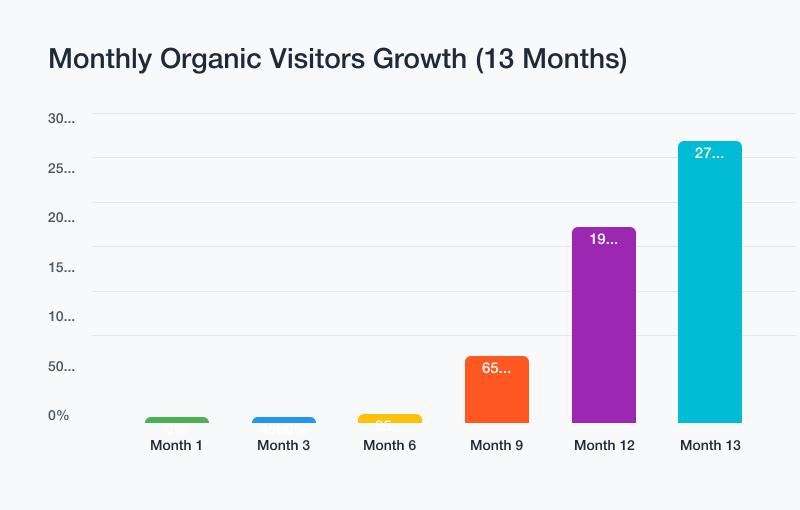
This growth was the direct output of a systematic organic strategy. The key performance indicators tell a clear story: monthly organic traffic surged from zero to 2.73 million, the number of ranking keywords expanded from under 100 to over 22,500, and the Ahrefs Domain Rating (DR) climbed from 0 to 65. This type of scaling mirrors other successful content-led strategies, such as the growth observed in an Omnius case study where a focused SEO initiative achieved a similar expansion in keyword rankings.
The journey followed a classic compounding curve, with initial months building a foundation before growth accelerated dramatically.
| Month | Monthly Organic Visitors (Approx.) | Keywords Ranked (Top 100) |
|---|---|---|
| 1 | 0 | 110 |
| 3 | 4,500 | 750 |
| 6 | 85,000 | 4,100 |
| 9 | 650,000 | 11,500 |
| 12 | 1,900,000 | 19,000 |
| 13 | 2,730,000 | 22,500 |
These results are not a matter of luck; they are the direct, predictable outcome of a meticulously executed organic growth engine.
Your Blueprint for Replicating This SaaS Growth
This growth story is not an inimitable feat but a replicable blueprint. It is a strategic framework built on disciplined execution, a deep understanding of user intent, and programmatic patience.
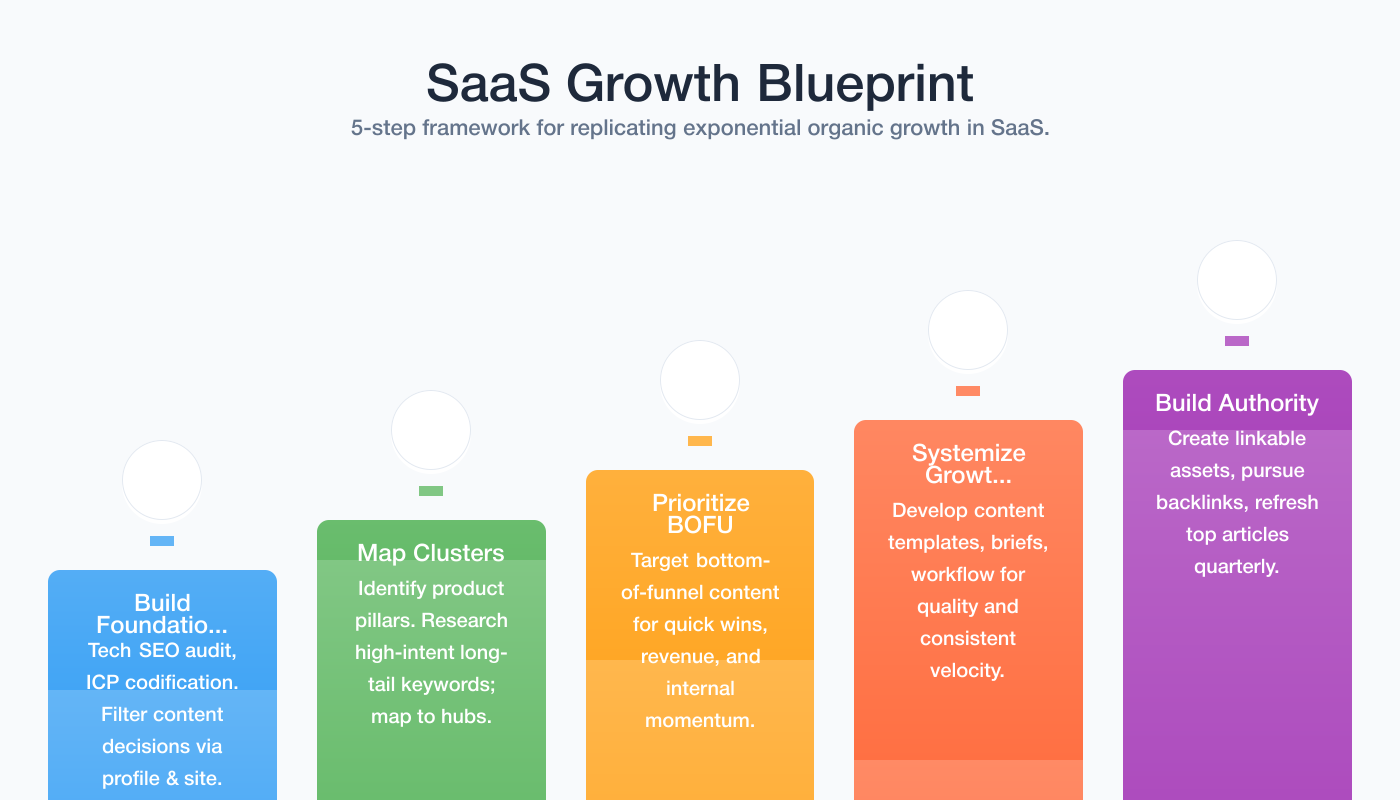
This model deconstructs the path to significant organic growth, enabling any ambitious team to build a similar engine. The core principle involves shifting focus from chasing disparate keywords to building comprehensive topical authority, a strategy proven to align with Google’s E-E-A-T guidelines. As demonstrated in the well-documented Groove case study, anchoring content strategy in tangible customer problems is the most direct path to creating assets that rank and convert.
Here is the five-step operational blueprint to engineer this growth:
- Build Your Foundation. Begin with a comprehensive technical SEO audit to ensure your site is optimized for crawling and indexing. Simultaneously, work with sales and product teams to codify your Ideal Customer Profile (ICP). Every subsequent content decision must be filtered through the lens of this profile and a technically sound website.
- Map Your Clusters. Identify the core pillars of your product—the primary value propositions or feature sets. These become the hub pages of your topic clusters. From there, conduct exhaustive research into long-tail, high-intent keywords that your ICP uses when seeking solutions, mapping these spokes back to your central hubs.
- Prioritize and Execute. Resist the temptation to target high-volume, top-of-funnel terms first. Instead, prioritize bottom-of-the-funnel (BOFU) content that addresses immediate customer pain points and purchase intent. Securing these quick wins will generate initial revenue and build internal momentum.
- Systematize and Scale. To move from initial wins to exponential growth, you must systematize production. Develop detailed content templates, writer briefs, and a standardized editorial workflow. This operational rigor ensures quality and consistency remain high as you amplify content velocity.
- Build Authority and Iterate. Launching content is only the beginning. Develop linkable assets—proprietary data or free tools—and pursue strategic backlinks from authoritative domains to bolster your site’s credibility. Establish a quarterly cadence to review and refresh your top-performing articles to maintain their relevance.
Ultimately, this blueprint transforms SEO from a series of disparate tactics into a cohesive, scalable system for sustained growth.
The journey from zero to 2.73 million organic visitors in 13 months is a testament to strategic execution in SaaS SEO. This case study demonstrates that such growth is the direct outcome of a disciplined, data-driven approach to content and technical optimization.
Here are the critical takeaways from this transformative growth engine:
- Topical Authority through Cluster Strategy: The foundational pillar was a meticulously implemented topic cluster strategy, which systematically established deep topical authority by comprehensively covering relevant search intent.
- Strategic Keyword Prioritization: Early traction was accelerated by a focused approach on low-difficulty, high-intent Bottom-of-Funnel (BOFU) keywords, delivering immediate value and proving the content strategy's ROI.
- Compounding Content & Technical SEO: Scalable content velocity, integrated with robust technical SEO, product-led content, and systematic internal linking, created a powerful growth flywheel that continuously amplified organic reach.
This blueprint proves that earning significant visibility in organic search is achievable. It requires a clear strategy, consistent execution, and a commitment to building a comprehensive content moat. Your path to replicating this success begins with an audit of your current organic footprint, identifying underserved topic clusters, and architecting a scalable content framework. The strategic application of these principles can unlock a similar trajectory of exponential organic growth.