It’s SEO + GEO, Not SEO vs. GEO: A Guide to Integrated Search Strategy
Stop thinking in terms of SEO vs. GEO. Discover how Generative Engine Optimization (GEO) and traditional SEO work together as complementary forces to maximize your visibility, authority, and growth in the new era of AI-driven search. This guide provides actionable, integrated strategies.


For years, digital strategists have viewed the AI search landscape as an adversarial dynamic: SEO versus GEO. This perspective, however, misinterprets the evolution in how users find information and how search engines deliver it. The practice of optimizing exclusively for lists of blue links is becoming insufficient as users increasingly expect instant, synthesized answers from AI overviews and conversational agents. To maintain visibility and relevance, a strategic adjustment is necessary.
This guide presents a more integrated perspective, viewing Generative Engine Optimization (GEO) and traditional Search Engine Optimization (SEO) as complementary disciplines. They are the two core components required to maximize visibility, build authority, and drive growth in the new era of AI-driven search. Understanding this synergy is the key to a comprehensive digital strategy, ensuring your brand is not just found in search results but is also cited as a credible source by the AI systems shaping them.
This guide moves beyond the outdated "vs." paradigm to define the new search landscape, which has evolved from traditional links to dynamic AI conversations. We will clarify the core differences between SEO and GEO and then explore their synergy, explaining how a robust SEO foundation rooted in E-E-A-T serves as the catalyst for GEO success. To succeed in the next era of search, businesses must adopt an integrated strategy that treats SEO and GEO as two sides of the same coin.
TL;DR
The search landscape is undergoing a significant transformation, and optimization strategies must evolve accordingly. The objective is not to choose between Search Engine Optimization (SEO) and Generative Engine Optimization (GEO), but to integrate them for comprehensive visibility.
SEO secures a position in traditional search results and drives traffic through rankings, while GEO aims to have your expertise cited directly within AI-generated answers. A strong SEO foundation built on E-E-A-T (Experience, Expertise, Authoritativeness, Trustworthiness) is a prerequisite for GEO success, as AI engines prioritize credible sources. Early data indicates that specific GEO tactics can significantly amplify visibility within these new formats.
- Complementary, Not Competitive: SEO targets search engine rankings; GEO targets AI answer citations.
- SEO as Foundation: A strong SEO base is essential for AI engines to deem your content credible for citation.
- GEO for Amplification: Specific tactics directly influence inclusion in AI-generated summaries and conversations.
- Integrated Strategy: A dual focus is required to capture user-driven clicks and AI-driven mentions for complete market visibility.
A successful digital strategy requires optimizing for both human-driven clicks (SEO) and AI-driven citations (GEO) to address the entire user journey.
Defining the New Search Landscape: From Blue Links to AI Conversations
For two decades, a primary digital marketing objective was to secure a top position in a list of blue links. Today, that objective has expanded. A new measure of visibility is becoming the authoritative voice within a direct, conversational AI answer.
This paradigm shift demands an evolved optimization framework. Search Engine Optimization (SEO) remains the indispensable foundation for digital visibility. It is the practice of optimizing web pages, technical architecture, and authority signals to rank in traditional search engines like Google and Bing. Its primary KPIs are keyword rankings, organic traffic, and conversions driven from those clicks. It is a proven model for attracting users with clear intent to a website.
Alongside SEO, a new, complementary discipline has emerged: Generative Engine Optimization (GEO). GEO is the strategic process of structuring and enhancing content so that it is easily discoverable, parsed, and cited by large language models (LLMs). The goal shifts from earning a click to becoming a canonical source that directly informs the answers generated by platforms like ChatGPT, Perplexity, and Google's AI Overviews. Success is measured not in traffic, but in citations and brand mentions within these AI-powered conversations.
The modern user journey is fracturing. While many searches still follow the traditional path, a growing user segment now initiates its discovery process directly within conversational AI interfaces. This divergence creates two parallel visibility channels. A strategy focused solely on traditional SEO risks becoming invisible to this cohort of users who find their answers without ever seeing a traditional SERP.
This transformation is accelerating. Research from McKinsey shows that organizational adoption of generative AI has nearly doubled in less than a year, changing how information is consumed and distributed. This trend amplifies the challenge of "zero-click searches," where users find their answer directly within the search environment. As AI engines become more adept at providing direct answers, the imperative to be the source of that information grows.
Note: The strategic objective is no longer just to be a destination (a clicked link) but also to be the definitive source (a cited fact). Failing to optimize for AI-driven answers means forfeiting authority and visibility in a rapidly expanding segment of the search ecosystem.
The evolution of search from a list of links to a conversational answer engine necessitates a parallel evolution in optimization strategy, blending traditional SEO with the new discipline of GEO.
SEO vs. GEO: Understanding the Core Differences
To master the new search landscape, you must first understand its distinct territories. While SEO and GEO share the ultimate goal of connecting users with valuable information, their primary platforms, tactics, and success metrics are different.
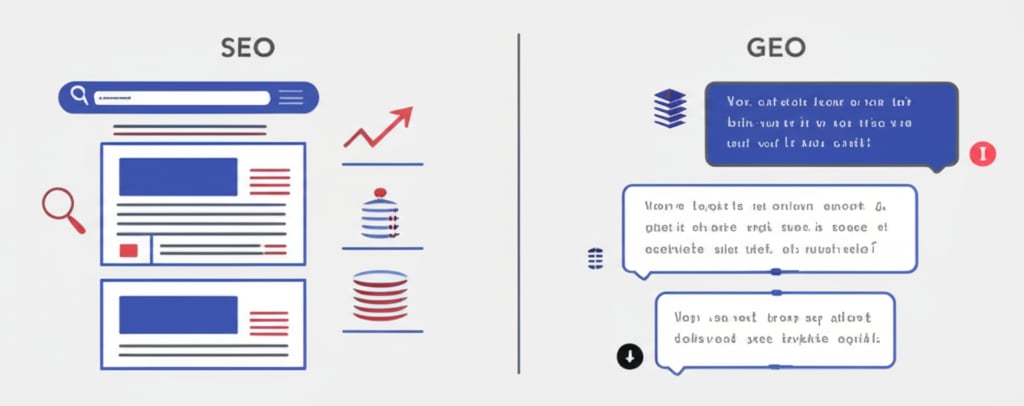
Acknowledging these distinctions is the first step toward building a dominant digital strategy. SEO is a mature discipline focused on a well-understood ecosystem of algorithmic search engines like Google and Bing. Here, success is quantitatively defined by achieving high rankings for target keywords, which in turn drives user clicks and organic traffic to a website. The optimization process involves on-page content relevance, technical site architecture, user experience signals, and off-page authority indicators such as backlinks.
In contrast, GEO is an emergent field targeting generative AI platforms, including conversational interfaces like ChatGPT and Claude, as well as integrated search features like Google's AI Overviews and Microsoft Copilot. The primary objective is not to win a click but to earn a citation. Success means your brand, data, or perspective is explicitly mentioned or used as a foundational source within a synthesized, conversational answer.
This requires a shift in optimization focus. Where SEO hones in on keywords and link equity, GEO prioritizes entities, factual precision, and structured information that LLMs can easily parse and verify. The emphasis moves from satisfying a search algorithm's ranking factors to satisfying an AI's need for credible and unambiguous data. The content must be structured for machine readability as much as for human comprehension.
The operational divergence is clear when deconstructing the core components of each discipline. As highlighted in analyses from industry pioneers, the entire strategic funnel is different. SEO is engineered to win in a competitive, multi-choice environment—the SERP—where the user makes the final selection. GEO is engineered to be selected by the AI before the answer is presented to the user. This dynamic influences traffic patterns; while strong SEO is designed to increase website visits, effective GEO can result in a "successful" zero-click interaction where the brand gains an authority-building citation, but the user receives their answer without leaving the AI interface.
| Aspect | Search Engine Optimization (SEO) | Generative Engine Optimization (GEO) |
|---|---|---|
| Primary Platforms | Google, Bing, DuckDuckGo | ChatGPT, Perplexity, Google AI Overviews, Copilot |
| Desired Outcome | High SERP ranking, website clicks, organic traffic | Citation, mention, or inclusion in an AI-generated answer |
| Content Focus | Keyword optimization, metadata, backlinks, user intent | Factual accuracy, structured data, conversational language, entities |
| Core Mechanics | Algorithmic ranking based on 200+ signals (e.g., E-E-A-T) | Information retrieval from a training corpus, source credibility analysis |
| Success Metrics | Keyword rankings, organic traffic, click-through rate (CTR) | Citation frequency, brand mention rate, answer share |
| User Interaction | User selects from a list of links and navigates to a site | User receives a single, synthesized answer, often without a click |
While both SEO and GEO aim to deliver valuable information, they operate on different platforms with distinct mechanics, content requirements, and success metrics.
The Power of Synergy: How a Strong SEO Foundation Fuels GEO Success
The conversation around AI search has often positioned established strategies against emerging ones. This is not a matter of replacement but an evolution where existing authority becomes the foundation for future visibility.
Generative Engine Optimization (GEO) does not replace Search Engine Optimization; it builds upon it. The core principles that drive authority and rank in traditional search—especially E-E-A-T (Experience, Expertise, Authoritativeness, and Trustworthiness)—are the very signals AI models use to validate and prioritize information. High-ranking, authoritative content is a primary source for training Large Language Models (LLMs), giving established SEO performers an inherent advantage in shaping AI-generated answers.
This foundational relationship is practical, not just theoretical. AI systems are engineered to trust content from high-ranking domains because existing authority signals, like quality backlinks and demonstrated expertise, serve as a proxy for reliability. Your hard-won SEO authority directly informs your potential GEO visibility. This synergy extends to the technical level, where fundamentals like site speed, mobile-friendliness, and clean architecture make your content more accessible for both traditional search crawlers and AI bots like GPTBot.
| SEO Principle | Impact on Traditional Search (SEO) | Impact on Generative Engines (GEO) |
|---|---|---|
| E-E-A-T Signals | Builds trust with Google, leading to higher rankings and topical authority. | Serves as a primary validation signal for LLMs, increasing the likelihood of being cited as a trusted source. |
| Technical SEO | Ensures efficient crawling, indexing, and a positive user experience (Core Web Vitals). | Facilitates access for AI crawlers (e.g., GPTBot), ensuring content is available for model training and answer generation. |
| Content Structure | Uses clear headings (H1, H2, H3) and logical flow to improve readability and rank for featured snippets. | Provides a clear, navigable structure that AI can easily parse to extract direct answers and key concepts. |
| Topical Authority | Demonstrates deep expertise on a subject, enabling ranking for a wide range of related keywords. | Establishes the site as a comprehensive knowledge base, making it a go-to source for AI-generated summaries. |
A robust SEO program is the most effective prerequisite for GEO success. The work invested in building a fast, authoritative, and well-structured site creates the ideal conditions for your content to be discovered, trusted, and referenced by the next generation of search. It is not about abandoning one discipline for another but about leveraging your existing momentum to succeed on a new frontier.
Strong SEO performance is not just correlated with GEO visibility; it is the foundational layer upon which a successful GEO strategy is built.
Actionable GEO Strategies to Amplify Your SEO Efforts
With a powerful SEO foundation in place, the objective shifts from building authority to strategically channeling it. You can amplify your visibility within AI-generated answers by enhancing your content with specific elements that generative models are engineered to prioritize.
This involves enriching your existing, high-performing content with layers of verifiable proof, contextual clarity, and conversational structure. Instead of merely optimizing for keywords, you are now optimizing for direct citation. This requires a deliberate focus on providing explicit signals of credibility—such as direct quotes from experts, verifiable data points, and clear attribution—that an AI can easily parse and present to users as fact.
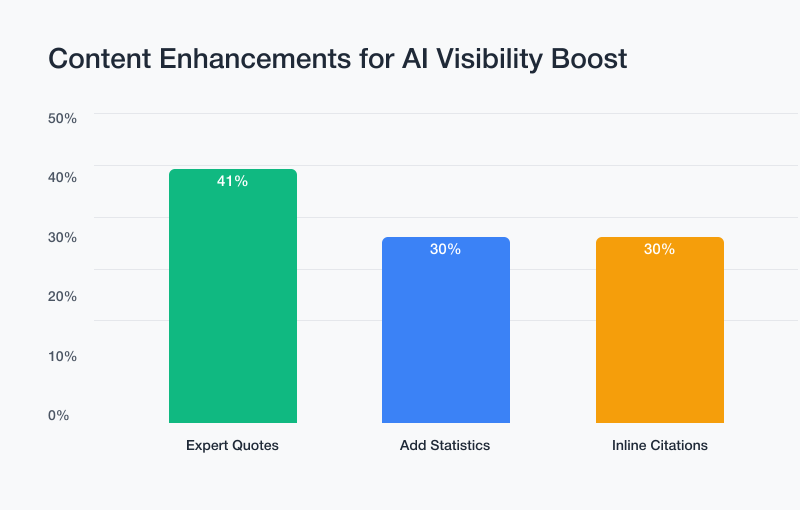
A 2024 Princeton research paper provided evidence for this approach, demonstrating how specific content enhancements can increase visibility in AI results. The study quantified the impact of various edits, showing that signals of authority and clarity deliver significant gains, while outdated tactics like keyword stuffing can have a negative effect. This data provides a clear roadmap for converting SEO assets into powerful GEO performers. By making your content more useful to the machine, you make it more valuable to the end-user.
To translate your SEO authority into GEO dominance, implement these data-informed strategies:
Embed Authoritative Voices and Data: Integrate direct quotes from recognized industry experts and include clear, verifiable statistics. According to the Princeton research, embedding expert quotes can boost visibility by 41%, while adding statistics and inline citations can each yield a 30% increase. This directly injects E-E-A-T signals into your content.
Optimize for Conversational Queries: Structure content with natural language, using question-based headings (e.g., "What is the difference between SEO and GEO?") followed by concise, factual answers. This format mirrors how users interact with AI assistants and makes your content a prime candidate for direct inclusion in answers.
Define and Connect Your Entities: Clearly and consistently define key entities—the people, organizations, products, and concepts central to your brand and industry. Use consistent naming and context to help AI models understand the relationships between these entities, establishing your brand as a central node of authority in your niche.
Leverage Advanced Schema Markup: Go beyond basic schema to provide explicit context for AI engines. Use
FAQPageschema to structure Q&A sections,HowToschema for step-by-step guides, andPersonschema to clearly identify authors and experts cited in your content. This reduces ambiguity and makes your data more machine-readable.Build Comprehensive Topic Clusters: Reinforce your expertise by developing deep, interconnected content hubs around your core topics. By creating a comprehensive resource that logically links pillar pages to detailed cluster content, you build a knowledge graph that AI can easily navigate, reference, and synthesize, positioning your domain as the definitive source. Tools like OutblogAI can help streamline this process.
By strategically enhancing content with elements that AI models value—such as direct answers, statistics, and expert validation—you can convert your SEO authority into GEO visibility.
Measuring What Matters: Redefining Success in the AI Search Era
As user journeys evolve beyond the traditional click, our measurement frameworks must also transform. Relying solely on website traffic to gauge success in an AI-driven search landscape provides an incomplete picture of your market impact.
The new era demands a dual-funnel approach to measurement, one that honors traditional SEO metrics while embracing new indicators of GEO influence. While organic traffic, keyword rankings, and conversions remain critical for measuring direct-response success, they fail to capture the brand value generated by citations within AI answers. These "zero-click" interactions, where a user's query is answered without a visit to your site, are important touchpoints for building authority and brand recall.
The challenge lies in attribution. As noted by industry analysts, a user might discover your brand through an AI citation, internalize your expertise, and later convert through a direct visit or branded search. This indirect path to conversion is difficult to track with conventional analytics alone, necessitating a broader view of performance that accounts for both on-site actions and off-site influence. To gain a complete picture, you must monitor not only who is visiting your site but also how and where your brand is being mentioned across the digital ecosystem.
Note: The primary challenge for marketers is shifting from a purely traffic-based attribution model to a more holistic one that measures influence. Success now includes being the trusted source in a conversation, even when that conversation doesn't immediately lead to a click.
To build a comprehensive measurement strategy, integrate these traditional and emerging metrics:
Core SEO Metrics (The Traffic Funnel): Continue to track these foundational KPIs to measure direct impact.
- Organic Traffic & Sessions
- Keyword Rankings & SERP Feature Ownership
- Click-Through Rate (CTR)
- Conversion Rate & Goal Completions
- Backlink Profile Growth
Emerging GEO Metrics (The Authority Funnel): Add these KPIs to measure your influence within AI ecosystems.
- AI Mention Rate: The frequency your brand, products, or experts are cited in AI-generated answers for relevant queries.
- Citation Share of Voice: Your percentage of mentions compared to competitors for a target set of topics.
- Citation Accuracy & Sentiment: The correctness and tone of information presented about your brand in AI results.
- AI Crawler Activity: Analysis of server logs to monitor the frequency and depth of visits from bots like GPTBot and ClaudeBot, indicating your content's value to AI models.
This modernized approach requires a combination of traditional analytics platforms, brand monitoring tools, and log file analysis. By tracking both streams of metrics, you can accurately assess the total ROI of your integrated SEO and GEO strategy, proving value through both direct traffic and growing brand authority.
Success in the new search landscape requires a dual-metric approach, tracking not only the traffic SEO brings to your site but also the authority GEO builds for your brand within AI platforms.
The new search landscape demands a strategic evolution, moving beyond the outdated dichotomy of SEO versus GEO. This guide has underscored a fundamental truth: these are not competing forces but integral components of a comprehensive digital visibility strategy. The convergence of traditional blue links and dynamic AI-generated answers necessitates an integrated approach to secure a durable online presence and authority.
A strong SEO framework, rooted in E-E-A-T, is the foundation for GEO success. By crafting content that ranks in traditional SERPs while also providing structured, verifiable information for generative AI, businesses can optimize for both human and machine-driven user journeys. The future of search is integrated, and the brands that succeed will be those that strategically combine established SEO principles with forward-thinking GEO tactics.
An integrated strategy that leverages SEO's foundational authority to fuel GEO's influence is no longer optional—it is essential for durable visibility in the modern search ecosystem.