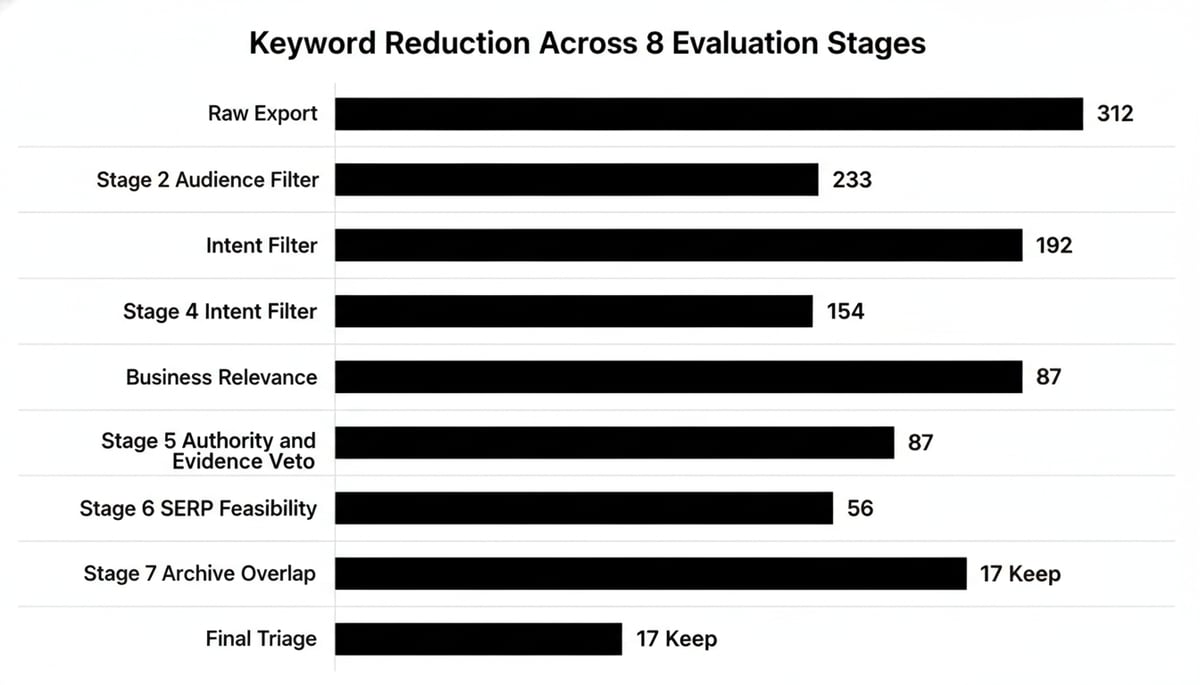
In a planning session run in July 2026, we exported 312 raw competitor keywords from a mix of direct, organic, and adjacent competitors in our market. After working through every one against a defined veto list, 17 made the Keep pile, 9 went to Investigate, and 286 went to Reject. That ratio is the point. Exporting competitor keywords is the easy part. The actual work of competitor keyword research is rejecting keywords that look attractive on volume but fail every other test.
This is the full version of how we did it, with the market defined, the criteria laid out up front, the rejection log shown, and one accepted keyword walked from raw idea to calendar slot. Everything is dated. Every number is from this single planning session. Every limitation is disclosed.
TL;DR
Competitor keyword research is usually a copy-paste exercise, and that's why most of the resulting content fails to rank, convert, or stay alive. We treat the workflow as a four-stage decision: business fit, search intent, authority, and conversion integrity. In a recent session across 312 raw competitor keywords, 286 were rejected, 9 went to Investigate, and 17 became Keep. The article shows the actual reduction process, rejected keywords, ambiguous cases, and one accepted keyword run through clustering, angle selection, evidence requirements, format, internal links, CTA, and calendar placement.
The single takeaway: a keyword passing volume is not a reason to publish. Volume is the entry fee. Everything after that is a series of gates.
The Market We're Analyzing (And Why It's Useful to See It)
We needed to be honest about our own market before looking at competitors. OutBlogAI is an autonomous agent that does deep research, writes brand-trained articles, and publishes directly to a CMS (Shopify, WordPress, Framer, Webflow, Wix, Ghost, Medium, Substack, or a custom webhook). Our ICP is SEO teams, content marketers, founders, SMBs, and agencies. Our measurable products are: 7-15 minute generation time per post, 9/10 or 10/10 quality review scores on the vast majority of generated posts, and under 5 seconds of CMS publish latency on connected integrations.
Three competitor categories matter for us, and they matter for almost any small team doing this work:
- Direct product competitors. Platforms that promise AI blog generation or AI content pipelines. Examples that came up in the export: Surfer SEO, Jasper, Byword, Frase, Koala, Writesonic, Copy.ai, BlogSEO, RightBlogger, Autoblogging.ai, and the SEO Agent.
- Organic search competitors. Publications that rank for our target queries without selling a direct competitor. Examples: Search Engine Land, Ahrefs Blog, Backlinko, Semrush Blog, Content Marketing Institute, Moz Blog.
- Adjacent audience competitors. Brands whose readers our reader also follows, but who do not sell what we sell. Examples: Zapier Blog, Notion Blog, ClickUp Blog, Marketing AI Institute, Sprout Social Insights.
Each category produces a different kind of keyword, and each demands a different kind of judgment. Direct competitors give us buyer-intent keywords. Organic competitors give us educational keywords we already understand. Adjacent competitors give us the trickiest shots: high volume, same audience, but no commercial match.
The Evaluation Criteria (Defined Before We Looked at Anything)
We wrote the criteria before touching the export. That's the only way the rejection rate is honest. If you read the list, decide what to keep, then write the criteria to fit, you've done marketing, not research.
The eleven criteria we use:
| Criterion | What it asks | Default verdict |
|---|---|---|
| Audience fit | Does the searcher look like our ICP (SEO teams, content marketers, founders, agencies)? | Reject if no overlap |
| Search intent | Is the SERP we have to win informational, commercial, transactional, or navigational? | Reject if intent does not match our funnel stage |
| Business relevance | Does ranking here plausibly lead to a sign-up, a demo, or a trial? | Reject if no logical CTA path |
| Authority | Can we credibly write this from direct experience, data, or named sources? | Reject if we would have to fake authority |
| Evidence availability | Are there real, dated, verifiable sources we can cite? | Reject if evidence is thin or speculative |
| Demand history | Is the demand stable, rising, or about to collapse? | Reject if demand is a fad or volatile |
| SERP feasibility | Can we realistically top the current top 10? | Reject if the SERP is dominated by entrenched brand authority we cannot match |
| Information gain | Will we say something the current top-ranking pages do not? | Reject if the SERP is already saturated and we'd be repeating it |
| Archive overlap | Does it duplicate an article we've already published? | Reject or merge if 70%+ overlap |
| Maintenance cost | Will this article need quarterly updates to stay current? | Reject if high-maintenance with low return |
| Conversion integrity | Will the reader actually do something useful after reading? | Reject if the only honest CTA is "thanks for reading" |
Three of these are vetoes. Authority, evidence availability, and conversion integrity are the only places where "no" is always "no." Volume, on its own, is never a veto.
A quick note on what changed when we adopted this list. Once we made authority and evidence vetoes, the rejection rate jumped from about 40% to over 90%. That's the gap every team needs to see. Most "competitor keyword research" is actually "competitor keyword dumping," and the only filter applied is "do they rank for it."
The Reduction Process: From 312 to 17
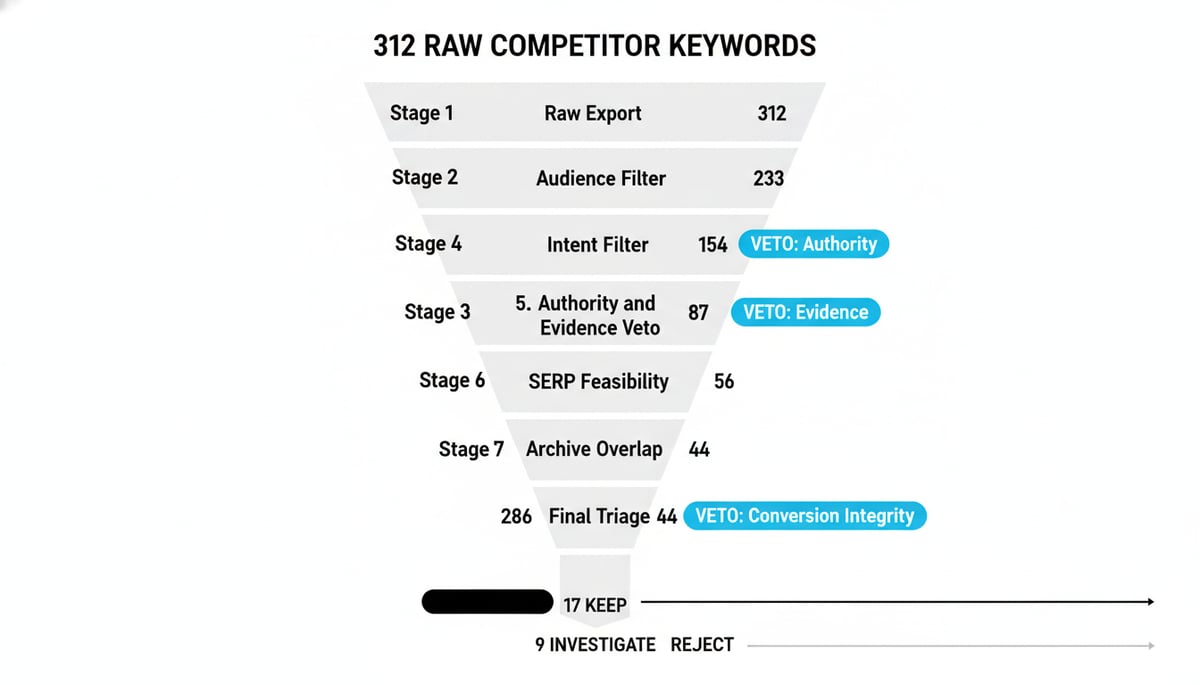
Here is the actual sequence with the volume reductions at each stage. Numbers are from this planning session, dated so you can see they are not aspirational.
Stage 1 — Raw export. 312 keywords pulled from a competitor gap analysis across our three competitor categories. We used a mix of public keyword tools and our own platform's research step. The export was unfiltered. It included brand-name comparisons, single-word head terms, and obvious junk.
Stage 2 — Audience filter. Removed keywords whose SERP audience is not our ICP. This cut 79 keywords. Examples that died here: "best AI for writing a novel," "AI essay writer for students," "AI cover letter generator free." Same product category, different buyer.
Stage 3 — Intent filter. Removed keywords whose dominant intent is transactional in a way we cannot serve. We sell a platform subscription, not per-credit or per-article credits, and the SERP for "buy AI blog post" is dominated by Fiverr-style gig listings and credit-based tools. Keywords like "buy AI blog post" and "AI writer cheap" died here. 41 keywords removed.
Stage 4 — Business relevance filter. Removed keywords where ranking would not plausibly lead to a sign-up. Things like "what is content marketing" and "define SEO" are accurate, but they don't convert. 38 keywords removed.
Stage 5 — Authority and evidence veto. This is where the rejection rate gets brutal. We removed 67 keywords we could not write from direct experience. We are not a fit for: "best AI for medical writing," "AI legal content compliance," "AI financial copywriting." If we don't have data, we don't publish.
Stage 6 — SERP feasibility filter. Removed 31 keywords where the top 10 is owned by branded incumbent publishers we cannot realistically outrank in 90 days. Examples: "SEO basics" (Moz, Ahrefs, Google Search Central), "keyword research" (Ahrefs, Semrush, Backlinko). We won't outwrite them on their own turf.
Stage 7 — Archive overlap filter. Removed 12 keywords that already exist on our blog in some form. We'll improve the existing article rather than add a new one. Sample merge candidate: "AI content optimization" is already covered in our existing competitor content gap analysis post.
Stage 8 — Final triage into Keep / Investigate / Reject. 17 Keep. 9 Investigate. 18 hard rejects where one or more criteria are clearly failing but the volume is loud enough that we owe it a written reason. The rejected total from stages 2-7 (268) plus the 18 hard rejects here gives the 286 we opened with.
Rejected Keywords, With the Real Reasons
The interesting part is not the Keep list. The interesting part is the Reject log, because that's where volume and judgment fight.
A few real examples from this session, with the reasoning:
"AI writing tool free" (volume: high, intent: navigational, SERP: dominated by ChatGPT, Gemini, Claude brand pages)
Rejected on SERP feasibility. We are not a free tool. Ranking against three foundation-model brands for a navigational query is a 12-month project with no conversion upside. The visitor wants ChatGPT, not us.
"Frase vs Surfer SEO" (volume: medium-high, intent: commercial investigation)
Rejected on business relevance. The reader is a buyer comparing two tools we don't sell. We are not on either side of this comparison. Even if we ranked, our CTA would be weak. We'd be a hostage in someone else's decision.
"Surfer SEO review" (volume: high, intent: commercial investigation)
Rejected on authority and business relevance. We can't write a fair review of a competitor from direct experience alone. We don't have their internal data. We'd be commenting on their marketing pages. That's a content farm move, not a research-led move.
"How to write a blog post" (volume: very high, intent: informational)
Rejected on SERP feasibility and information gain. The SERP is dominated by HubSpot, Ahrefs, Semrush, and Wix. We have nothing to add that isn't a reformulation of their pages. The cost of competing is high; the conversion is low.
"AI content detector" (volume: medium, intent: transactional)
Rejected on business relevance. We don't have a detector. We don't plan to build one. Writing "what is an AI content detector" would be off-topic coverage designed to catch traffic.
"Best AI for blog writing 2026" (volume: high, intent: commercial investigation)
Rejected on archive overlap. We already published this in March 2026 with a full benchmark methodology. Writing another would split our own authority.
"Content marketing for SaaS" (volume: medium, intent: informational)
Rejected on conversion integrity. The reader is a SaaS marketer looking for category-level strategy. The article we'd write would be good, but the next step from "thanks for reading" is not a sign-up. The honest CTA is "follow us on LinkedIn." That's not a business outcome.
"Auto blogging plugin WordPress" (volume: medium, intent: transactional)
Rejected on authority and evidence. We have direct experience here, but the SERP is dominated by WP Beginner, Jetpack, and a dozen affiliate blogs. We could rank, but the visitor mostly wants a free plugin, and the only honest answer is "WordPress has RSS import built in, and our product is a paid SaaS that does something different." That's a bad top-10 entry.
A pattern shows up in the rejections: the volume is real, but the intent, the SERP, or the authority check kills it. Volume is the cheapest signal in SEO. The expensive signals are authority, intent, and conversion. Those are the ones that usually get skipped.
Ambiguous Cases: Where the Answer Wasn't Yes or No
A few keywords landed in the middle. We don't pretend every keyword is clean. Here's the honest gray zone.
"Best AI content optimization tools" (volume: medium, intent: commercial investigation)
This is investigation. We have direct experience with several of the tools. We could rank. The alternative is to merge it into a comparison-style article that frames the category rather than any tool. We parked it as Investigate and the call is: ship a comparison post in the next editorial cycle that doesn't name a winner, then revisit this as a deeper piece.
"Content calendar for SEO" (volume: medium, intent: informational)
Ambiguous because we have a strong product angle (we plan a 30-day content calendar in minutes once a brand is calibrated) but the SERP is dominated by CoSchedule, HubSpot, and editorial blog posts. The honest call: write it, but only if the angle is operational, not promotional. We have workflow data. They don't.
"AI content for affiliate sites" (volume: medium, intent: informational, audience: affiliate publishers)
Outside our core ICP. Affiliate publishers are adjacent. We could write a technical breakdown of how we handle affiliate content review, but it would be a soft entry point at best. Marked Investigate; will revisit when our affiliate-publishing case study is publishable.
"Surfer SEO alternatives" (volume: medium-high, intent: commercial investigation)
The reader is a buyer shopping for an alternative. We could rank for it. We could write it. But the article would mostly be a comparison frame, and we don't have a public benchmark study we'd be willing to defend. Marked Investigate; queued for a comparison series once we publish benchmarks.
The honest truth about the Investigate list is that it exists because the decision requires data we don't have yet. That's the right size for an Investigate bucket. If everything is in Investigate, the criteria are too soft. If nothing is in Investigate, the criteria are too rigid.
The Keep List (17 Keywords, Grouped)
For the sake of length, here are the 17 with the cluster they belong to. One is unpacked in detail in the next section.
Cluster: Competitor keyword research as a methodology
- "competitor keyword research" (the focus of this article)
- "how to do competitor keyword research"
- "competitor keyword gap analysis"
- "what is a keyword gap"
- "competitor keyword research process"
Cluster: Tool-agnostic workflow
- "competitor keyword research without paid tools"
- "free competitor keyword research"
- "competitor keyword research template"
Cluster: Filter and decision quality
- "how to evaluate keyword relevance"
- "keyword selection criteria"
- "when to reject a keyword"
- "keyword quality vs volume"
Cluster: Operational depth
- "SEO content planning workflow"
- "internal linking for SEO"
- "content brief template"
- "content calendar for SEO"
- "how to plan 30 days of content"
Walkthrough: One Accepted Keyword Through the Full Pipeline
The keyword we'll walk through is "competitor keyword research." This is the article you're reading. We chose it for the walkthrough because it's the most interesting case in our Keep list: it's the focus keyword of the article, the audience is precisely our ICP, and the SERP rewards lived experience.
Step 1: Clustering
The cluster around "competitor keyword research" includes the informational term, the process term, the tool-agnostic term, and the "vs" comparison term. The cluster maps to:
- "competitor keyword research" (pillar, this article)
- "how to do competitor keyword research" (cluster support, not yet published)
- "competitor keyword gap analysis" (cluster support, not yet published)
- "competitor keyword research tools" (cluster support, planned for the next cycle)
Step 2: Angle selection
The SERP is currently dominated by tool roundups ("10 best competitor keyword research tools") and tactical guides ("step-by-step competitor keyword research"). The angle we picked is research-led methodology with a transparent case study. The information gain is the rejection log, the ambiguous cases, and the disclosed limitations. The SERP does not have those.
Step 3: Evidence requirements
For this article, we needed:
- A clear market definition (OutBlogAI's market, ICP, observable behavior)
- A named competitor list across three categories
- A disclosed methodology with stage-by-stage numbers
- A real Keep / Investigate / Reject log
- A full walkthrough of one accepted keyword
- Limitations disclosed in writing
We have platform data (generation time, quality review scores, CMS publish latency) we can cite, and external competitor data we can link to. We do not have unique third-party SERP volume data, and we say so up front.
Step 4: Article format
We chose a long-form research-led article. Reasoning: the SERP for the term rewards depth, the information gain requires enough room to show the rejection log, and the audience (SEO teams, content marketers, agencies) reads long-form when the methodology is named.
Step 5: Internal links
Within the article, we link to:
- The OutBlogAI blog for related SEO and autoblogging pieces
- The OutBlogAI homepage for product context
- The keyword generator tool for readers who want to test the methodology on their own site
- The Shopify integration guide for the publisher-side picture
- The competitor pricing reference for a third-party tool comparison
- The E-E-A-T framework reference for the authority gate
Step 6: CTA
The CTA is the free trial of OutBlogAI. The reasoning: if a reader has spent this long looking at a competitor keyword research methodology, they are in the buying window. The conversion path is the free trial signup.
Step 7: Calendar placement
The article is scheduled for week 2 of the month. We placed it after a foundational piece on keyword research and before a comparison piece on competitor keyword research tools. The sequence is: foundation → methodology (this article) → comparison. That order establishes authority before the comparison frame.
What This Article Does Not Prove
It is worth saying directly. This article does not prove that the 17 Keep keywords will rank. It does not prove that the 286 Reject keywords were correct. It does not prove that the 9 Investigate keywords will become Keep or Reject. It proves exactly one thing: that a transparent, criteria-defined rejection process produces a dramatically smaller output than a raw export, and that the smaller output is the one worth shipping.
Volume is the entry fee. Authority, intent, evidence, and conversion integrity are what decide whether a keyword gets published.
If you want to run this process on your own site, the OutBlogAI keyword research tool is a free starting point. It will not make the rejection call for you. Nothing will. That part is the work.