The ChatGPT 52% Referral Crash: A Wake-Up Call for Channel Diversification
A sudden 52% drop in ChatGPT referral traffic reveals a critical vulnerability for brands. This analysis explores why relying on a single AI or organic channel is a high-risk strategy and outlines how to build a resilient, diversified digital presence for long-term growth.

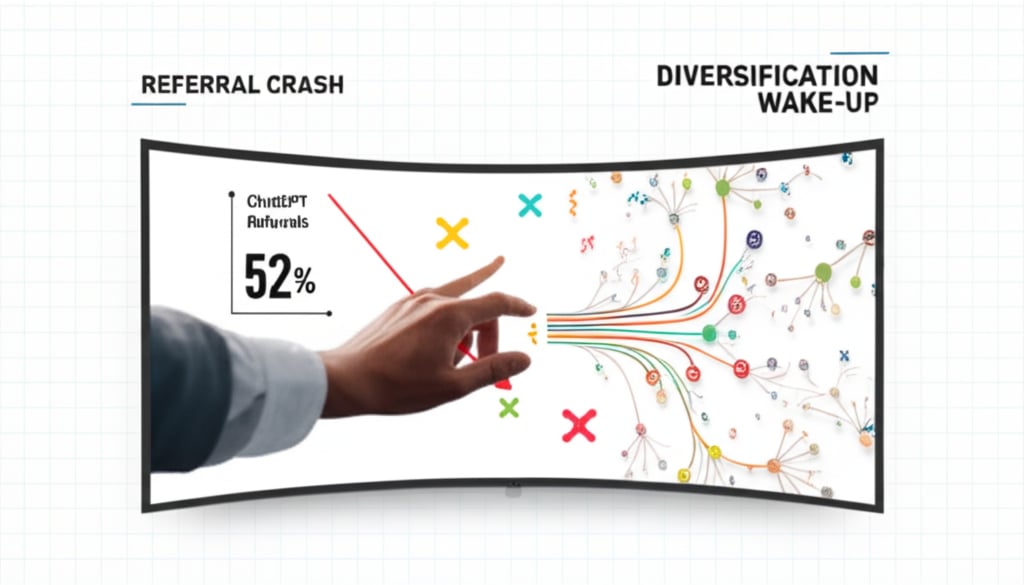
A significant development has emerged within the digital marketing ecosystem: a 52% drop in referral traffic from AI platform ChatGPT since late July. This decline, which has impacted brands that came to rely on the AI platform as a new traffic source, exposes a vulnerability that warrants strategic attention. For many founders and marketing teams, ChatGPT was seen as a new frontier for lead generation and brand visibility—a high-potential referral source that promised scale. Its sudden volatility, however, serves as a critical reminder of the inherent risks of consolidating a digital strategy around any single, third-party platform. This incident illustrates that even the most dominant emerging channels are subject to rapid, unpredictable shifts.

This incident demonstrates that over-reliance on any single, third-party AI or organic channel is a high-risk strategy. True digital resilience now requires robust channel diversification to ensure sustained performance.
In this analysis, we will dissect the factors that led to this traffic crash, including AI company OpenAI's strategic pivot towards "answer-first" content. We will examine the broader implications of relying on volatile AI referral sources and illustrate why a resilient digital presence necessitates a multi-faceted approach. This context provides the critical steps required to build a diversified, defensible, and high-growth digital strategy that supports long-term market authority, a strategy that platforms like Outblog are designed to support.
TL;DR
The recent decline in ChatGPT referral traffic serves as a critical reminder that channel diversification is essential for sustainable digital growth. Businesses that heavily relied on this emerging AI channel experienced a significant downturn, underscoring the risks of external platform dependence. This shift was not accidental but a strategic repositioning by OpenAI.
OpenAI intentionally pivoted to an "answer-first" content strategy, prioritizing authoritative sources like Reddit and Wikipedia over brand-specific pages. This change caused a 52% drop in ChatGPT referral traffic since late July, impacting numerous digital properties. Research firm Profound Research (2025) highlighted that while ChatGPT referrals plummeted, citations from Community Reddit surged by 87% and Wikipedia by 62%, with these top three domains now commanding 22% of all ChatGPT citations.
Note: Over-reliance on any single, third-party traffic source, especially one controlled by an evolving AI platform, introduces unacceptable business risk and limits strategic control.
A resilient marketing strategy necessitates broad diversification across owned and external channels, including traditional SEO, dedicated AI Engine Optimization (AEO), community platforms, and direct traffic streams.
The Calm Before the Crash: When a Top Traffic Channel Falters
For months, AI platforms like ChatGPT emerged as a powerful and expanding source of referral traffic. Early adopters witnessed significant and seemingly stable growth, with some retailers reporting AI becoming a top-tier referral channel. This period fostered a sense of security, encouraging increased investment in AI-centric content strategies.
However, this perceived stability proved to be a critical vulnerability. The sudden 52% crash shattered these expectations, exposing the risks of constructing a growth strategy on platforms outside of direct ownership or control. This event serves as an important case study, reaffirming the strategic importance of a diversified and resilient marketing framework.
Prior to the drop, ChatGPT's influence was significant. Analytics Similarweb (2025) data revealed that referral traffic from ChatGPT to news and media websites had nearly doubled in just four months, soaring from 123.2 million visits in January to 243.8 million in April. Media Digiday (2025) further illustrated this impact, noting that for major retailers like Retailer Walmart, ChatGPT grew to account for a substantial 20% of all referral traffic, demonstrating its rapid ascent as a key channel.
| Strategy Component | Impact of Single AI Channel Reliance | Mitigating Diversified Strategy |
|---|---|---|
| Traffic Volatility | Extreme vulnerability to platform shifts | Reduced risk from individual channel changes |
| Control & Ownership | Zero control over algorithm updates | Enhanced control over multiple owned/earned channels |
| Growth Potential | Capped by platform's strategic direction | Unlocked via broader market reach & innovation |
| Business Resilience | High risk of sudden revenue drops | Stable, sustainable growth despite external shifts |
Over-dependence on any single traffic source, particularly a third-party AI referral channel, creates a critical vulnerability for modern businesses seeking sustainable growth.
Anatomy of the Crash: A Data-Driven Look at the 52% Drop
In the third quarter of 2024, a significant channel for digital traffic experienced an abrupt contraction. This was not a gradual market correction but a swift, platform-driven event that reset expectations for a source of organic growth.
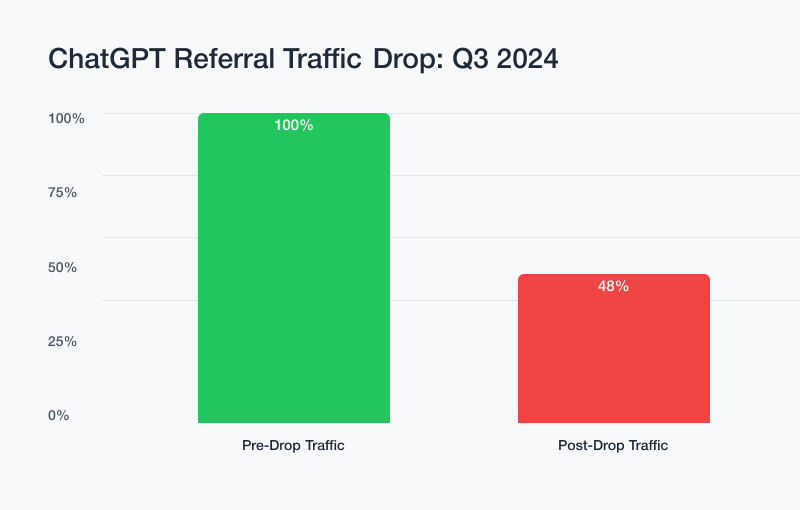
The core event was a 52% decline in referral traffic originating from ChatGPT, which began on July 21st and unfolded over just a few weeks. This drop was a direct consequence of a deliberate change in how the AI model processes and presents information, specifically de-prioritizing external citations in its responses. This decision by a single platform instantly devalued the optimization efforts of brands that were leveraging AI referral traffic. The incident highlights a key vulnerability: when a traffic source operates as a closed ecosystem, its strategic shifts can impact downstream value without warning.
This decline is substantiated by extensive data analysis. A comprehensive study by Research firm Profound Research (2024), which analyzed over one billion ChatGPT citations and one million referral visits, pinpointed the start and scale of the drop. Reporting from industry authorities like SEO Search Engine Land (2024) confirmed the impact, framing it as a cautionary tale for marketers dependent on AI-driven platforms. The data shows this was not a broad market trend but an isolated, algorithmic change within a single, dominant environment.
Note: A 52% decline in referral traffic from a major source, occurring in under a month, is not a market fluctuation. It is an algorithmic intervention that highlights the fragility of AI-dependent traffic strategies and the influence platforms have over publishers.
The data reveals a deliberate de-prioritization of external websites, proving that referral traffic from generative AI is subject to platform-driven volatility. For businesses that had started to build strategies around this emerging channel, the crash served as a powerful reminder of the risks associated with channel over-reliance. It demonstrates that what a platform provides, it can also retract to serve its own strategic interests, such as keeping users within its ecosystem. This event serves as a definitive case study on the inherent volatility of relying on a single, opaque AI platform for organic growth.
The 'Why' Behind the Drop: OpenAI's Pivot to 'Answer-First' Content
The downturn in ChatGPT referral traffic was not a technical glitch but a calculated strategic adjustment. OpenAI is recalibrating the algorithm that determines which online sources it trusts and cites.

This referral crash is the direct result of a strategic choice to favor high-utility, informational content over commercial marketing pages. An analysis by Marketing Optiweb Marketing reveals an experiment in citation weighting, designed to prioritize sources that provide direct, comprehensive answers to user queries. The model is now engineered to reward content for its informational utility rather than its ability to guide a user toward a conversion.
The data confirms this pivot. During the observation period, citations from community-driven and encyclopedic sources surged, with Community Reddit citations increasing by 87% and Wikipedia by 62%. According to Profound Research (2025), a trio of informational sources—Wikipedia, Reddit, and Tech news TechRadar—now accounts for 22% of all ChatGPT citations, a 53% growth in their collective share in just one month. This shift demonstrates a clear preference for content that educates over content that sells.
| Attribute | Answer-First Content (Favored) | Conversion-First Content (De-prioritized) |
|---|---|---|
| Primary Goal | To comprehensively inform and educate the user. | To capture a lead or drive a commercial action. |
| Key Characteristics | In-depth explanations, data, community discussion, tutorials. | Gated content, prominent CTAs, product-centric language. |
| Example CTA | "Learn more in our detailed guide" or no CTA. | "Schedule a Demo" or "Buy Now." |
| Citation Performance | Significantly increasing in frequency and authority. | Experiencing a sharp and sustained decline. |
This recalibration effectively penalizes pages where the primary purpose is conversion. Branded content built around a "Schedule a Demo" or "Start Your Free Trial" call-to-action is being systematically deprioritized because it serves the business's funnel before it fully serves the user's query. The model now seeks to resolve the user's need directly within the answer, sourcing from pages that function as self-contained resources.
Adapting to this new paradigm requires a strategic shift from creating conversion funnels to building comprehensive knowledge hubs.
A Volatile Frontier: The Boom-and-Bust Cycle of AI Referrals
The rise of generative AI as a traffic source created a period of rapid growth. This new frontier promised exponential gains, but it operates on a foundation of inherent volatility.

The recent referral crash is not an isolated incident but a characteristic of the cycle inherent to AI discovery. These channels, while capable of driving massive volume, are centralized and subject to abrupt algorithmic or policy shifts. This creates an environment where a single platform decision can either amplify a brand’s reach or significantly reduce its traffic.
The growth phase of this cycle has been significant. Between January and April, media sites experienced a 98% surge in visits from ChatGPT alone, a testament to its power as a discovery engine, according to a report from Media Digiday (2025). This growth underscores the immense potential—and the subsequent risk—of this emerging channel.
| Player | AI Crawler Policy | Referral Traffic Impact |
|---|---|---|
| Walmart | Permissive | 20% of referrals from ChatGPT |
| Amazon | Restrictive (Blocks Bot GPTBot) | 18% decrease in ChatGPT referrals |
While the quality of AI-referred traffic often rivals or exceeds traditional channels in engagement, the ecosystem's instability is its defining trait. Relying on a single, centralized AI platform for organic growth introduces a significant and unpredictable business risk. This volatility demands a more resilient, multi-channel acquisition strategy.
Beyond ChatGPT: The Danger of Relying on Any Single Channel
The recent volatility in ChatGPT referrals follows a recurring pattern in digital marketing. For veteran strategists, this disruption is familiar—it is the latest example of platform dependency and the risks of building on borrowed land.
The core principle is simple: building a growth engine on a single, third-party channel is a fundamentally unstable strategy. The history of digital marketing includes many examples of businesses impacted by a failure to diversify. This occurred with Google's Algorithm Google Panda and Algorithm Google Penguin updates, which disrupted companies built on now-prohibited SEO tactics. It happened again as Social media Facebook’s organic reach for business pages declined, forcing brands to pay for access to their own audience.
This cycle of disruption is accelerating as the digital landscape fragments. The nature of search is changing, moving beyond traditional link-based results. According to analysis from SEO Search Engine Land (2024), the rise of AI-native search and an increase in zero-click SERPs are creating new, siloed pathways for discovery. Users who once started their journey on Google might now begin with a conversational query in an AI model, bypassing traditional websites entirely. This fragmentation validates the need for a multi-channel presence.
Each of these shifts followed the same script: a third-party platform altered its algorithm or business model to better serve its own objectives, and businesses dependent on the old system were left to adapt. This creates a single point of failure that can affect lead generation and revenue without warning. The table below illustrates this recurring pattern.
| Channel Disruption | The Dependent Strategy | The Abrupt Shift & Consequence |
|---|---|---|
| Algorithm Google Panda/Algorithm Google Penguin | Over-reliance on thin content, exact-match domains, and aggressive link schemes for SEO authority. | Algorithm updates penalized these tactics, causing catastrophic drops in organic traffic and revenue for non-compliant sites. |
| Social media Facebook Organic Reach | Using a Facebook Business Page as the primary marketing and customer communication hub. | Algorithm changes throttled organic post visibility from ~16% to less than 2%, forcing a "pay-to-play" model. |
| ChatGPT Referrals | Leveraging ChatGPT's user base as a primary source of high-intent referral traffic through citations. | Unannounced changes to the model's behavior or UI caused a sudden, significant drop in referral volume for many publishers. |
This pattern is an intrinsic feature of building on platforms you do not ultimately control. Digital resilience is achieved not by mastering one channel, but by architecting a balanced and defensible portfolio of traffic sources. This includes owned channels like email and direct traffic, alongside a diversified mix of third-party platforms. Your brand's long-term viability depends on diversifying acquisition channels to mitigate the risk of any single platform's inevitable evolution.
How to Adapt: Building a Resilient, Multi-Channel Strategy
The volatility in AI-driven referral traffic is the new strategic reality. Relying on a single channel for organic growth is no longer a calculated risk—it is a significant liability.
To navigate this landscape, businesses must pivot from channel dependency to strategic resilience. This requires a hybrid approach: optimizing content for machine intelligence while aggressively diversifying across owned, earned, and paid channels. The goal is to build a growth engine insulated from the shocks of any single platform's algorithmic shifts. This pivot is already underway, as top marketing teams reallocate resources. A recent Marketing HubSpot report highlighted that a significant majority of marketers plan to increase their investment in channels they directly control, such as their website and email lists (HubSpot via Finance Yahoo Finance, 2024).
The first pillar of this strategy is a sophisticated approach to content that serves both AI crawlers and human users. This is the essence of AI Engine Optimization (AEO). It moves beyond traditional keyword density to focus on creating comprehensive, topically deep content that directly answers user intent. AI models rely on vector embeddings to grasp conceptual relationships, meaning they reward content that provides exhaustive coverage of a subject.
To optimize for machine readability, structure your content into logical "chunks" where each section can stand alone as a complete thought. Use clear headings, structured data, and semantic language. However, AEO is an extension of, not a replacement for, foundational SEO. Technical health, a robust backlink profile, and a seamless user experience remain indispensable for discoverability by all crawlers, including [Bot GPTBot](https://medium.com/@jorgecabaco/gptbot-explained-how-openais-web-crawler-works-and-why-it-matters-1cf9b43bdded).
The second pillar is to reduce reliance on third-party platforms by building channels you own and control. Your email newsletter and direct website traffic are your most defensible assets. Cultivating these channels creates a direct line to your audience, insulating your business from the whims of search and social algorithms. This is about building a loyal audience that seeks out your brand directly.
Simultaneously, you must build authority on the platforms that are becoming source material for Large Language Models. Communities like Community Reddit are increasingly mined for training data. Establishing your brand as a credible voice in relevant subreddits is no longer just a community management tactic; it is a strategic imperative for influencing future AI-generated answers.
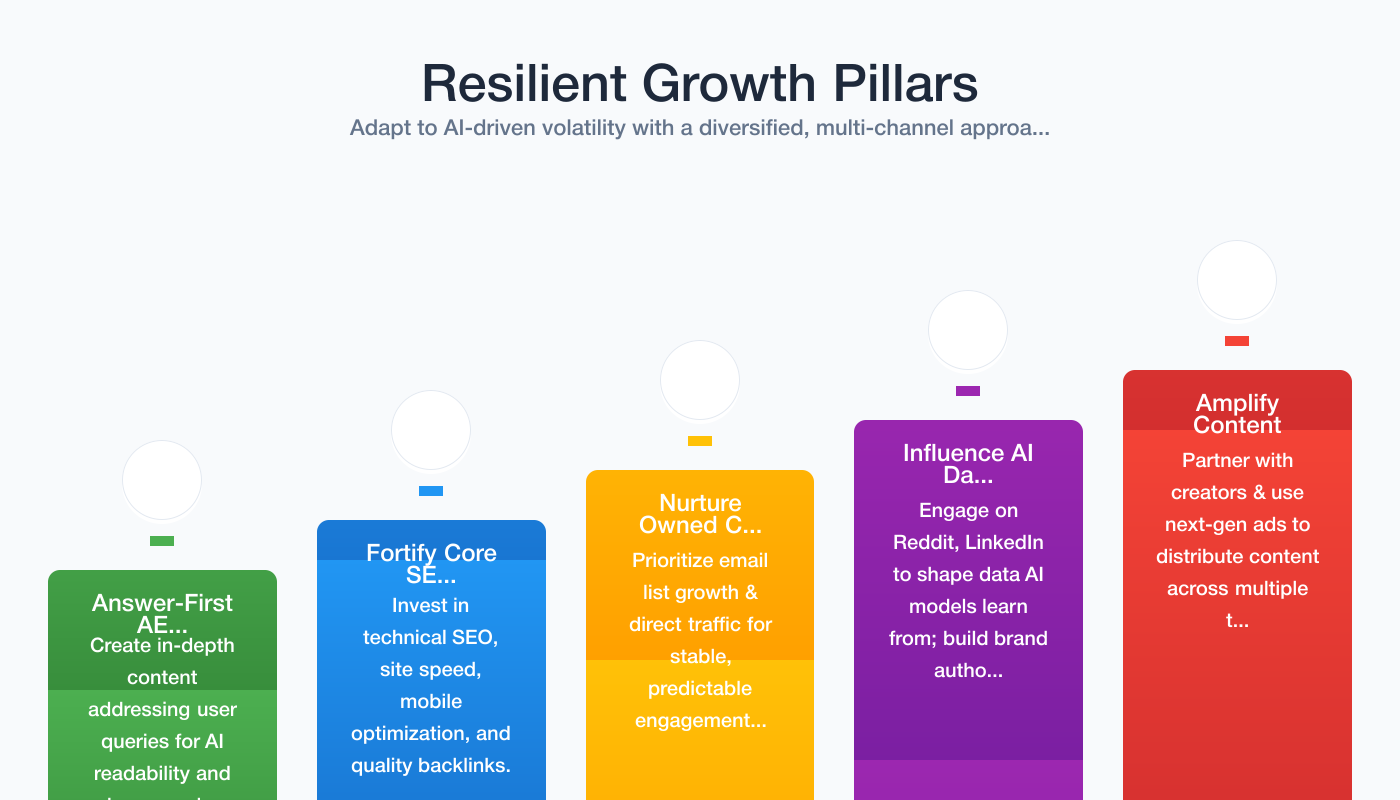
A resilient digital strategy can be implemented through these core actions:
- Develop an "Answer-First" Content Engine: Create in-depth articles, guides, and FAQs that comprehensively address user queries, structured with clear headings and schema markup for machine readability.
- Fortify Foundational SEO: Continue to invest in technical SEO, site speed, mobile optimization, and high-quality backlink acquisition as the bedrock of all online visibility.
- Build and Nurture Owned Audiences: Prioritize email list growth and implement strategies to increase direct, branded search traffic, creating a stable and predictable source of engagement.
- Establish Authority on Key Third-Party Platforms: Actively participate and share expertise on high-value community platforms like Reddit and professional networks like Professional network LinkedIn, shaping the data that future AI models will learn from.
- Amplify Content Strategically: Move beyond a passive publishing model by partnering with trusted creators and exploring next-generation advertising formats to distribute your content to targeted audiences across multiple touchpoints.
This multi-pronged approach transforms your marketing from a fragile system into a resilient, diversified portfolio. It ensures that your brand not only survives the next algorithmic shift but is positioned to lead in the new landscape of AI-driven discovery. True market leadership in the AI era will be defined not by mastering a single channel, but by architecting a resilient and diversified growth ecosystem.
The recent 52% plunge in ChatGPT referral traffic delivers a clear message: the digital landscape's volatility demands a proactive, diversified strategy. Over-reliance on any single channel, particularly third-party AI platforms whose algorithms are subject to external control, represents a significant and avoidable business risk. This event is not an isolated anomaly but a stark illustration of the imperative for brands to build a truly resilient digital presence.
Here are the key takeaways from this incident:
- Extreme Channel Volatility: The rapid drop in ChatGPT referrals underscores the unpredictable nature of AI-driven traffic, directly influenced by platform shifts like OpenAI's pivot to "answer-first" content.
- High Risk of Single-Channel Dependence: Relying heavily on any one traffic source, especially an external, uncontrollable platform, exposes businesses to severe revenue and growth vulnerabilities.
- Imperative for Diversification: A robust, future-proof marketing strategy mandates the strategic integration of traditional SEO, proactive AI Engine Optimization (AEO), active community engagement, and direct traffic initiatives.
The evolving digital ecosystem rewards adaptability and strategic foresight. This incident is not merely a challenge but a catalyst for re-evaluating and fortifying your digital presence.
To safeguard against future disruptions and ensure continuous growth, brands must audit their traffic sources and implement a comprehensive channel diversification strategy. Begin by strengthening your foundational SEO, exploring tailored AEO strategies for various AI engines, and actively cultivating owned and community channels. Leveraging advanced AI tools, such as the suite offered by Outblog, can streamline the analysis, optimization, and management of these diverse channels, transforming potential vulnerabilities into sustainable strategic advantages.