AI''s Advantage: Optimize Visual & Audio Content for SERPs
Discover how AI is revolutionizing SEO for visual and audio content. Learn practical strategies to optimize images, videos, and podcasts to dominate AI-driven search results and capture more organic traffic in this evolving landscape.


The digital landscape of search engine results pages (SERPs) is undergoing a significant transformation, driven by the escalating intelligence of artificial intelligence. Traditional SEO strategies, once centered almost exclusively on text, now operate in a multimodal reality where images, videos, and audio are increasingly featured directly in search results. This is not merely a visual update; AI-driven algorithms are actively interpreting and presenting these rich media formats as primary answers, often bypassing standard text listings to capture immediate user attention. This shift represents a strategic pivot in how content earns visibility and drives organic traffic. Brands that fail to adapt their optimization efforts to this AI-driven evolution risk ceding ground in an increasingly competitive digital arena.
The path to sustained SERP performance now demands an integrated approach that elevates visual and audio assets to the same strategic importance as textual content. This transformation is not about merely including multimedia; it is about leveraging AI's analytical power to ensure these assets are fully understood, categorized, and prioritized by search algorithms. This article will demonstrate how AI provides a distinct advantage in optimizing these content formats, transforming them into powerful organic traffic drivers and establishing your brand's authority.
This guide will equip marketers and teams with the practical strategies required to navigate this new frontier. Readers will gain clear insights into the evolving SERP landscape, understanding why multimedia content has become so important. We will delve into AI-powered visual optimization techniques, detailing how to achieve SEO success for images and videos, and provide actionable methods for audio SEO by optimizing for voice search and podcasts. Furthermore, this post will outline an essential AI toolkit for multimedia SEO and clarify the critical role of advanced schema in communicating with AI systems about your visual and audio assets.
TL;DR
The search engine results page is no longer a simple list of text links. It has evolved into a dynamic, multimedia-rich environment where visuals and audio are paramount for visibility.
To achieve a strong market position, your SEO strategy must extend beyond keywords to encompass every asset. AI provides the engine to systematically optimize images, videos, and audio, ensuring search crawlers can index and rank this content effectively. This is critical as search becomes increasingly multimodal and visual.
The strategic importance of visual content is underscored by user behavior shifts, with a beebyclarkmeyler.com (2025) analysis noting that many younger users now prefer visual-first platforms for discovery over traditional search engines.
- Automate Metadata: Leverage AI to generate optimized alt text, file names, and captions for all visual assets, improving crawler comprehension.
- Optimize for Voice: Use AI-powered transcription to convert audio into indexable text and structure it in a conversational Q&A format to capture voice search queries.
- Implement Schema: Deploy structured data like
VideoObjectandImageObjectto provide search engines with explicit, machine-readable context about your media. - Integrate Strategy: Treat visual and audio content as core components of your SEO framework, not as afterthoughts.
AI provides the essential tools to automate and enhance the optimization of visual and audio content, making it a critical part of modern SEO strategy.
The New SERP Landscape: Why Visuals and Audio Reign Supreme
The era of the '10 blue links' has evolved. The search engine results page (SERP) has transformed into a dynamic, AI-driven answer engine, fundamentally altering the process for achieving organic visibility.
This new landscape features elements like AI Overviews, which synthesize information from multiple sources to provide direct answers. In this environment, the goal shifts from simply ranking to being featured within these rich, consolidated results. Organic visibility is increasingly won through well-optimized visual and audio content that directly addresses user intent, as these assets are frequently integrated into AI-generated summaries. Success requires a strategic pivot toward creating and optimizing multimedia that can be easily parsed and presented by search algorithms.
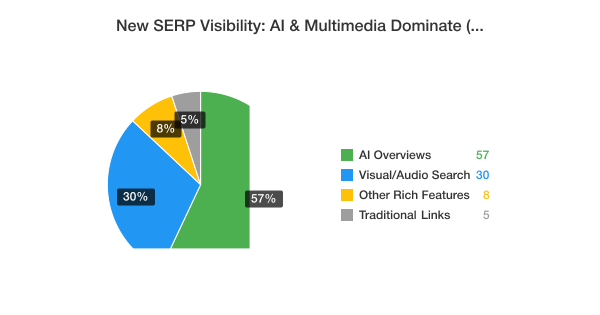
Research from Xponent21 (2025) confirms this disruption, revealing that 57% of SERPs now feature AI Overviews. This shift is compounded by changing user behavior; a 2025 analysis by beebyclarkmeyler.com found that a majority of Google searches result in the user never leaving the results page, making visibility within these summaries essential for capturing attention.
Note: Ignoring multimedia optimization is no longer a viable strategic option. It is a concession of visibility within the primary real estate of modern search results.
This evolution is not limited to desktop search. User behavior is fragmenting toward more conversational and visual platforms, with many search journeys now beginning on social media or through voice commands. The rise of visual search technologies like Google Lens turns every image into a potential entry point, while the proliferation of voice assistants necessitates content structured for audio consumption. As AI models become the primary interface for information retrieval, they will increasingly rely on a diverse set of well-labeled, high-quality media to construct comprehensive answers.
In this transformed landscape, a strategic focus on optimizing visual and audio content is an essential path to securing digital authority and market presence.
AI-Powered Visual Optimization: Seeing SEO Success
Manually writing descriptive alt text and file names is an inefficient workflow that can slow content velocity. Modern AI engines transform this process by automating the creation of contextually rich alt text, captions, and file names at scale. This system embeds semantic keywords with precision, enhancing relevance for both standard and visual search algorithms without the drain of manual oversight.
According to analysis from RevvGrowth (2025), AI-driven metadata generation directly correlates with improved topical relevance signals, which are critical for SERP visibility.
Caution: While AI excels at scale, a final strategic review is essential. Ensure the generated text aligns with user intent and brand voice before deployment to maintain content integrity.
Automating descriptive metadata with AI is the first step toward transforming your image library from a passive asset into an active driver of organic traffic.
Your visual assets contain significant SEO potential, but they are underutilized unless search engines can interpret their content and context. AI-powered image recognition automates the tagging and categorization of vast visual libraries, improving their discoverability. To elevate this further, AI can programmatically generate and inject structured data like <mark class="hl">ImageObject</mark> and <mark class="hl">VideoObject</mark> schema. This provides a clear, machine-readable blueprint of your content directly to search crawlers, improving eligibility for rich results.
Research from beebyclarkmeyler.com (2025) confirms that pages with valid VideoObject schema are substantially more likely to be featured in video carousels and other enhanced search results.
{
  "@context": "https://schema.org",
  "@type": "VideoObject",
  "name": "Strategic AI for Market Domination: A 2025 Guide",
  "description": "An in-depth guide on leveraging AI to analyze market trends and achieve a competitive advantage.",
  "thumbnailUrl": "https://example.com/images/thumbnail.jpg",
  "uploadDate": "2025-05-21T08:00:00+08:00",
  "duration": "PT5M30S",
  "contentUrl": "https://example.com/video/123"
}
Implementing structured data via AI is a requirement for competing effectively in visual search.
To compete in a market, you must understand not only what your competitors write, but also the visual language they use. AI platforms provide an advantage by analyzing the visual content of top-ranking competitors at scale. This process deconstructs their strategy, revealing patterns in imagery—such as the consistent use of data visualizations or specific infographic styles—that resonate with the target audience and signal authority to search engines.
A study by Once Interactive demonstrates that AI-driven visual analysis is highly effective at identifying high-engagement image formats, enabling a more strategic and results-driven visual content plan.
| Visual Asset Type | Strategic Use Case | Primary KPI |
|---|---|---|
| Infographics | Simplify complex data; build authority | Backlinks, Social Shares |
| Data Charts/Graphs | Substantiate claims with evidence | Time on Page, Credibility |
| Product In-Use Shots | Show value in a real-world context | Conversion Rate, CTR |
| Step-by-Step GIFs | Illustrate a process or workflow | User Engagement, Dwell Time |
Leveraging AI for competitive visual analysis allows you to understand successful approaches and deploy a more effective visual strategy.
A visually appealing asset becomes a liability if its file size compromises page speed and degrades the user experience. Page load speed is a critical ranking factor, and unoptimized images are a primary cause of performance degradation. AI-powered platforms automate the entire optimization workflow, from intelligent, lossless compression to converting images to next-generation formats like WebP. This ensures high visual fidelity with minimal impact on Core Web Vitals.
RevvGrowth (2025) confirms that automated image optimization is a key differentiator for websites achieving high Core Web Vitals scores, directly impacting their search rankings.
- Automated Ingestion: The AI engine ingests all new visual assets uploaded to the CMS.
- Intelligent Analysis: It analyzes each image for complexity and content to determine the optimal compression level.
- Format Conversion: The system automatically converts images to the most efficient format (e.g., WebP for supported browsers, with a JPEG/PNG fallback).
- CDN Deployment: Optimized images are served through a Content Delivery Network (CDN) for accelerated global delivery.
Automating technical image optimization ensures your visual content supports, rather than hinders, your SERP performance.
A comprehensive AI strategy for visual content automates metadata, schema, competitive analysis, and technical optimization to convert static images into active SEO assets.
Tuning In to Audio SEO: Optimizing for Voice and Podcasts
The growth of podcasts and voice search has created a vast landscape of valuable audio content. For search engines, however, this content has largely remained an unindexable asset, representing a missed opportunity for establishing authority.
AI transforms this dynamic by serving as a translation engine between the spoken word and machine-readable text. It systematically converts audio files into structured, keyword-rich data that search crawlers can parse, index, and rank. This process elevates audio from a supplementary format into a primary driver of organic visibility and topical authority, directly addressing the market's shift toward conversational search.
This shift is a measurable evolution in user behavior. Research cited by beebyclarkmeyler.com (2025) reveals that AI-driven search prompts now average 23 words, a stark contrast to the 4.2-word average for traditional typed queries. This demonstrates a demand for detailed, direct answers that well-optimized audio content is uniquely positioned to provide.
Automated Transcription for Foundational Indexing
The first and most critical step is converting audio into text. AI-powered transcription services now offer high levels of accuracy at scale, creating a comprehensive text version of every episode. This transcript becomes the foundation of your audio SEO strategy, providing a complete, indexable record of every word spoken. This makes previously unreachable keyword territory accessible, turning every relevant phrase into a potential entry point for organic traffic.Intelligent Thematic and Keyword Analysis
Once transcribed, the text becomes a rich dataset for analysis. AI tools employ Natural Language Processing (NLP) to parse the entire transcript, identifying core themes, named entities, and high-value long-tail keywords. The AI identifies semantic relationships to build a strategic roadmap for metadata optimization. This deep analysis allows you to optimize not just for a single keyword but for an entire conversational topic, establishing comprehensive authority.Enhanced User Experience through Structural Generation
Beyond keyword optimization, AI enhances the listener experience, which sends positive signals to search engines. It can automatically generate concise summaries, chapter markers, and clickable timestamps for key moments within an episode. This improved navigability directly impacts user engagement metrics. When users can easily find the information they need, they stay longer, reducing bounce rates and signaling to algorithms that your content is valuable.Content Reformatting for Conversational Queries
Voice search prioritizes concise, direct answers. AI can analyze your transcript to identify segments that directly answer common questions and reformat them into an 'answer-first' structure. By creating these standalone content 'chunks'—often presented as FAQ sections or highlighted takeaways in your show notes—you strategically position your content to be selected as the definitive answer. This proactive structuring is essential in the zero-click environment of voice search, where being the featured answer is key.
By systematically converting spoken expertise into a discoverable and indexable asset, you build a distinct advantage in search results.
The Marketer's AI Toolkit for Multimedia SEO
Navigating the expansive landscape of AI-powered marketing tools can be a challenge. The objective is not to accumulate applications, but to construct a strategic, integrated toolkit.
A modern multimedia SEO strategy requires an intelligent stack of AI solutions, often orchestrated by platforms like OutblogAI, designed to work in concert. This approach streamlines the entire workflow, from initial concept and visual creation to semantic optimization and performance analysis. It transforms disparate tasks into a single, efficient engine that consistently produces high-ranking content, creating an advantage in speed, scale, and strategic execution.

The adoption of integrated AI workflows is a marker of market leaders. A Techmagnate (2025) analysis indicates that organizations leveraging a connected AI stack for content production see a significant acceleration in their ability to deploy and rank multimedia assets. This systematic approach reduces bottlenecks and enhances the strategic value of every piece of content published.
To achieve this level of operational efficiency, marketers must select tools based on their specific function within the content lifecycle. The following table provides a curated overview of high-performance AI tools, categorized to help build a comprehensive multimedia optimization engine.
| Category | Tool Examples | Strategic Function |
|---|---|---|
| Visual Creation & Optimization | Canva Magic Studio, Surfer SEO |
Automate the generation of on-brand visuals and systematically optimize image attributes (alt text, file names) directly within the content workflow to enhance visual search performance. |
| Audio & Video Repurposing | OpusClip |
Transform long-form video and audio recordings into a high volume of shareable, short-form clips, maximizing asset utility and extending reach across multiple platforms with minimal manual effort. |
| Research & Content Structuring | ChatGPT, Perplexity |
Accelerate the initial phases of content strategy by rapidly sourcing data, brainstorming multimedia concepts, and generating comprehensive, SEO-driven outlines that guide content creation. |
| SEO & Semantic Analysis | Clearscope |
Ensure that all text accompanying visual and audio content is semantically rich and precisely aligned with user search intent, directly improving topical authority and SERP relevance. |
| Workflow Automation | Zapier, <mark class="hl">[Gumloop]</mark>(https://www.credal.ai/blog/launching-agentic-and-other-robust-workflows-on-gumloop) |
Serve as the connective tissue for the entire tool stack, integrating disparate applications to build a seamless, trigger-based pipeline from content ideation to final publication and analysis. |
These platforms should not be viewed as isolated solutions but as interoperable components of a larger strategic system. By connecting a research tool like Perplexity to an automation service like Zapier, for instance, a team can automatically generate content briefs and social media captions based on a single input. This integration transforms a fragmented workflow into a streamlined and effective content production line.
A well-chosen stack of AI tools transforms the multimedia optimization workflow from a series of manual tasks into a cohesive and automated system for improving SERP performance.
Speaking the Language of AI: Advanced Schema for Multimedia
AI crawlers perceive the digital world through code, not sight or sound. To gain their attention and improve SERP performance, you must translate your multimedia assets into the structured language they understand.
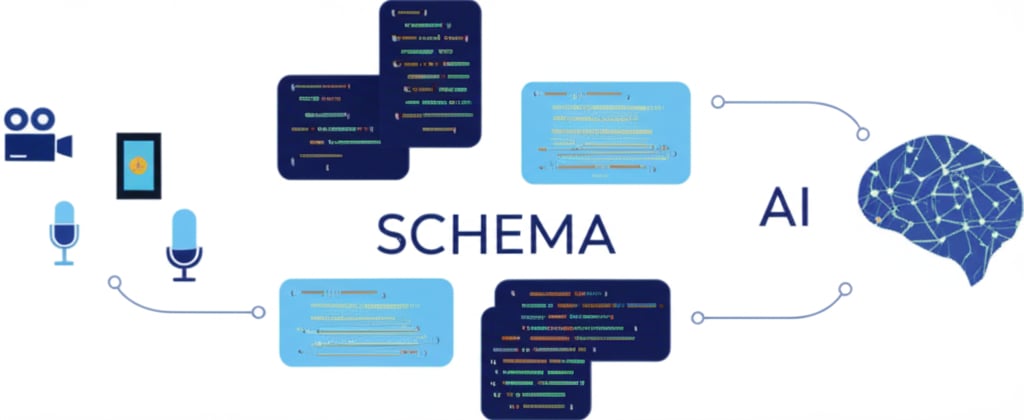
This translation is accomplished through schema markup, a form of structured data that serves as a direct communication channel to search engine AI. It systematically removes ambiguity about your visual and audio content, providing the precise context required to index, understand, and feature your assets in rich results and AI Overviews. Moving beyond basic implementation to advanced types like VideoObject and ImageObject is essential for building a competitive advantage.
The strategic implementation of structured data is a competitive necessity. Research from beebyclarkmeyler.com (2025) confirms that specific schema types, including VideoObject, HowTo, and FAQPage, are instrumental for ranking in AI-driven search features, directly correlating with enhanced visibility and user engagement.
For instance, when marking up a video tutorial, a detailed VideoObject implementation provides a comprehensive blueprint for AI systems.
{
  "@context": "https://schema.org",
  "@type": "VideoObject",
  "name": "Advanced SEO Automation Strategies",
  "description": "A deep dive into automating your SEO workflow for market domination.",
  "thumbnailUrl": "https://www.example.com/thumbnails/seo-automation.jpg",
  "uploadDate": "2025-10-26",
  "duration": "PT15M33S",
  "contentUrl": "https://www.example.com/videos/seo-automation.mp4",
  "embedUrl": "https://www.example.com/embed/seo-automation",
  "transcript": "Welcome to our guide on advanced SEO automation..."
}
This level of detail, including properties for duration, thumbnail, and the full transcript, transforms your video from an opaque media file into a rich, indexable data source. For content featuring visual step-by-step guides, combining HowTo schema with nested ImageObject markup for each step provides an unparalleled level of clarity for AI crawlers. It is critical that all content marked up with schema is also visible to the user on the page; hiding structured data violates search guidelines. Regular validation with tools like Google's Rich Results Test is a necessary step to ensure your implementation is error-free and eligible for these SERP enhancements.
The correct application of advanced schema is the most direct technical method for communicating the value of your multimedia content to search engines.
Measuring the Impact in a Zero-Click World
The expansion of zero-click searches challenges conventional methods for measuring SEO performance and ROI. As AI-driven answers directly address user queries on the SERP, justifying investment in visual and audio content requires a strategic pivot in analytics.
The measurement paradigm must evolve beyond click-through rates. The new objective is to measure influence and establish authority at the point of discovery, which is now frequently within an AI-generated summary. This requires a shift to AI-centric metrics: impressions within AI Overviews, brand mentions in generated answers, and strong visibility in SERP features like video carousels. The traffic that does click through from these features is often pre-qualified and demonstrates stronger intent.
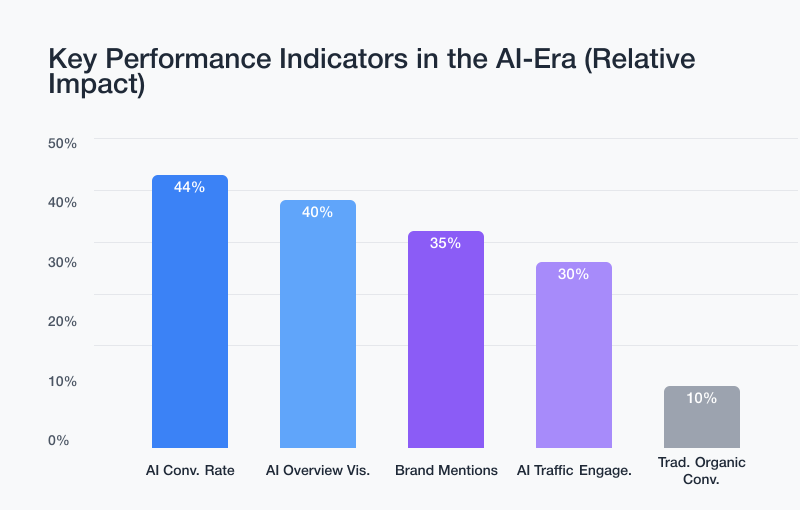
This strategic pivot is validated by performance data. Traffic referred from AI-powered results is reported to convert at a rate 4.4 times higher than traditional organic search traffic, underscoring its value (beebyclarkmeyler.com 2025). Furthermore, users who engage with a link after reading an AI summary tend to exhibit deeper on-site engagement, signaling a more qualified audience (Xponent21 2025).
| Metric Category | Traditional SEO Focus | AI-Era SEO Focus |
|---|---|---|
| Top-Funnel | Click-Through Rate (CTR) | Impressions & Visibility in AI Overviews |
| Mid-Funnel | Bounce Rate, Time on Page | Engagement Signals from Referred Traffic |
| Brand | Organic Traffic Volume | Brand Mentions & Citations in AI Answers |
| Conversion | Conversion Rate (Volume) | Conversion Rate (Quality & Value) |
To operationalize this new measurement framework, marketers must adapt their toolset and analysis. Utilize Google Search Console’s 'Search Appearance' filter to isolate and analyze performance data specifically for video results and other rich snippets. While GSC does not yet directly report impressions within AI Overviews, this functionality is widely anticipated. The important value of brand lift—the authority and recall built by being the cited source in an AI answer—must also be factored into any comprehensive ROI calculation.
Success in this new landscape is measured not by the volume of clicks, but by the quality of resulting traffic, the strength of brand visibility within AI summaries, and the overall lift in market authority.
The digital landscape has fundamentally shifted, demanding a new strategic approach to content visibility. As AI-driven search engines increasingly prioritize and display multimedia directly within results, optimizing your visual and audio assets is no longer supplementary but central to your SEO success.
Here are the critical takeaways for achieving strong SERP performance in this evolving environment:
- Multimodal Search is Paramount: AI-driven search engines now feature images, videos, and audio clips prominently, making integrated multimedia optimization essential for capturing organic traffic. Your visibility hinges on treating visual and audio content with the same importance as text.
- Automate Optimization with AI: Leverage advanced AI tools to streamline the optimization process. This includes automatically generating precise alt text for visuals, and transcribing audio content and structuring it for voice search queries.
- Structure Data for AI Comprehension: Implement specific structured data, such as
VideoObjectandImageObjectschema, to provide explicit, machine-readable context about your multimedia assets. This signaling helps AI understand your content's relevance, improving its chances for prominent rankings.
The strategic integration of AI-powered optimization for visual and audio content is a critical imperative for achieving and sustaining top SERP positions. To secure an advantage in this evolving landscape, begin by systematically integrating AI-driven tools into your multimedia content strategy, ensuring every asset is meticulously optimized for AI comprehension. This proactive approach will transform your content into a powerful engine for organic growth and market authority, a core principle behind successful content strategies.