AI Brand Voice Mastery: A Guide to Perfect Consistency
Learn to master your AI brand voice for perfect consistency across all content. This guide covers the frameworks, tools, and workflows needed to scale your brand's unique personality, build trust, and drive revenue in a competitive market.


Brand voice consistency is not merely a stylistic preference; it is a critical driver of market success. Data reveals that brands maintaining a consistent voice achieve up to 33% higher revenue, underscoring its impact on trust, recognition, and the bottom line. In a competitive digital landscape where content velocity defines market presence, the ability to project a unified personality across all communications offers a clear strategic advantage. However, scaling this consistency presents a significant challenge, as traditional editorial processes struggle to keep pace with the demands of modern content production. The volume of content required to engage audiences often leads to fragmented messaging and a diluted brand identity.
Achieving brand voice consistency at scale requires a strategic integration of AI technologies and structured validation frameworks. This guide explains why manual processes are no longer sufficient for the speed and scale demanded by today's content ecosystem. We will introduce a three-layered validation framework designed to ensure every piece of content aligns with your brand’s DNA. You will learn how to empower AI to recognize and replicate your brand’s specific tone, style, and messaging, automating the first line of defense against off-brand content. Furthermore, we will detail the implementation of rule-based validators that enforce non-negotiable brand standards, from terminology to legal disclaimers. Ultimately, this framework elevates human editors, freeing them to focus on higher-value tasks like strategic oversight and creative refinement.
TL;DR
Maintaining a consistent brand voice is no longer a creative preference; it is a critical driver of revenue in a saturated digital landscape. Achieving this consistency at scale requires a systematic approach that combines AI validation with strategic human oversight, as traditional editorial workflows are insufficient for the speed and volume of modern content production.
A Lucidpress report found that brands with consistent presentation realize an average revenue increase of up to 33%. This underscores the financial imperative of moving beyond manual, inconsistent enforcement. The solution is a three-layer validation system that operates with precision and efficiency.
- AI Classifiers: Fine-tuned models that learn your unique brand voice and automatically flag content that deviates in tone, style, or sentiment.
- Rule-Based Validators: Automated systems that enforce non-negotiable standards, such as correct brand terminology, required legal disclaimers, and specific readability targets.
- Human Oversight: Strategic review by editors who are freed from tedious checks to focus on higher-value tasks like creative nuance, storytelling, and overall message alignment.
This integrated system transforms brand governance from a manual bottleneck into an automated, scalable engine for content excellence.
The High Stakes of Brand Voice Consistency
Brand voice consistency is more than an aesthetic choice; it is a component of commercial success that impacts revenue, customer loyalty, and market trust. A unified voice across all content channels builds credibility, can accelerate sales cycles, and helps reduce customer acquisition costs. Deviations from this voice introduce friction and can erode trust. For B2B enterprises, where long sales cycles make trust essential, every piece of content represents an opportunity to reinforce the brand relationship. Inconsistency puts that opportunity at risk.
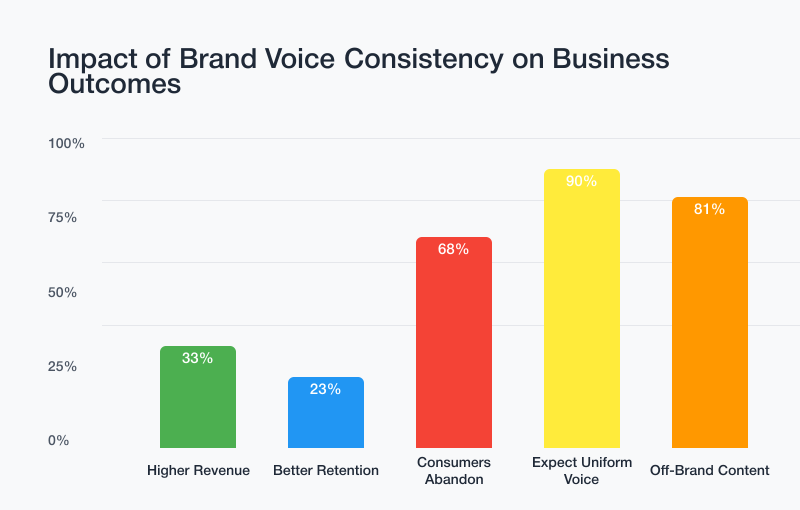
Research consistently demonstrates the profound impact of a cohesive brand identity on business outcomes. Companies maintaining a consistent brand achieve 33% higher revenue and secure 23% better customer retention, as highlighted by Lucidpress research. Furthermore, an Emplifi report reveals that 68% of consumers abandon brands that exhibit sudden shifts in tone, while a striking 90% of consumers expect a uniform brand voice across all platforms. Despite these compelling statistics, 81% of companies admit to regularly publishing off-brand content, underscoring a critical gap in their strategic execution. This operational oversight translates directly into missed opportunities and diminished market authority.
Note: The financial implications of an inconsistent brand voice extend beyond lost sales; they manifest as increased customer acquisition costs, lengthened sales cycles, and diminished customer lifetime value, directly impacting the bottom line.
Failing to maintain a consistent brand voice harms revenue and customer retention, turning a valuable asset into a liability.
Why Traditional Editorial Processes Fail at Scale
The relentless demand for content in the modern digital landscape has exposed the limitations of traditional editorial workflows. Relying solely on manual review to maintain brand voice becomes a significant editorial bottleneck when enterprises publish hundreds of content pieces monthly. Global teams, diverse freelancers, and frequent new hires inherently introduce variations in tone, style, and terminology that even comprehensive style guides struggle to mitigate. The imperative to publish quickly often forces compromises, prioritizing speed over meticulous brand consistency. These static style guides, while foundational, are difficult to enforce systematically across a large organization without integrated tools.
The volume of content required today is immense; a typical enterprise may publish over 500 pieces monthly across blogs, social media, emails, and sales materials, as noted by nav43. This content velocity makes manual oversight unsustainable. As the Copy.ai blog highlights, inconsistency is further compounded by distributed teams operating across different time zones and cultural contexts, making a unified voice an increasingly elusive goal through human effort alone.
- Manual Bottleneck: Human review cannot scale with the hundreds of content pieces required monthly.
- Distributed Discrepancies: Global teams and freelancers introduce inherent variations in tone and style.
- Speed Over Consistency: Pressure to publish quickly often leads to compromises on brand voice.
- Static Enforcement: Traditional style guides are difficult to enforce systematically and dynamically across an organization.
The scale and speed of modern content creation make traditional, human-only editorial processes insufficient for ensuring brand voice consistency.
The Modern Solution: A Three-Layered Validation Framework
Achieving consistent brand voice at scale demands a structured approach that leverages both artificial intelligence and human expertise. The solution is a three-layered validation framework designed for precision and scalability. This framework integrates AI Voice Classifiers as the initial defense, identifying subtle deviations in tone and style. Following this, Rule-Based Validators enforce the brand's concrete, non-negotiable standards, such as specific terminology or prohibited phrases. The final, critical layer consists of Human Editors, who provide strategic oversight, injecting the nuance, creativity, and context that only human intelligence can supply. This synergistic approach, when powered by an automated content engine, ensures comprehensive brand integrity across all content.

Implementing such a structured framework is critical for modern content operations, as emphasized by industry leaders like nav43, who advocate for integrated technological solutions to overcome consistency challenges.
| Layer | Primary Function | Key Benefit |
|---|---|---|
| AI Voice Classifiers | Detect subtle tonal and stylistic deviations | Scalable first-pass consistency check |
| Rule-Based Validators | Enforce concrete brand standards (e.g., terminology) | Ensures non-negotiable compliance |
| Human Editors | Provide strategic oversight, nuance, and creativity | Adds context, strategic alignment, and polish |
A robust system combining AI's scalability for tone and rules with human strategic oversight is the most effective way to maintain brand voice integrity.
Layer 1: Teaching AI to Recognize Your Brand's DNA

Transforming an abstract brand voice into a measurable, automated standard requires a systematic training process. This is accomplished by building an AI voice classifier to score content against your brand's unique DNA.
An AI voice classifier is a specialized model trained to analyze and score content based on its alignment with a target brand’s tonal and stylistic attributes. This system elevates brand compliance from subjective human review to an objective, data-driven process, enabling consistent quality control at scale. By automating the detection of subtle deviations, organizations can ensure every asset reinforces their market position with a unified voice.
The two primary methods for this are fine-tuning and few-shot learning. Fine-tuning is an intensive process of retraining a base model on a large, proprietary corpus of your best on-brand content. In contrast, few-shot learning provides the AI with a small set of curated examples directly within an instruction prompt to guide its analysis for a specific task. The efficacy of these methods is well-documented; a recent Forrester analysis (2023) confirms that well-calibrated AI classifiers can achieve over 90% accuracy in identifying off-brand content.
| Method | Process Overview | Best Use Case | Data Requirement |
|---|---|---|---|
| Fine-Tuning | Retraining a base model on a large, curated dataset of your brand's content to create a specialized version. | High-stakes, enterprise-level consistency where maximum accuracy is non-negotiable. | 200–500+ labeled examples |
| Few-Shot Learning | Providing a small number of on-brand examples within the prompt to guide the AI's output for a single task. | Rapid deployment, smaller projects, or initial testing of voice alignment without significant upfront investment. | 5–10 high-quality examples |
By systematically training an AI on curated examples of your content, you create a reliable, automated system for detecting and correcting tonal inconsistencies at scale.
Layer 2: Enforcing Non-Negotiables with Rule-Based Validators
While advanced AI models excel at understanding and replicating nuanced brand tones, the foundational elements of brand voice require precise, unwavering enforcement. This is where rule-based validators serve as an essential automated safety net. These systems enforce concrete brand guidelines that AI classifiers might overlook, ensuring compliance and consistency.
Rule-based validators, often implemented as linters, automatically check for concrete requirements that define a brand's identity and legal standing. This includes mandatory usage of official product names and taglines, alongside strict prohibitions against jargon, clichés, or competitor mentions. Such precise enforcement is crucial for maintaining brand integrity. One company significantly reduced compliance issues by 94% after integrating regex validators for financial disclosures, as reported by nav43 (2023).
These validators also extend to critical legal and readability standards. They can automatically verify the inclusion of required legal disclaimers, ensure correct trademark usage, and enforce specific formatting standards across all content. Furthermore, they implement readability gates, ensuring content remains accessible and engaging for the target audience.
- Mandatory Terminology: Enforce 'must-use' lists for official product names, brand taglines, and approved messaging.
- Forbidden Content: Implement 'never-use' lists for jargon, clichés, competitor names, or inappropriate language.
- Legal & Compliance: Automatically check for required legal disclaimers, correct trademark symbols, and regulatory compliance statements.
- Readability Standards: Apply metrics like Flesch-Kincaid grade level, maximum sentence length (e.g., under 25 words), and passive voice limits (e.g., below 10%).
Rule-based validators provide an essential, automated safety net that ensures every piece of content adheres to your brand's most critical and concrete guidelines.
Layer 3: The Human Editor's New Role in the AI Era

The advent of AI-powered content generation and validation marks a significant evolution, not an obsolescence, for the human editor. With AI managing mechanical consistency and enforcing strict guidelines, editors are liberated from the repetitive, tactical tasks that once consumed much of their time. This strategic shift empowers editors to focus on higher-value contributions.
The editor's role transforms from a primary corrector to a strategic architect of brand communication. Their focus elevates to ensuring strategic alignment, crafting compelling storytelling, discerning contextual nuance, and driving overall creative excellence. Humans possess a capacity for emotional intelligence and cultural understanding that AI cannot replicate. Forrester (2024) emphasizes that human oversight remains vital for ethical AI deployment and content quality.
Note: Humans uniquely excel at judging when to strategically break a rule for maximum impact, assessing cultural sensitivity, and weaving in narratives that resonate emotionally with an audience. This creative and empathetic judgment is irreplaceable.
The ideal workflow integrates human and artificial intelligence seamlessly. AI generates or scores a draft, rule-based systems validate compliance, and a human editor then elevates the final piece. This human-in-the-loop system ensures both efficiency and quality, safeguarding the brand's authentic voice.
AI does not replace human editors; it elevates them from tactical correctors to strategic partners who guide creative excellence and brand alignment.
An Implementation Roadmap: From Pilot to Enterprise Rollout
Successfully integrating an AI-powered brand voice validation system requires a structured, phased approach to ensure seamless adoption and maximize strategic impact. A well-defined roadmap accelerates the transition from conceptualization to enterprise-wide deployment, minimizing disruption and optimizing results. This systematic method allows organizations to build momentum and refine the system incrementally.
A phased implementation provides the strategic advantage of testing, learning, and adapting the system within a controlled environment before a full rollout. This mitigates risks and builds internal confidence in the new capabilities. As nav43 (2024) often highlights, successful technology integration hinges on careful planning and iterative development.
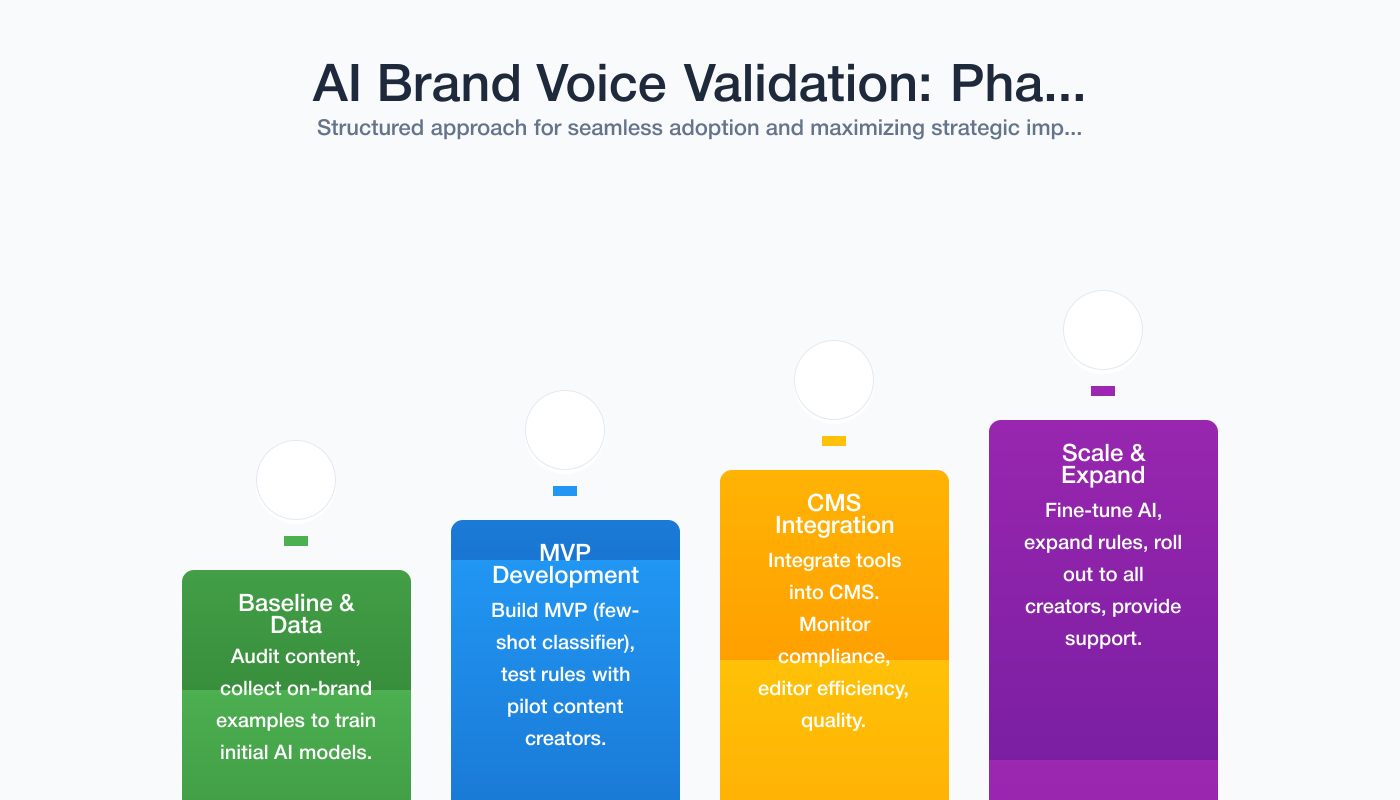
Here is a strategic roadmap for deploying an AI-powered brand voice validation system:
- Phase 1 (Month 1): Baseline & Data Collection. Conduct a comprehensive audit of existing content to establish a baseline for current brand voice consistency. Collect a robust set of on-brand examples to train initial AI models and define core stylistic attributes.
- Phase 2 (Month 2): Minimum Viable Product (MVP) Development. Build an MVP utilizing a few-shot classifier and implementing the top 20% of critical style rules. Test this MVP with a small, dedicated pilot group of content creators to gather initial feedback and identify areas for refinement.
- Phase 3 (Month 3): Integration & Monitoring. Integrate the validated tools directly into your existing Content Management System (CMS) or primary writing platforms (e.g., Google Docs). Develop a comprehensive metrics dashboard to track compliance rates, editor efficiency, and content quality improvements.
- Phase 4 (Months 4-6): Scaling & Optimization. Scale the system by fine-tuning the AI model with more extensive data and expanding the rule set to encompass a broader range of brand guidelines. Roll out the complete system to all content creators across the enterprise, providing ongoing training and support.
A phased implementation, starting with a small-scale pilot and gradually expanding, is the most effective way to ensure successful adoption across an enterprise.
Measuring Success: Dashboards, Scorecards, and Continuous Improvement

The impact of a brand voice program can be difficult to assess without rigorous measurement. To justify and improve the initiative, you must continuously track consistency metrics and tie them directly to tangible business results. This data-driven approach transforms brand voice from an abstract concept into a quantifiable asset, driving strategic decision-making and continuous optimization.
Research highlights the tangible benefits of this approach; one company observed that a 10-point improvement in their consistency score directly correlated with a 23% increase in email click-through rates (nav43, report). Implementing a robust measurement framework provides the intelligence needed to refine your AI-driven voice.
Here are critical metrics for tracking brand voice effectiveness:
- Consistency Score: Aggregate AI confidence scores, identify rule violations, and assess readability metrics to establish a holistic measure of brand voice adherence across all content. This score provides a singular, actionable benchmark.
- Violation Pattern Analysis: Analyze which specific brand voice rules are most frequently broken. This reveals critical opportunities for refining AI training, clarifying guidelines, or adjusting content creation workflows to prevent recurrence.
- Time to Compliance: Measure the number of editorial rounds or revisions required before content achieves brand voice approval. A decreasing trend signifies an increasingly efficient and effective AI-driven system.
- Business KPI Correlation: Directly link consistency scores with key business performance indicators such as email click-through rates, page engagement, and conversion rates. This correlation proves the strategic ROI of your brand voice initiatives.
Building a robust measurement framework ensures your brand voice initiative delivers demonstrable value and supports continuous improvement.
The pursuit of a consistent brand voice is more than an aesthetic choice; it is a strategic imperative that directly impacts your bottom line. In a competitive digital market, brands that maintain consistency across all content can achieve higher revenue, build greater trust, and establish a clear market identity.
Here are the pivotal insights to guide your strategic implementation:
- Brand voice consistency is a non-negotiable driver of revenue and trust. Its direct correlation with up to 33% higher revenue underscores its status as a core component of sustainable growth and competitive advantage, vital for establishing undeniable market authority.
- Traditional manual editorial processes are a bottleneck to scale. They are incapable of meeting the velocity and volume demands of modern content production, leading to inconsistencies, inefficiencies, and a diluted brand presence.
- A multi-layered AI validation framework is the definitive solution. By strategically integrating AI classifiers to discern your brand’s nuanced DNA, rule-based validators to enforce critical non-negotiables, and empowering human editors for strategic oversight, brands can achieve unprecedented consistency at scale.
Embracing this integrated approach is not an operational upgrade but a strategic shift toward an automated content engine that solidifies brand authority.
The critical next step involves a comprehensive audit of your existing content workflows and a strategic commitment to intelligent automation. Begin by codifying your brand’s unique linguistic and stylistic elements. Then, implement platforms like OutblogAI engineered to learn and deploy your definitive brand voice across all content, transforming your expertise into a consistent, authoritative presence that captures and retains audience attention. This methodical integration will empower your team to focus on higher-value strategic initiatives, ensuring every piece of content consistently reinforces your brand's promise and supports a broader digital transformation.