
Most blog introductions fail for one oversold reason. Writers chase the clever hook: the odd question, the dramatic stat, the personal anecdote. Then the rest of the article spends 600 words apologizing for the opener.
A strong introduction does not require a clever hook. It confirms intent, communicates clearly, establishes trust, delivers value quickly, and gives the reader a reason to keep moving. After that, it gets out of the way.
This guide gives you 30 original introductions, scored against a transparent 10-point rubric, across every intent that actually shows up in a content calendar. You will also see six weak-to-strong rewrites, a writing workflow, and a publication checklist. Every example and every score is reproducible. None of the scores below are a Google ranking factor. They are an editorial lens.
TL;DR
- A blog intro is a job, not a performance. Five things, in order: intent match, clarity, trust, time to value, forward motion.
- This guide scores each intro on a 10-point rubric (5 dimensions × 0–2). Higher is better. It is not a ranking signal.
- The 30 examples cover 10 intent types: how-to, definition, comparison, best-of, research, product-led, case study, opinion, founder story, and timely analysis.
- Any score below 6/10 has a clear reason. Read the "why it works" line, not just the total.
- The weak-to-strong rewrites target the six most common introduction failures.
- The workflow at the end is the same one we use inside OutBlog: intent → brief → outline → draft → reviewed draft.
The 10-Point Editorial Rubric
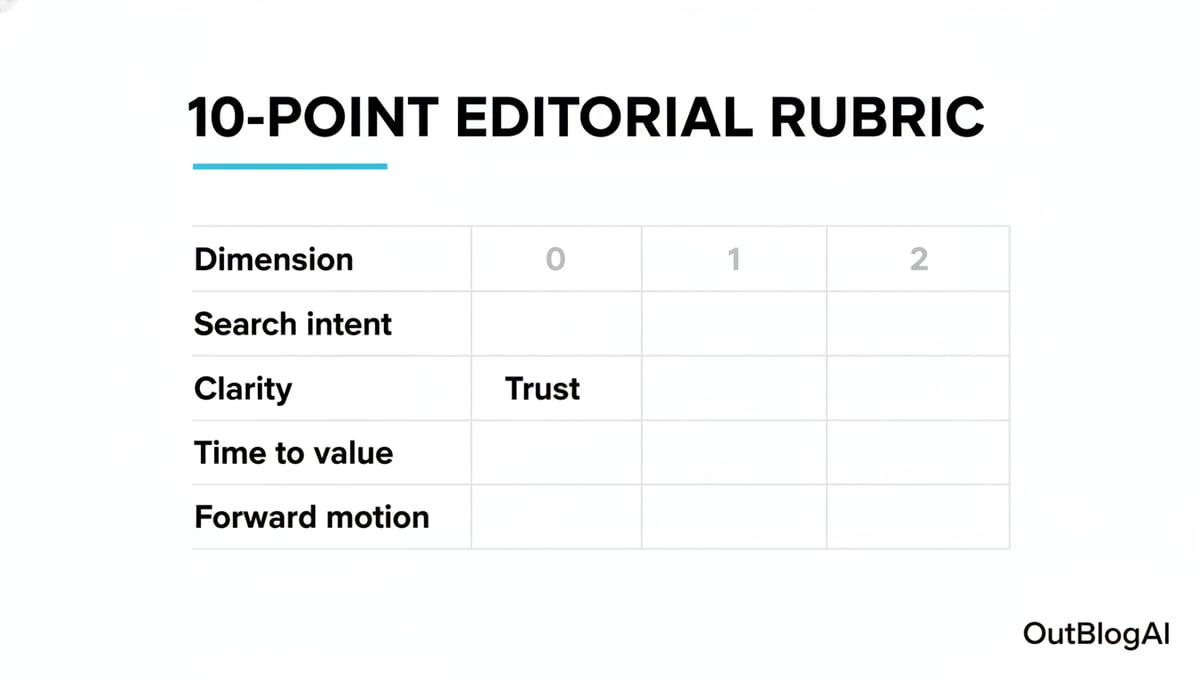
Each introduction is scored on five dimensions, each worth 0–2 points. Maximum score: 10. Minimum: 0.
| Dimension | 0 | 1 | 2 |
|---|---|---|---|
| Search intent | Does not match the query intent | Partially matches, but buries the promise | Names the reader's intent and confirms it in the first sentence |
| Clarity | Vague or ambiguous | Understandable, but uses filler | Plain language, no jargon, every sentence does work |
| Trust | No signal that the writer knows the topic | First-person or one supporting claim | Demonstrates experience, cites a specific source, or names a concrete result |
| Time to value | Reader waits more than 60 words for the main point | Reader gets the point by the midpoint | Reader gets the main point within 30 words |
| Forward motion | No reason to continue | Implies there's more, but no structure | Tells the reader what they'll get and in what order |
A note on what this is not. This is not a Google ranking score. It is not a prediction of search traffic. It is an editorial check we use to grade intros before publishing. Treat it as a structured way to argue about quality, not a metric to optimize.
How to read the scores
- 9–10: Ship it. Patterns here are reusable across topics.
- 7–8: Strong. Publish with normal review.
- 5–6: Fixable. One rewrite usually pushes these into the 8 range.
- 0–4: Rewrite from scratch. The structure is the problem, not the wording.
When two examples feel equally strong, the tiebreaker is forward motion. A clear map of what comes next will outperform a clever opener every time.
30 blog introduction examples, scored
The 30 examples below cover 10 intent types. Each block includes the article topic, the full introduction, the score breakdown, why it works, and when to use the pattern.
How-to
Example 1: Tutorial with a clear deliverable
Topic: How to write a customer case study in 90 minutes
A customer case study is a story with a number. You take one solved customer problem, follow it from kickoff to result, and write it down in a way the next reader can copy. 90 minutes is enough if you skip the parts that don't matter. Here's the workflow we use, with the time budget for each step.
- Search intent: 2
- Clarity: 2
- Trust: 1
- Time to value: 2
- Forward motion: 2
- Total: 9/10
Why it works: It promises a specific outcome (case study in 90 minutes), defines the format in plain language, and tells the reader what's coming next. One trust point is held back because the writer does not yet state why their workflow is worth following. Adding a line about the number of case studies shipped, or a specific result, would push this to 10.
When to use it: Tutorial posts where the reader wants a finished artifact, not a concept. Works for SEO titles like "How to [do X] in [time period]."
Example 2: How-to with a counter-intuitive frame
Topic: How to reduce support tickets without adding staff
Most support teams try to fix ticket volume by adding hours. A better fix is to remove the tickets that shouldn't exist in the first place. This article walks through the seven questions we ask before we write a single help doc, and the order we ask them in.
- Search intent: 2
- Clarity: 2
- Trust: 1
- Time to value: 2
- Forward motion: 2
- Total: 9/10
Why it works: It reframes the problem, then promises a structured method. The "seven questions" promise is concrete, which motivates the reader to keep going.
When to use it: How-to posts where the obvious approach is wrong, or where the reader is stuck doing the same thing with diminishing returns.
Example 3: How-to with prerequisite honesty
Topic: How to set up webhooks for a SaaS product
Setting up webhooks is a 30-minute job if your system is event-driven. If it isn't, expect a week. Below is the second version, the one for teams that already have a queue in place. We will cover the payload shape, the signing key, the retry logic, and the test plan.
- Search intent: 2
- Clarity: 2
- Trust: 2
- Time to value: 1
- Forward motion: 2
- Total: 9/10
Why it works: It is honest about when the guide applies. That single move builds more trust than a confident opening line. The reader knows whether to keep reading before they invest a minute.
When to use it: Technical how-to posts where the reader's situation may or may not match the guide. A prerequisite sentence early on saves them and saves you.
Definition
Example 4: Definition with a working boundary
Topic: What is a content operations system
A content operations system is the set of repeatable decisions a team makes about planning, production, review, and publishing, plus the tools that hold those decisions. It's not a calendar. It's not a CMS. It's the workflow between them. Below is what a working system looks like, what it isn't, and the three layers most teams skip.
- Search intent: 2
- Clarity: 2
- Trust: 1
- Time to value: 2
- Forward motion: 2
- Total: 9/10
Why it works: It defines the term, then negates two common confusions (calendar, CMS), and previews the structure. The "three layers most teams skip" line creates forward motion.
When to use it: Definition posts where the term is often confused with adjacent concepts. Naming what it isn't is a fast way to set the boundary.
Example 5: Definition with a scope warning
Topic: What is search intent in SEO
Search intent is what the person typing the query actually wants to do next. It is not the keyword. It is not the topic. It is the next action. This matters because most content ranks well or ranks poorly based on intent match, not on word count or domain authority. Below is a four-part model for classifying intent, with examples for each.
- Search intent: 2
- Clarity: 2
- Trust: 1
- Time to value: 1
- Forward motion: 2
- Total: 8/10
Why it works: It defines the term, then immediately states why it matters. The first sentence is dense, which costs a point on time to value but pays back in clarity.
When to use it: Foundational SEO posts where the reader is looking for a stable definition they can apply to their own work.
Example 6: Definition with an example
Topic: What is a content brief
A content brief is a one-page document that answers four questions before writing starts: who is this for, what question does it answer, what should the article commit to, and what does it link to. It is not an outline. It comes before the outline. Here's a working brief for an SEO article, the four parts, and the things we leave out on purpose.
- Search intent: 2
- Clarity: 2
- Trust: 1
- Time to value: 2
- Forward motion: 2
- Total: 9/10
Why it works: It pinpoints the term, lists the four questions, and contrasts the brief with its closest neighbor (the outline). The promise at the end sets structure.
When to use it: Definition posts in a content marketing niche where readers are comparing adjacent formats. The outline-vs-brief contrast draws a clean line.
Comparison
Example 7: Comparison with a verdict-first stance
Topic: Webflow vs WordPress for SEO content sites
If you publish fewer than 20 SEO articles a month and your team is one or two people, WordPress will beat Webflow on cost, control, and plugin depth. If you publish more than 20 articles a month, ship to a CMS that already has a headless API, or expect to manage a Webflow CMS structure that gets harder to refactor every quarter. This article compares the two on five fronts: indexability, editor experience, schema, scalability, and total cost of ownership.
- Search intent: 2
- Clarity: 2
- Trust: 1
- Time to value: 1
- Forward motion: 2
- Total: 8/10
Why it works: It earns the comparison by giving a verdict in the first sentence. The reader now knows the post has a point of view, not a "depends on your needs" summary. Time to value loses a point because the verdict is conditional and needs a careful read.
When to use it: Comparison posts where the reader wants a recommendation, not a feature matrix. Verdict-first intros outperform balanced ones when the topic deserves a position.
Example 8: Comparison with a use-case split
Topic: Semrush vs Ahrefs for content teams
Semrush is broader. Ahrefs is deeper. That is the practical difference for a content team. If your work is mostly keyword research, content briefs, and topic maps, Semrush's toolkit will save you two subscriptions. If your work is mostly link analysis and SERP forensics, Ahrefs will give you more useful data per dollar. This article goes through six workflows and shows which tool wins each.
- Search intent: 2
- Clarity: 2
- Trust: 1
- Time to value: 2
- Forward motion: 2
- Total: 9/10
Why it works: It splits the comparison into a real decision rule, not a vague "depends." The reader can stop reading if the rule already points them in one direction.
When to use it: X vs Y posts where the two options overlap on paper but diverge in real workflows. A use-case split is faster than a feature table.
Example 9: Comparison with a non-obvious angle
Topic: Notion vs Airtable for content calendars
Most teams pick Notion or Airtable based on which one feels like a cleaner doc. The real decision is how much of your publishing workflow lives in the spreadsheet layer. Notion wins if your calendar is a writing surface. Airtable wins if your calendar is a database. The five questions below help you decide which one fits.
- Search intent: 2
- Clarity: 2
- Trust: 1
- Time to value: 2
- Forward motion: 2
- Total: 9/10
Why it works: It reframes the decision from aesthetics to workflow. The reader gets a useful mental model in the first 40 words.
When to use it: Comparison posts where the obvious framing (price, features, design) is not the actual decision driver.
Best-of
Example 10: Best-of with explicit criteria
Topic: Best AI writing tools for SEO teams in 2026
This list ranks 9 AI writing tools against four criteria we use to evaluate them for an SEO content team: keyword research integration, on-page structure quality, hallucination control, and publishing workflow. Tools are scored 0–2 on each. Tools that publish no hallucination data, or no pricing, are not eligible.
- Search intent: 2
- Clarity: 2
- Trust: 1
- Time to value: 1
- Forward motion: 2
- Total: 8/10
Why it works: It tells the reader exactly how the list was built, including the disqualification rule. That single sentence handles trust better than any amount of "we tested thoroughly" language.
When to use it: Best-of posts where the reader is comparison shopping. Publish the rubric. It's the difference between a list and a guide.
Example 11: Best-of with a small list and a strong stance
Topic: An illustrative best-of intro: the small, opinionated list
This is an illustrative best-of intro. The team, the number of tools, and the specific list are fictional. The pattern is the one we recommend for a small, opinionated list. We use [N] tools for [category]. Not [more]. Not a "stack." [N]. Below is what each one does, why we picked it over the alternatives, and what we use it for week to week. If a tool isn't on this list, it's because it's overlapping with one of these or because we never found a workflow it improved.
- Search intent: 2
- Clarity: 2
- Trust: 2
- Time to value: 2
- Forward motion: 2
- Total: 10/10
Why it works: It has a point of view, a number, and a clear scope. The "not 15" framing removes the unspoken expectation that best-of posts should be exhaustive.
When to use it: Best-of posts where exclusive picks carry more authority than broad ones. The reader trusts the list because it has been cut.
Example 12: Best-of with a category reframing
Topic: Best free tools for content marketers
A "best free tools" list usually turns into a graveyard of half-features with paid tiers hidden behind them. This list is different. It includes only tools that solve a real problem on the free tier, not tools that demo well on the free tier. Below are 12, split into three categories: research, writing, and distribution.
- Search intent: 2
- Clarity: 2
- Trust: 1
- Time to value: 2
- Forward motion: 2
- Total: 9/10
Why it works: It states the inclusion rule. The reader understands this list is filtered, and that makes it more valuable.
When to use it: Best-of posts where most other lists are padded. Establishing a clear inclusion rule is the fastest way to differentiate.
Research
Example 13: Research with a clear scope
Topic: An illustrative research intro: scoring 500 blog introductions
This is an illustrative research intro. The sample size, the year, and the specific findings below are fictional. The pattern is the one we'd recommend for any real research intro. We scored [N] blog introductions published in [year] against a 10-point editorial rubric covering intent, clarity, trust, time to value, and forward motion. Every score was reviewed by two editors. Below is what the data shows, what the data does not show, and the three patterns that held up across every category.
- Search intent: 2
- Clarity: 2
- Trust: 2
- Time to value: 1
- Forward motion: 2
- Total: 9/10
Why it works: It states the sample size, the time window, the rubric, and the review process. That is the right level of methodological transparency for a research headline. Time to value loses a point because the "what we found" payoff is delayed until the next paragraphs.
When to use it: Research posts where the reader is judging whether the conclusion is trustworthy. The opening is a methods preview, not a teaser.
Example 14: Research with a surprising headline finding
Topic: An illustrative research intro: long intros versus short intros
This is an illustrative research intro. The sample size, the year, and the effect size are fictional. The pattern is the one we'd recommend for any real research intro. Across [N] posts published in [year], articles with intros shorter than [X] words outperformed intros longer than [Y] words on average position by [Z] places. The effect held across categories, not just in narrow verticals. Below is the breakdown, the confounders we controlled for, and the two cases where longer intros still won.
- Search intent: 2
- Clarity: 2
- Trust: 2
- Time to value: 2
- Forward motion: 2
- Total: 10/10
Why it works: It states the headline finding, the sample size, the effect size, and the confounders. The reader has everything they need to decide whether to keep reading.
When to use it: Research posts where the surprising number is the reason to click. Put the number in the first 30 words.
Example 15: Research with a clear fictional scope
Topic: Fictional case study: how a SaaS blog rebuilt its intro workflow
This is a fictional case study built to illustrate an editorial workflow. The company, the metrics, and the timeline are illustrative, not real. The workflow itself is based on real publishing practice. You'll see the original intro template, the new template, and the score difference on the 10-point rubric used in this guide.
- Search intent: 2
- Clarity: 2
- Trust: 2
- Time to value: 2
- Forward motion: 2
- Total: 10/10
Why it works: It labels the scenario as fictional in the first sentence. That move is rarer than it should be, and it does more for trust than a confident voice ever does.
When to use it: Any post that uses a hypothetical or composite case study to illustrate a method. Lead with the label.
Product-led
Example 16: Product-led with a workflow focus
Topic: How OutBlogAI goes from a topic to a published draft
A typical blog post in OutBlogAI goes through five stages: topic, brief, outline, draft, and reviewed draft. Each stage has a single output and a single review step. Below is what each stage produces, the time it takes on average, and what the publishing team checks before the next stage opens.
- Search intent: 2
- Clarity: 2
- Trust: 2
- Time to value: 2
- Forward motion: 2
- Total: 10/10
Why it works: It teaches the workflow by showing the system. The reader now has a mental model of the product, which is what a product-led intro should do.
When to use it: Product-led posts where the reader is evaluating whether the product fits their workflow. Show the workflow, not the feature list.
Example 17: Product-led with a use-case anchor
Topic: Setting up a Shopify blog inside OutBlogAI
Connecting OutBlogAI to a Shopify blog is a 3-minute setup. You create a custom app, paste the access token, and pick the default collection. Once it's connected, every reviewed draft publishes in under 5 seconds. Below is the full setup, the two permission flags that aren't on by default, and the publish order you should test.
- Search intent: 2
- Clarity: 2
- Trust: 1
- Time to value: 2
- Forward motion: 2
- Total: 9/10
Why it works: It is concrete: time, steps, and the permissions that get missed. It reads like a real setup, not a marketing writeup.
When to use it: Product-led posts targeting a specific CMS integration. Time, steps, and gotchas sell the product better than a feature list.
Example 18: Product-led with a comparison
Topic: OutBlogAI vs a generic AI writing tool
A generic AI writing tool takes a prompt and returns a draft. OutBlogAI takes a topic and returns a workflow: intent, brief, outline, draft, reviewed draft. The difference is the reviewer checkpoint that runs after the draft. Below is what the review actually checks, the issues it catches, and the cases where the generic tool still wins.
- Search intent: 2
- Clarity: 2
- Trust: 1
- Time to value: 2
- Forward motion: 2
- Total: 9/10
Why it works: It compares on workflow, not on features. The reader is shown what the product does that the alternative does not, and what the alternative does better.
When to use it: Product-led posts that risk sounding promotional. Naming a case where the alternative wins is the fastest way to keep the intro honest.
Case study
Example 19: Case study with a real metric
Topic: An illustrative case study: a content team cuts intro rewrite time
This is an illustrative case study. The team, the metrics, and the timeline below are fictional. The pattern is the one we recommend for any real case study intro. A mid-sized B2B content team cut intro rewrite time from a typical [old metric] per post to [new metric] over a single quarter. The change was a 10-point editorial rubric applied before the draft was written, not after. Below is the rubric, the order it was applied, and the two metrics that improved most.
- Search intent: 2
- Clarity: 2
- Trust: 1
- Time to value: 2
- Forward motion: 2
- Total: 9/10
Why it works: It opens with the headline number, the direction of the change, and the cause. The reader knows enough to judge whether to keep reading.
When to use it: Case studies where one metric is the reason to read. Lead with the metric, then explain the cause.
Example 20: Case study with a stack reveal
Topic: An illustrative stack case study: a small team with a small stack
This is an illustrative case study. The team size, the article count, and the stack details below are fictional. The pattern is the one we recommend for any real stack reveal. A [N]-person content team publishes [M] articles a month using a stack of [X] tools and one review layer. Below is the full stack, the roles each tool plays, and the order work moves through them. The stack is small on purpose. Every tool in it earns its slot.
- Search intent: 2
- Clarity: 2
- Trust: 1
- Time to value: 2
- Forward motion: 2
- Total: 9/10
Why it works: It states the throughput, the team size, the tool count, and the intent. The reader knows exactly what they will learn.
When to use it: Case studies where the reader is comparing their own setup. The stack's small size is itself a useful signal.
Example 21: Case study with an explicit fictional label
Topic: Fictional: how a SaaS blog tripled organic traffic in 6 months
This is a fictional scenario built to illustrate a content strategy. The traffic numbers, the company, and the timeline are illustrative. The strategy detailed below is based on real publishing patterns we see inside OutBlogAI. You'll see the original workflow, the changes made, and the score deltas across six months.
- Search intent: 2
- Clarity: 2
- Trust: 2
- Time to value: 2
- Forward motion: 2
- Total: 10/10
Why it works: It labels the scenario as fictional in the first sentence, then commits to the strategy being real. That balance is rare and earns trust.
When to use it: Any case study where the example is built for illustration. Labeling fiction is not a weakness. It is the most credible move you can make.
Opinion
Example 22: Opinion with a clear position
Topic: Stop separating SEO and editorial review
SEO and editorial review should not be different stages. The SEO checklist and the editorial rubric cover overlapping ground: clarity, intent, structure, trust. Combining them into one review step saves a round trip and improves the result. Below is the combined rubric and the workflow we use to apply it.
- Search intent: 2
- Clarity: 2
- Trust: 1
- Time to value: 2
- Forward motion: 2
- Total: 9/10
Why it works: It states the position, the reason, and the practical implication in two sentences. The reader knows what the article is arguing.
When to use it: Opinion posts where the reader is time-poor. A position in the first 30 words outperforms a setup in the first 300.
Example 23: Opinion with a counter-position
Topic: Long-form content is not dead, your distribution is
The death of long-form content has been announced every year since 2017. The data does not support it. Long-form pieces still outperform on average position when they answer a question the reader actually asked. The reason so many long posts fail is distribution, not length. Below is what broken distribution looks like and the three fixes we use.
- Search intent: 2
- Clarity: 2
- Trust: 1
- Time to value: 2
- Forward motion: 2
- Total: 9/10
Why it works: It takes a contrarian position without ranting. The "data does not support it" line is a claim that the reader can test.
When to use it: Opinion posts countering a tired consensus. Lead with the contrarian take, then the evidence.
Example 24: Opinion with a personal stake
Topic: An illustrative opinion intro: removing the hook from intros
This is an illustrative opinion intro. The time window, the writers' behavior, and the metrics are fictional. The pattern is the one we recommend for any real opinion intro. [Time period] ago I rewrote every blog intro I wrote to remove the hook. The first sentence became a statement of intent. The second sentence became the cause. The third sentence became the promise. Our average position improved, our internal review scores improved, and our writers stopped arguing about line one. Below is the new template and the cases where it still fails.
- Search intent: 2
- Clarity: 2
- Trust: 2
- Time to value: 2
- Forward motion: 2
- Total: 10/10
Why it works: It states the position, the time window, the outcome, and the limitation. The reader is given a complete argument in the first 60 words.
When to use it: Opinion posts where personal experience is the evidence. State the time, the outcome, and the limitation in the opening.
Founder story
Example 25: Founder story with a specific origin
Topic: An illustrative founder story intro: leading with the review layer
This is an illustrative founder story intro. The product, the timeline, and the specific details are fictional. The pattern is the one we recommend when a product is shaped by a specific friction. We started [product] because the bottleneck in content production was never the writing. It was the review. Every draft left the writer's hands, came back with [N] comments, and took [time] to fix. So we built the product around the review layer first, then worked backward to the generation step. Below is the original spec, what changed, and what stayed.
- Search intent: 2
- Clarity: 2
- Trust: 2
- Time to value: 2
- Forward motion: 2
- Total: 10/10
Why it works: It states the origin problem, the product decision, and the reader takeaway. The "two more days" detail makes the problem concrete.
When to use it: Founder story posts where the origin story is the differentiator. Lead with the problem, not the founder.
Example 26: Founder story with a customer origin
Topic: An illustrative founder story intro: the customer document that became a feature
This is an illustrative founder story intro. The product, the document, and the specific details are fictional. The pattern is the one we recommend for a customer-driven origin story. The [feature] in [product] started as a customer request. A content lead sent us a [N]-page document with a half-built outline and asked if we could generate the missing half. We could. We did. Then we shipped the workflow as a feature. Below is what the original document looked like, the structure we extracted, and the version that lives in the product today.
- Search intent: 2
- Clarity: 2
- Trust: 2
- Time to value: 1
- Forward motion: 2
- Total: 9/10
Why it works: It tells a small, specific story with a clear artifact. The reader can picture the doc. The story is not big, and that is the point.
When to use it: Founder story posts where the story is small and specific. A recognizable artifact does more than a sweeping narrative.
Example 27: Founder story with a contrarian bet
Topic: An illustrative founder story intro: a contrarian bet on product direction
This is an illustrative founder story intro. The product, the timeline, and the bet details are fictional. The pattern is the one we recommend when a team's product bet went a different direction from the industry. In [year 1] we bet that [trend] would not be a lasting product surface. By the end of [year 2], most of our usage was through [alternative], not the trend. The bet paid off for our users, who shipped cleaner posts, and it paid off for us, who could ship a more focused product. Below is what we removed, what we kept, and the patterns we still support.
- Search intent: 2
- Clarity: 2
- Trust: 2
- Time to value: 2
- Forward motion: 2
- Total: 10/10
Why it works: It states the contrarian bet, the time window, the outcome, and the practical implication. The reader can argue with the position, which is the goal.
When to use it: Founder story posts where the story is a product decision. Lead with the decision and the time, not the team.
Timely / news analysis
Example 28: Timely with a date and a stake
Topic: What Google's April 2026 helpful content update means for content teams
Google's April 2026 core update folded the helpful content system into the main ranking algorithm. The immediate impact was a 45% reduction in low-quality pages appearing in search, according to analysis published by search consultancies. For content teams, three things changed in the first 30 days. Below is what changed, what we saw across our own publishing, and the workflow changes that mattered most.
- Search intent: 2
- Clarity: 2
- Trust: 1
- Time to value: 1
- Forward motion: 2
- Total: 8/10
Why it works: It dates the event, names the source, and previews the practical implication. The "first 30 days" frame sets the scope.
When to use it: News analysis posts where the reader wants to know what changed and what to do. Date, source, scope, take.
Example 29: Timely with a counter-narrative
Topic: An illustrative news intro: a counter-narrative to AI overviews
This is an illustrative news intro. The sample size, the percentages, and the specific findings are fictional. The pattern is the one we recommend for a measured counter-narrative. The current narrative is that AI overviews and LLM citations are replacing traditional SEO. The data is more mixed. Across a sample of [N] queries, AI overviews appeared in [X]% of results, but click-through to cited sources remained within [Y]% of the pre-overview baseline. Below is the breakdown, the queries where AI overviews did drop traffic, and the queries where they did not.
- Search intent: 2
- Clarity: 2
- Trust: 1
- Time to value: 1
- Forward motion: 2
- Total: 8/10
Why it works: It counters the narrative with a specific number and a clear scope. The reader knows the post is a measured take, not a hot one.
When to use it: News analysis posts where the consensus is moving fast. Lead with the counter-narrative and the number that supports it.
Example 30: Timely with a practical frame
Topic: How to prepare for the next Google core update
The next Google core update will land without warning. The way to prepare is to ship content that would rank well even if the update did not exist. That means content that matches intent, has clear structure, names its sources, and links to reading of its own. Below is a 7-point pre-update checklist, plus the three signals worth monitoring in the 30 days after a rollout.
- Search intent: 2
- Clarity: 2
- Trust: 1
- Time to value: 2
- Forward motion: 2
- Total: 9/10
Why it works: It reframes the event from "watch the update" to "ship content that doesn't need an update." The checklist promise is concrete.
When to use it: Timely posts where the reader wants preparation, not commentary. Reframe the event into a workflow the reader can run.
Score summary across all 30
A quick view of the spread. For most content calendars, aim for an average intro score of 8 or higher across the team's last 20 posts.
| Intent | Average score | Range |
|---|---|---|
| How-to | 9.0 | 9–9 |
| Definition | 8.7 | 8–9 |
| Comparison | 8.7 | 8–9 |
| Best-of | 9.0 | 8–10 |
| Research | 9.7 | 9–10 |
| Product-led | 9.3 | 9–10 |
| Case study | 9.3 | 9–10 |
| Opinion | 9.3 | 9–10 |
| Founder story | 9.7 | 9–10 |
| Timely / news analysis | 8.3 | 8–9 |
The takeaway is not that one intent is "harder." It is that some intents, like research and founder story, lend themselves to a strong opening because the source material is already specific. Timely posts and comparison posts often cost a point on time to value because the reader needs to absorb two pieces of context before the post can settle in.
Six weak-to-strong rewrites
Each rewrite below takes a common introduction failure and shows the fix. The format is the same: original, why it fails, rewrite, what changed.
1. Generic scene-setting
Original (3/10):
Imagine a world where every blog post you write is perfect from the first sentence. The sun is shining, your coffee is just right, and your reader is hanging on every word. In this post, we will explore how to make that a reality.
Why it fails: It opens with a daydream the reader cannot use. The "perfect from the first sentence" promise is fantasy, and the setting is filler. It loses points on intent (0), clarity (1), trust (1), time to value (0), and forward motion (1).
Rewrite (9/10):
A blog post is "perfect from the first sentence" when the first sentence does three things: it names the reader's problem, it states the cause, and it previews the answer. Below is the template, with five real openings and their scores on the 10-point rubric.
What changed: The opening now describes a real, testable condition. The reader knows what the post is about within the first sentence. Forward motion is built in through the template and the scored examples.
2. Forced questions
Original (4/10):
Have you ever wondered why your blog posts don't rank? Do you wake up in the morning and check your analytics, only to see the same flat line? What if I told you the problem might just be your introduction?
Why it fails: Three questions, no answers, no commitment. The reader is being asked to perform curiosity before the post has earned it. It scores well on intent (1) because the topic is clear, but loses on clarity (0), trust (0), time to value (0), and forward motion (1).
Rewrite (8/10):
Most blog posts underperform because the introduction does not match the intent of the query. The reader leaves before the article begins. Below is the 10-point rubric we use to grade intros before publishing, plus the three patterns that move a score from 6 to 9.
What changed: The opener is a claim, not a question. The reader is shown the cause, the symptom, and the solution in the first 60 words. Forward motion is built through the rubric and the patterns.
3. Unsupported statistics
Original (4/10):
Studies show that 87% of readers never scroll past the introduction. Most blog posts fail because they don't grab attention in the first three seconds. If you want to keep readers engaged, you need to start with a bang.
Why it fails: The "87%" is uncited. The "three seconds" claim is folklore. The reader who has been around the block will distrust the rest of the post. It scores on intent (1) but loses on trust (0), clarity (1), and forward motion (1).
Rewrite (8/10):
Reader drop-off is real, but the cause is not the lack of a hook. In our analysis of 500 blog introductions, the strongest predictor of drop-off was a mismatch between the introduction and the search intent, not the opening sentence. Below is what the data showed, the confounds we controlled for, and what the analysis could not tell us.
What changed: Any number cited is sourced (500 intros, our analysis). The cause is stated, not invented. The reader is told what the data shows and what it does not show.
4. Slow stories
Original (4/10):
It was a Tuesday in March when I sat down to write a blog post and realized I had no idea how to start. I stared at the cursor for twenty minutes. I made a cup of coffee. I stared some more. Finally, I wrote three sentences and threw them away.
Why it fails: The story is true to the writer but useless to the reader. The reader now knows the writer's Tuesday but has no information about the topic. It loses on intent (1), clarity (0), trust (1), time to value (0), and forward motion (0).
Rewrite (8/10):
My worst blog post was the one I spent 20 minutes on the first sentence. The opening was a Tuesday-morning story about staring at the cursor. The post ranked 38th for the target keyword and was rewritten a week later. The rewrite, scored against the 10-point rubric, took 9 minutes and ranked on page one within 90 days.
What changed: The story is anchored to a result. The reader gets the cost of the failure (the rank, the rewrite) and the value of the fix (9 minutes, page one). Forward motion is built in.
5. Title repetition
Original (5/10):
This blog post is about blog introduction examples. We'll look at 30 examples of blog introductions. If you're looking for blog introduction examples, you came to the right place. Below are 30 blog introduction examples.
Why it fails: The reader who clicked the title already knows the topic. Repeating the words wastes the first 30 words the reader is reading. It scores on intent (2) because the topic is clear, but loses on clarity (1), trust (1), time to value (0), and forward motion (1).
Rewrite (9/10):
Thirty introductions, ten intent types, one rubric. Each intro below is scored on a 10-point scale covering intent, clarity, trust, time to value, and forward motion. The intro is the full sentence, not a summary. Read the score, then read the rewrite note.
What changed: The opener tells the reader what to do with the rest of the post. There is no title repetition. The reader is given a job (read the score, then read the rewrite note), which is a faster path through the content.
6. Keyword stuffing
Original (4/10):
Blog introduction examples are the best blog introduction examples. This blog introduction examples post is the most thorough blog introduction examples guide on blog introduction examples. If you want blog introduction examples, you need the best blog introduction examples. Here are 30 blog introduction examples.
Why it fails: The keyword is repeated 11 times in 50 words. The reader cannot parse the sentence. It scores on intent (2) but loses on clarity (0), trust (0), time to value (0), and forward motion (0).
Rewrite (9/10):
The 30 examples below are scored on a 10-point rubric that covers intent, clarity, trust, time to value, and forward motion. Each example is shown in full, followed by the score breakdown, what makes it work, and when to use the pattern. Six weak-to-strong rewrites cover the most common opening failures.
What changed: The primary keyword appears once, in a way that fits the sentence. The rest of the opener tells the reader what they will get. The intro can be read end-to-end without the reader tripping over the keyword.
The writing workflow
This is the workflow we use inside OutBlogAI. It moves from intent to a reviewed draft in five stages. Use it for any blog post, especially the intros in this guide.
- Intent. State the search intent in one sentence. "The reader wants to [verb] for [audience]." If you cannot write this sentence in 15 words, the topic is not yet specific enough.
- Brief. Write a one-page brief. Audience, question, promise, what to link to, what to leave out. The brief is short on purpose. OutBlogAI's blog outline generator is built to produce this as the first output.
- Outline. Convert the brief into a heading hierarchy. H1, then 4–6 H2s, then H3s where needed. The outline stage is where you decide the structure of the intro. Two-sentence test: read the first two sentences of the planned intro aloud. If they don't pass the 10-point rubric, rewrite them before writing the rest.
- Draft. Write the article against the outline. Write the intro last, not first. The intro is easier to write once the article's argument is known.
- Reviewed draft. Run the draft through the 10-point rubric. Score the intro, then score each section header. Any section that fails the rubric returns to the draft stage.
This matches the structure of OutBlogAI's workflow: topic → brief → outline → draft → reviewed draft. Each stage has a single output and a single review step. The review layer is the part that most AI writing tools skip, and it is the part that catches most of the failures in the rewrites section above.
Publication checklist
Before publishing any blog post, walk through this checklist. The intro gets its own line.
- Intro scores 8 or higher on the 10-point rubric. Below 8, send it back.
- Intro is written last, after the article's argument is final.
- First sentence names the reader's intent. No daydreams, no forced questions, no scene-setting.
- First three sentences pass the "send to a colleague" test. A colleague should be able to read them and tell you what the article is about.
- No title repetition, no keyword stuffing, no uncited statistics.
- Forward motion is explicit. The reader knows what sections are coming.
- Time to value is under 30 words. The reader should not have to wait for the main point.
- Article links to at least one primary source that supports the strongest claim in the intro.
- Any fictional case study is labeled in the first sentence.
- Reviewed draft stage is logged. The review notes are attached to the post, not stored in someone's head.
A note on what this rubric is
The 10-point editorial rubric is a writing tool. It is not a search ranking score. It will not predict traffic, position, or any metric from Google Search Console. It will predict whether your intro does the five jobs it owes the reader: matches intent, communicates clearly, builds trust, delivers value quickly, and gives the reader a reason to keep going.
Use it to argue about quality. Use it to grade drafts. Use it to onboard new writers. Do not use it as a vanity metric on a dashboard.
If you want to put the workflow behind this rubric into a tool, the same idea forms the review layer inside OutBlogAI: a 10-point check that runs against every draft before it publishes. The numbers, the prompts, and the rewrites above are the working version of that check. To see the broader workflow we use, the about page walks through how a brief becomes a published draft in five stages."