Is Your AI Content Penalized? Debunking Google's Myths with Data
Worried about Google penalizing your AI content? We debunk the myths with fresh data and expert analysis. Learn Google's actual stance on AI in SEO, what triggers penalties, and how to create high-ranking, AI-assisted content that search engines and readers will trust.


A significant question has emerged within the digital marketing landscape: whether Google penalizes content generated by artificial intelligence. Many founders, marketing teams, and SEO agencies operate under the assumption that using AI tools for content creation leads to search engine suppression and diminished organic reach. This apprehension, however, often misinterprets Google's sophisticated search algorithms.

This analysis will demonstrate that Google does not penalize content simply for being AI-generated. Instead, its algorithms are designed to identify and de-rank low-quality, unhelpful, and spammy material, regardless of its creation method. The origin of the content is secondary to its adherence to established quality benchmarks.
We will begin by decoding Google's official stance on AI-generated content to provide clarity on its guidelines and dispel common myths. Our data-driven exploration will then reveal how AI-assisted content performs in competitive search rankings, showcasing its capacity for high visibility when executed strategically. Furthermore, we will examine the factors that actually trigger a Google penalty, moving beyond the AI-versus-human debate to identify the core elements that determine content success. This guide will help you apply Google's E-E-A-T (Experience, Expertise, Authoritativeness, Trustworthiness) guidelines effectively. Finally, we will present a strategic framework for using AI responsibly, ensuring you create high-ranking content that earns search engine trust and reader engagement.
TL;DR
Many strategists question if AI-generated content triggers Google penalties. The answer is that Google does not penalize content based on its AI origin.
Google's algorithms are engineered to identify and reward high-quality, helpful, and reliable content, irrespective of the tools used in its creation. The core focus remains on adherence to E-E-A-T principles—Experience, Expertise, Authoritativeness, and Trustworthiness. AI serves as a tool for efficiency, not a replacement for human insight and strategic oversight.
Official statements from the Google Search Central Blog consistently confirm this stance. A comprehensive Semrush (2024) study analyzing 20,000 articles revealed a negligible performance gap between human and AI-assisted content in top search results.
- Google's March 2024 core update specifically targeted low-quality, unoriginal content, aiming for a 40% reduction in such material.
- A significant 73% of marketers now integrate AI tools with human oversight, reporting superior or equivalent performance in their content strategies.
- Only 9% of marketing professionals found AI-generated content performed worse than human-only content, demonstrating its strategic viability.
Google penalizes poor quality, not the tool used for creation, making human-guided AI an effective strategy for content development.
Decoding Google's Official Stance on AI-Generated Content
Uncertainty about Google's position on AI-generated content can create challenges for content strategists. Understanding the official guidelines is essential for effective content development and sustained organic growth.
Google's foundational principle is to prioritize "helpful, reliable, people-first content," regardless of its creation method. The critical distinction lies in intent: leveraging AI primarily to manipulate search rankings directly violates Google's spam policies. This means content generated solely for keyword stuffing or to create vast amounts of low-value material will be targeted. However, Google explicitly states that using AI to enhance or create genuinely helpful content is not inherently spam. This nuanced approach underscores the importance of Google's Helpful Content System and the E-E-A-T framework, which evaluate content on its intrinsic value, accuracy, and credibility.
The Google Search Central Blog provides definitive clarity on this subject. Official statements consistently emphasize that the purpose of automation dictates its acceptability, not the automation itself. This perspective is reinforced by Google's Search Quality Rater Guidelines, which instruct human raters on evaluating content. These guidelines state that the use of generative AI does not singularly determine a page's quality rating; rather, the overall relevance and helpfulness to the user are the decisive factors.
Note: Google explicitly states: “Using automation—including AI—to generate content with the primary purpose of manipulating ranking in search results violates our spam policies.” They immediately clarify: “Not all use of automation, including AI generation, is spam.” This distinction is crucial for content strategists.
Google's official policies confirm that the quality and helpfulness of content are the primary ranking factors, not its method of creation.
Data Dive: A Look at How AI Content Performs in Search Rankings
The idea that Google automatically suppresses AI-generated content is a common misconception. A closer look at search engine results pages (SERPs) reveals a more complex reality.

Recent empirical data demonstrates that AI-assisted content is not only present but also competitive in top search positions. The distinction between human and AI content is less of a factor in performance than overall quality and relevance. An analysis by Semrush (2024) of 20,000 articles found that while human-written content held a marginal lead, the performance gap was statistically insignificant.
This parity is further supported by marketer sentiment. A comprehensive survey revealed that the vast majority of users combining AI with human oversight report that their content performs either the same as or better than their human-only efforts. For many, AI provides a strategic advantage by accelerating the creation of well-organized and more thoroughly optimized content, leading to measurable traffic increases.
| Content Origin | Percentage in Top 10 SERPs | Key Observation |
|---|---|---|
| Human-Written | 58% | Holds a negligible 1% lead over AI-assisted content. |
| AI-Assisted | 57% | Demonstrates competitive performance in high-value rankings. |
| Undetermined | 56% | Performance is consistent across all origin types. |
Ultimately, the data indicates that Google's algorithms reward quality and user value, regardless of the tools used in the creation process. When used to enhance, structure, and scale high-quality output, AI is a valuable asset. Recent data confirms that high-quality, AI-assisted content achieves competitive search rankings, underscoring the importance of quality over creation method.
Beyond AI vs. Human: What Actually Triggers a Google Penalty
The fear of an "AI penalty" often masks a misunderstanding of Google's quality standards. The focus should not be on the tool but on the strategic integrity of the content produced.
Google's systems are engineered to identify and demote content that fails to provide value, not to police the use of specific technologies. Penalties are triggered by characteristics of low-quality output, such as thin content that lacks depth or unique insight. According to Google's Search Essentials, the primary objective is to reward content that is helpful and created for people—a standard that is agnostic to the method of creation.
The most significant red flags are classic spam tactics. Mass-producing unedited, unverified articles at scale without human oversight sends a clear signal of manipulation. This is precisely the type of low-effort pattern that systems like Google's SpamBrain are designed to detect. Furthermore, content that fails to demonstrate Experience, Expertise, Authoritativeness, and Trustworthiness (E-E-A-T) is particularly vulnerable, especially in critical "Your Money or Your Life" (YMYL) topics. A Semrush survey found that even among marketers who saw performance declines while using AI, very few attributed it to poor AI quality, pointing instead to external market factors.
Note: Google does not penalize content for being created with AI. It penalizes content for being low-quality, unhelpful, and spammy—attributes that can arise from poor human processes just as easily as from unmonitored automation.
The risk does not lie in leveraging AI to accelerate a workflow. The danger comes from abdicating strategic responsibility and allowing unrefined, low-value output to be published. Penalties are a consequence of producing content that violates core quality guidelines, not a direct result of using artificial intelligence.
The Winning Formula: How to Use AI Content Responsibly
To perform well in search, it is best to use AI as an efficiency tool, not as a replacement for human expertise and strategy. A responsible workflow transforms AI from a potential liability into a competitive advantage.
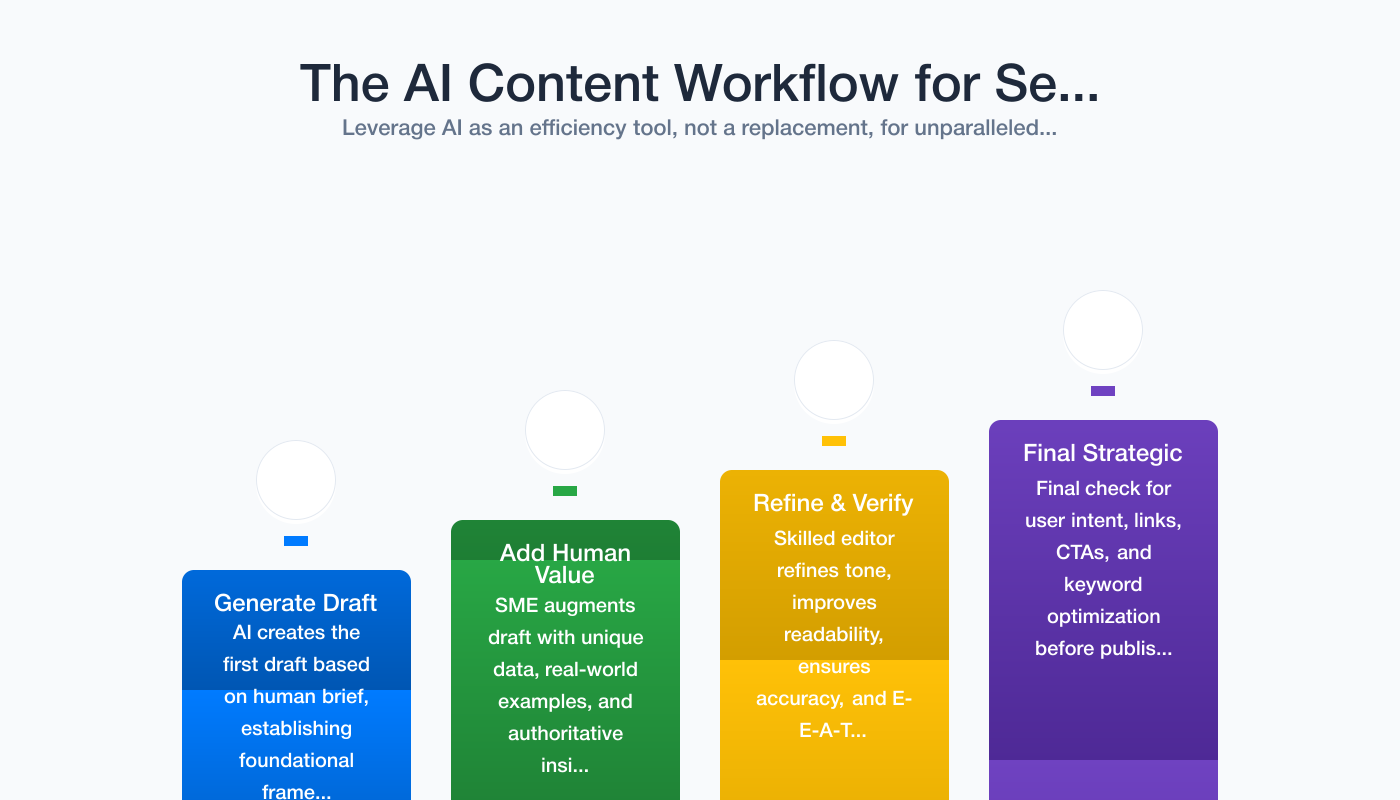
The most effective approach is a hybrid model where AI handles the laborious aspects of content creation while human experts provide critical layers of value that cannot be automated. Use AI as a strategic assistant for tasks like market research, topic brainstorming, structuring outlines, and generating first drafts. This accelerates the process, and tools like OutblogAI can help streamline this workflow, allowing your team to focus on high-impact activities. Once a draft is generated, the crucial human-led enrichment phase begins.
According to a Semrush (2024) study, the most successful marketers elevate AI drafts by adding unique value. This includes incorporating original data, firsthand experiences, case studies, and quotes from subject matter experts. This process of layering in authentic, proprietary information creates 'net-new value'—insights that did not previously exist on the web and that AI alone cannot replicate. This is key to creating content that is not only compliant with guidelines but also positioned to rank well.
A rigorous human editing process must be the final gate before publication. This workflow ensures strategic alignment and superior quality.
- Generate and Structure: Use AI to produce a well-structured first draft based on a detailed, human-devised brief that targets specific search intent.
- Enrich with Expertise: Have a subject matter expert (SME) review and augment the draft. This is the stage to add unique data, real-world examples, personal anecdotes, and authoritative insights that build trust.
- Refine and Fact-Check: A skilled editor must then meticulously fact-check all claims, refine the tone of voice to match brand standards, improve readability, and ensure accuracy. This step is critical for maintaining E-E-A-T signals.
- Final Strategic Review: A final check ensures the content fully addresses user intent, contains appropriate internal links and calls-to-action, and is strategically optimized for its target keywords.
This structured, human-in-the-loop system mitigates the risks associated with unmonitored automation. Industry analysis shows that websites relying solely on unedited AI content can face traffic loss, while those combining AI with strong human oversight see stable or improved performance. A responsible workflow uses AI for scale and efficiency while relying on human expertise to add the essential elements of authority, experience, and trust.
This data-driven exploration has shown that concerns surrounding AI content penalties are largely unfounded. Google's stance is clear: its algorithms reward content that delivers value, demonstrates E-E-A-T, and serves user intent, regardless of its creation method. The key to achieving strong search engine performance lies in the strategic application, not avoidance, of AI technologies.
The core insights reveal a precise framework for content strategies:
- Google's algorithms prioritize quality, helpfulness, and E-E-A-T above all else. Penalties target spam, unoriginality, or content that fails to deliver genuine value.
- Successful, high-ranking content consistently integrates human oversight, unique insights, and a deep understanding of audience needs. AI functions as a powerful tool for acceleration, not a replacement for human input.
- The intelligent integration of AI streamlines content production, enabling teams to scale high-performance articles when combined with rigorous human review.
The future of content SEO involves leveraging AI as a strategic asset to deliver exceptional user value. To maintain a competitive edge, focus on a sophisticated, data-driven approach. Establish a system that consistently converts your expertise into top-ranking articles, ensuring every piece meets stringent standards of trust and relevance.
Success in modern SEO requires leveraging AI as a strategic tool to enhance human expertise, not replace it.