Google''s AI Updates: What SEOs Need to Know for 2025
Navigate Google's 2025 AI updates, including AI Overviews and AI Mode. Understand the data-backed impact on CTR and learn actionable SEO, AEO, and GEO strategies to maintain visibility and drive qualified traffic in the new search landscape.

The competitive landscape for digital visibility is undergoing a significant shift. Early data reveals that Google's integration of AI Overviews (AIOs) has triggered a notable reduction in organic click-through rates (CTRs), with queries featuring AIOs seeing declines of over 60%. This transformation is not isolated; even queries without AIOs are registering a 41% drop, signaling a fundamental recalibration of search engagement. For ambitious teams, this trend requires an immediate and strategic re-evaluation of established SEO paradigms. Proactive adaptation is now necessary for sustained authority and traffic acquisition in 2025.
This analysis provides the strategic intelligence required to adapt to Google's AI evolution, ensuring sustained visibility and the generation of qualified traffic. We will dissect the new search landscape, detailing the impact of AI Overviews and the emerging AI Mode on click-through patterns, substantiated by concrete data. Readers will gain an understanding of how core SEO factors are evolving and learn about the imperative shift towards advanced strategies like Answer Engine Optimization (AEO) and Generative Engine Optimization (GEO). This post will underscore why foundational elements such as E-E-A-T and helpful content are now more critical than ever, as they directly influence your content's potential to be cited within AI Overviews. The strategic focus is shifting from raw traffic volume to methodically attracting qualified, high-intent users, providing a clear, actionable roadmap for your 2025 strategy, helping you build a successful online presence.
TL;DR
Google's integration of generative AI is actively transforming search, demanding an immediate and decisive strategic response from all marketing leaders.
The rollout of AI Overviews (AIOs) is altering traffic dynamics by reducing click-through rates for both organic and paid results. According to a recent analysis from Seer Interactive (2025), organic CTR for queries featuring an AIO has declined by over 60%. This data signals a clear move away from traditional SERP engagement, forcing a pivot in how performance is measured and achieved. The new objective is to secure citations within AI-generated answers.
To navigate this new terrain, SEO strategy must evolve:
- Prioritize E-E-A-T: Reinforce expertise, experience, authoritativeness, and trustworthiness as the foundation for being a citable source for AI.
- Adopt AEO/GEO: Shift focus from traditional SEO to Answer Engine Optimization and Generative Engine Optimization, targeting placement within AI-generated summaries.
- Refine Content Strategy: Create factually dense, well-structured, and clearly articulated content that directly answers user intent, making it easy for models to parse and cite.
- Re-evaluate KPIs: Move beyond raw traffic volume and prioritize metrics that reflect high-intent user acquisition and conversion quality.
The focus of modern SEO is shifting from optimizing for blue links to becoming the authoritative source that powers Google's answer engine.
The New Search Landscape: Understanding AI Overviews and AI Mode
To succeed in the future of search, one must first understand its new architecture. Google has deployed a two-pronged AI strategy that fundamentally reshapes the user experience: AI Overviews and a distinct AI Mode.
AI Overviews (AIOs) are AI-generated summaries that appear at the top of the standard search results page, designed to provide direct, synthesized answers. They integrate into the familiar SERP, pushing traditional organic listings further down. In contrast, AI Mode is a separate, immersive conversational search environment that users can opt into, often replacing the "10 blue links" entirely with a continuous, AI-driven dialogue.
While both features are powered by Google's Gemini models, their strategic implications differ. AIOs disrupt the existing search journey, while AI Mode seeks to replace it with a new paradigm. As noted by Google Search Central, these systems pull information from a wide array of web pages and the Knowledge Graph to construct their responses, making your content's clarity and authority paramount.
| Feature | Integration | User Experience | Primary Goal |
|---|---|---|---|
| AI Overviews (AIO) | Appears within the traditional SERP | A summary box above organic results | Provide a quick, direct answer |
| AI Mode | A separate, selectable tab/mode | A fully conversational, interactive chat | Deliver a comprehensive, multi-step answer |
Success in 2025 requires a dual strategy that addresses visibility within both the integrated AIO summaries and the fully conversational AI Mode experience.
The Unmistakable Impact on Clicks: A Data-Driven Analysis
The quantitative impact of Google's AI integration is becoming clear from the data, demanding a recalibration of all traffic-dependent strategies.
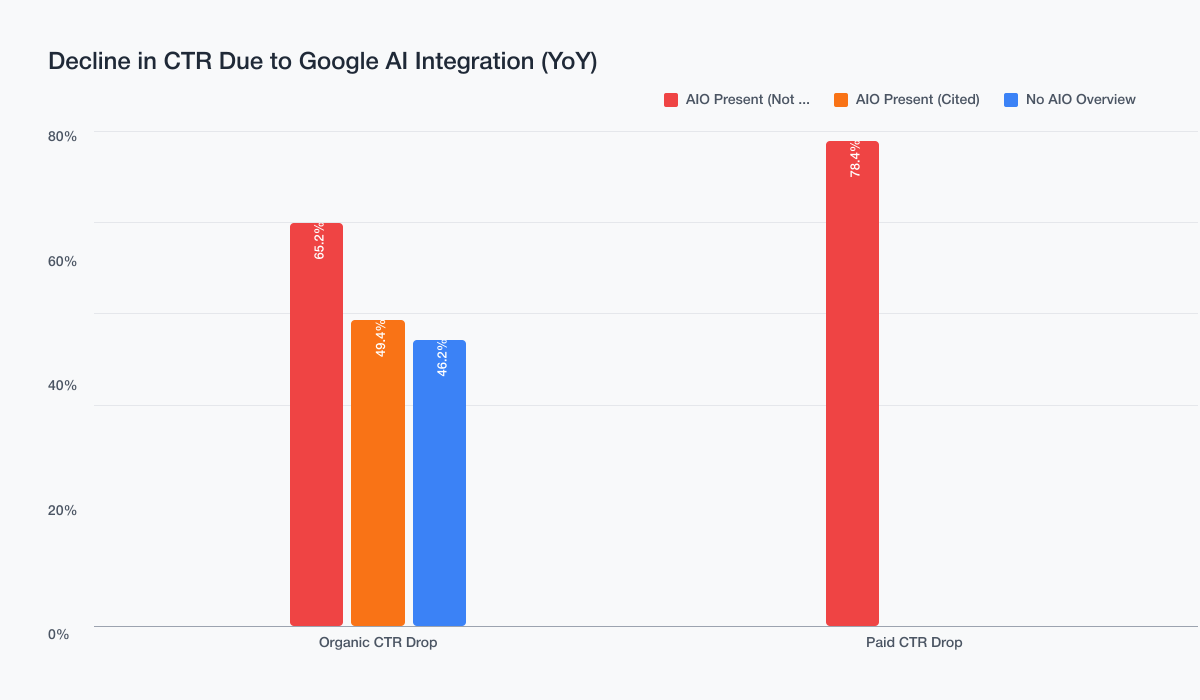
An extensive analysis from Seer Interactive (2025) presents a detailed picture of this performance shift. For queries that trigger an AI Overview, organic click-through rates have fallen by 65.2% year-over-year when a site is not cited in the answer. Even when a site earns a citation, its organic CTR is still down 49.4% YoY. This demonstrates that a "win" in the AIO world yields significantly less traffic than a comparable ranking in the pre-AI era.
The impact extends unequivocally to paid search, where CTR for AIO-present queries dropped 78.4% when not cited. The most alarming trend, however, is the erosion of clicks on searches that do not even feature an AI Overview. This suggests a conditioning of user behavior, where searchers are becoming less inclined to click through to websites regardless of the SERP format.
Note: The data reveals that even queries without AI Overviews are experiencing a 46.2% YoY decline in organic CTR. This indicates that the presence of AI is training users to expect direct answers, fundamentally reducing their propensity to click on traditional search results across the board.
This data indicates that the value of a traditional top-ranking position is changing, requiring strategies to adapt beyond capturing high-volume SERP traffic.
Rethinking Rankings: How Core SEO Factors are Evolving
The architecture of the SERP is transforming, but the foundational pillars of search optimization are being reinforced and re-weighted. Google's AI is calibrating its algorithm to prioritize authentic signals of quality and authority, rewarding content that genuinely resolves intent.
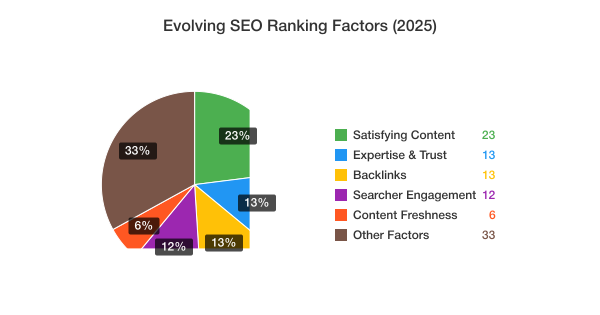
This evolution means that while technical SEO remains a prerequisite for entry, the factors that determine top performance are shifting. According to a 2025 analysis from First Page Sage, the emphasis has moved decisively toward holistic content quality and demonstrable expertise. The era of optimizing for simple signals like keyword density or sheer backlink volume is over; the new imperative is to build an authoritative content engine that consistently satisfies users.
| Ranking Factor Category | Weight in 2025 | Strategic Implication |
|---|---|---|
| Satisfying Content | 23% | Focus on comprehensive, helpful content that resolves user intent. |
| Niche Expertise & Trust | 13% | Build and demonstrate deep subject matter authority (E-E-A-T). |
| Backlinks | 13% | Quality and relevance of links now far outweigh raw quantity. |
| Searcher Engagement | 12% | Optimize for signals like low bounce rates and high time-on-page. |
| Content Freshness | 6% | Implement a system for regularly updating and enhancing content. |
Winning in the new landscape of AI-driven search requires a strategic commitment to producing consistently satisfying content that builds demonstrable authority and earns user trust.
The Modern SEO Playbook: Adapting with AEO and GEO
Traditional search engine optimization is no longer sufficient for top visibility. To secure placement within AI-driven results, practitioners must evolve their approach from optimizing for crawlers to optimizing for answers and generative models.

This new discipline is a hybrid of two connected practices: Answer Engine Optimization (AEO) and Generative Engine Optimization (GEO). AEO involves structuring your content to provide direct, clear, and comprehensive answers to user questions. GEO prepares that content to be easily parsed, interpreted, and cited by AI models like those powering AI Overviews. As noted by Foremost Media (2025), this dual approach is essential for becoming a citable source of truth, the ultimate goal in modern SEO.
Implementing a hybrid AEO and GEO strategy involves a systematic process:
- Identify Core Questions: Map out the entire cluster of questions a user has around a target topic, moving beyond single keywords to address comprehensive user intent.
- Structure for Answers: Use question-based headings (H2s, H3s) and create dedicated FAQ sections to frame content as direct answers. Present data in clear formats like bullet points and tables.
- Implement Semantic Markup: Deploy structured data, particularly
FAQPageandArticleschema, to explicitly define the content's structure and meaning for generative engines. - Establish Clear Provenance: Cite authoritative, primary sources for all data and claims within your content. This builds trust with both users and the AI models synthesizing information.
- Optimize for Snippets: Write concise, self-contained paragraphs that can be easily lifted as direct answers or featured snippets, which often feed into AI-generated summaries.
The objective is no longer just to rank a URL on a list of blue links. The new imperative is to have your brand's expertise synthesized directly into the AI-generated answer, capturing visibility and authority at the point of query.
Mastering the integrated disciplines of AEO and GEO is essential for securing durable visibility and establishing authority within generative search results.
Your 2025 Strategy: How to Respond to Google's AI Evolution
Navigating the current transformation in search requires more than tactical adjustments; it calls for a fundamental strategic realignment. Leaders must pivot their organizations from a mindset of traffic acquisition to one of authority-building and qualified audience engagement.
The goal is to build a brand so authoritative that Google's AI trusts it as a primary source. This involves resetting expectations with leadership, shifting KPIs, and expanding the definition of search. Traffic volume will likely decrease for many, but as case studies from firms like Seer Interactive (2025) demonstrate, this is often accompanied by a significant increase in traffic quality and conversion rates. The focus must shift from vanity metrics to business impact.
Note: CMOs must critically re-evaluate paid search budgets for high-funnel, informational queries. With AI Overviews absorbing user attention, the CTR for both organic and paid results on these SERPs is plummeting, which may render previous top-of-funnel PPC strategies inefficient.
This strategic shift requires a focus on four core pillars. First, treat AIO citations as a primary KPI; earning a citation provides a powerful competitive advantage. Second, expand from SEO to "Search Everywhere Optimization" (OmniSEO), optimizing for discovery on platforms where users seek information, including social networks and vertical search engines. Third, double down on fundamentals; a robust foundation of helpful content, technical performance, and E-E-A-T is the non-negotiable prerequisite for being trusted by Google's AI. Finally, as SEO.com (2025) advises, prepare for sustained CTR erosion by building a brand that users seek out directly.
Thriving in 2025 demands a strategic pivot from pursuing high traffic volume to building demonstrable brand authority, earning AI citations, and optimizing for qualified user engagement across all discovery platforms.
The digital search landscape is undergoing a significant transformation, driven by Google's sophisticated AI advancements. For SEO professionals, this evolution is not merely a challenge but a strategic imperative to redefine visibility and capture qualified demand.
Here are the critical takeaways shaping your 2025 strategy:
- Google's AI Overviews are altering user behavior, reducing traditional CTRs while creating a new advantage for content cited within these AI-generated results.
- The enduring principles of E-E-A-T and helpful content are now more critical than ever, serving as the bedrock for earning AI citations and maintaining relevance in evolving algorithms.
- Successful navigation of this new environment demands a shift towards Answer Engine Optimization (AEO) and Generative Engine Optimization (GEO), focusing on delivering precise, authoritative answers that align with user intent in AI-powered search.
This dynamic shift necessitates agile adaptation and strategic foresight. While the immediate impact is clear, the opportunities for those who master this evolution are substantial. To secure and elevate your market authority in this AI-first era, a proactive and systematic approach to content creation and optimization is no longer optional. It requires an efficient framework to consistently transform your expertise into top-ranking, AI-ready content; platforms like OutblogAI can streamline this process, ensuring your brand captures valuable, high-intent traffic and achieves continuous search dominance.