Conversational Search: How AI Content is Winning the Voice SEO Race
Explore how conversational search is transforming digital strategy. Learn why AI-driven content and natural language queries are key to dominating voice SEO, capturing high-intent users, and future-proofing your brand's visibility in a voice-first world.


By 2024, over half of all online searches are projected to originate from voice assistants, changing how users interact with information. This shift from typed keywords to natural language queries is more than an evolution in search; it is a new requirement for brands seeking digital visibility. The era of optimizing for terse keywords is being replaced by a demand for content that intelligently anticipates and directly answers complex, conversational questions. Brands that do not adapt risk becoming less visible in an increasingly voice-first world.
This evolution is driven by sophisticated AI that no longer just matches keywords but comprehends user intent and context within natural language. Search Generative Experience (SGE) and similar AI models are already reshaping search engine results pages, prioritizing content that is both authoritative and structured for direct, concise answers to spoken queries. This new paradigm requires a re-evaluation of content strategy, shifting focus toward creating AI-driven content designed for conversational fluency and precision.
The future of search engine visibility lies in mastering conversational search through strategically developed AI content. In this exploration, we will dissect why conversational search is becoming the new standard, moving beyond traditional typing to a voice-first interaction model. We will analyze how AI evaluates your content, delving into the new ranking rules introduced by systems like SGE. This post will then equip you with six actionable strategies to optimize for voice and conversational AI, ensuring your content resonates with high-intent users. Furthermore, we will illuminate the local advantage in "near me" searches with voice SEO and establish a framework for measuring success in a zero-click environment. This post provides a framework for future-proofing your brand and securing its position in the evolving digital landscape.
TL;DR
The use of short, typed keywords is yielding to a more natural, conversational interface. This shift in user behavior is transforming the search landscape.
This evolution demands a strategic pivot in content creation. As voice search grows, AI-powered search engines like Google's SGE are engineered to reward content that directly answers natural language questions. Content must be optimized for the conversational nature of these queries to achieve high visibility.
Projections from Single Grain (2025) indicate over 50% of all searches will soon be voice-based, underscoring the importance of this adaptation.
- Prioritize Long-Tail Queries: Target full-sentence, question-based keywords that mirror natural speech patterns.
- Deploy Structured Data: Implement
FAQPageandHowToschema to provide direct answers for search engines. - Focus on Local & Mobile: Ensure fast mobile speed and a complete Google Business Profile for high-intent "near me" queries.
- Rethink Success Metrics: Measure performance by featured snippet ownership and rankings for conversational queries, not just clicks.
Mastering voice SEO is a strategic imperative for achieving market visibility in the AI-driven search landscape.
The End of Typing: Why Conversational Search is the New Normal

The way users find information has transformed. We are moving beyond simple keywords to natural, spoken queries that mimic human dialogue. This evolution underscores a critical shift for digital strategy.
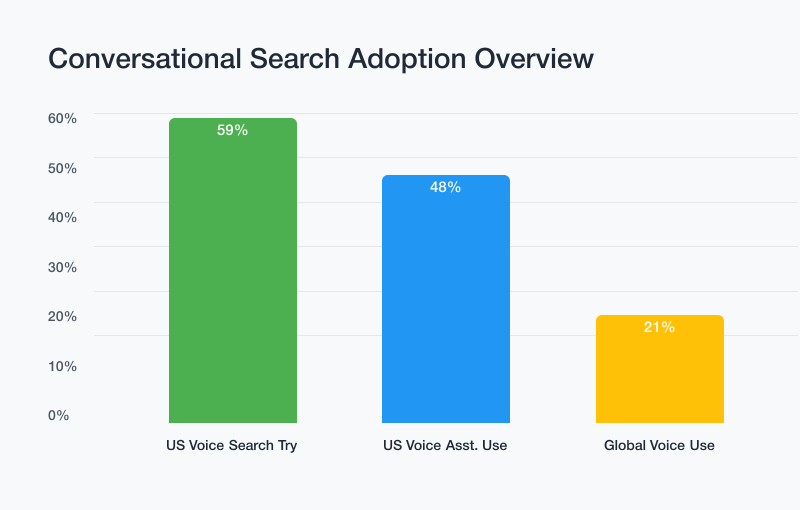
Conversational search involves using full-sentence questions and natural language to find information, often through voice commands. This shift is driven by the widespread adoption of voice assistants on smart speakers and mobile devices. Over 157 million people in the U.S. now regularly use voice assistants, signifying a pervasive change in user behavior.
Globally, 20.5% of internet users employ voice search across 8.4 billion devices, as reported by Search Engine Land (2025). This uptake indicates that traditional keyword-based SEO is increasingly insufficient. The transition impacts user intent, which becomes more specific and often action-oriented in voice queries.
| Search Type | Query Example | User Intent | SEO Focus |
|---|---|---|---|
| Traditional | CRM pricing small business |
Information gathering | Keywords, exact match |
| Conversational | What's the most affordable CRM for a small business near me? |
Specific solution, local, immediate | Natural language, long-tail, local SEO |
This data confirms that more than half of U.S. residents (58.6%) have tried voice search at least once (getpassionfruit.com, 2025). Google ’s global search market share has even dipped below 90%, partly due to the rise of conversational AI platforms, as noted by The Wise Marketer (2025). The adoption of voice assistants has fundamentally changed search behavior, making conversational queries a primary consideration for modern SEO.
How AI is Judging Your Content: SGE and the New Rules of Ranking
The era of simple keyword matching is over. Search engines no longer just index your content; they now use sophisticated AI to determine its value in a conversational context.

This new paradigm is driven by models like Google ’s Search Generative Experience (SGE), which act as intelligent curators rather than passive crawlers. These systems deconstruct user queries to understand semantic intent, seeking out content that provides direct, clear answers. For voice SEO, this is critical: the AI needs to find a single, authoritative response to read aloud, and it will only select content engineered for such clarity.
A report from Search Engine Land (2025) confirms that content strategically optimized for AI interpretation has a significantly higher probability of being surfaced in SGE ’s AI Overviews. This establishes a direct and measurable link between AI-centric content structure and visibility in the new search ecosystem. The rules of ranking have shifted from broad page-level signals to granular, trust-based factors that allow AI to extract specific passages.
| Factor | Traditional SEO Focus | AI-Driven SEO Requirement |
|---|---|---|
| Query Interpretation | Exact & Broad Keyword Matching | Semantic Intent & Conversational Context |
| Content Goal | Achieve a Top-10 Page Ranking | Become the Source for an AI-Generated Answer |
| Key Signals | Domain Authority & Keyword Density | E-E-A-T Signals & Structural Clarity |
| Unit of Ranking | The Entire Document or URL | The Single Most Relevant Passage or Sentence |
To be selected by these AI curators, content must exhibit strong signals of Experience, Expertise, Authoritativeness, and Trustworthiness (E-E-A-T). This framework is Google's primary method for evaluating information quality, and it is rigorously applied when selecting sources for generative answers. As noted in a LinkedIn (2024) analysis, AI models actively look for evidence of firsthand experience, author credentials, and corroboration from other trusted sources. Content that lacks these verifiable trust signals is less likely to be considered for voice and SGE responses.
This granular evaluation extends to the structure of your content. AI ’s passage-level understanding allows it to dissect long-form articles and extract the single most relevant sentence or paragraph that directly addresses a user ’s query. This means every section and paragraph should be optimized to function as a standalone, complete answer. Content already structured for featured snippets —using clear question-and-answer formats, ordered lists, and concise definitions —provides an advantage, as it is pre-formatted for AI consumption.
Success in conversational search requires shifting from creating content for crawlers to structuring information for AI-powered curators that prioritize clarity and authority.
6 Actionable Strategies to Optimize for Voice and Conversational AI

Winning in voice search requires a deliberate strategy that combines conversational keyword targeting, technical excellence, and structured data implementation. A comprehensive strategy for voice search combines conversational keyword targeting, technical SEO, and structured data implementation.
The Local Advantage: Winning 'Near Me' Searches with Voice SEO
When a potential customer asks their device for a solution "near me," they are often preparing to transact. This immediacy makes local voice search a critical channel for customer acquisition. Voice queries possess a strong local intent, directly connecting businesses with high-value customers at the moment of need. Overlooking this channel means ceding opportunities to competitors who have established their local digital authority.
This strategic importance is validated by market analysis. Research highlighted by Search Engine Land (2025) revealed that voice searches are three times more likely to be local in nature than text-based queries. This data underscores the need for local enterprises to optimize their digital presence for conversational, geo-specific commands. The key to capturing these high-intent searches lies in a well-maintained and comprehensive Google Business Profile (GBP), which serves as the primary data source for voice assistants.
To effectively capture this traffic, businesses must execute a precise optimization strategy.
- Fortify Your GBP Foundation. Your Google Business Profile is a critical asset. Ensure absolute consistency of your Name, Address, and Phone Number (NAP) across all online directories. Populate every field with accurate data, including precise hours of operation, service categories, and high-resolution imagery that showcases your business.
- Cultivate Social Proof. Actively solicit and respond to customer reviews. A steady stream of positive feedback serves as a powerful trust signal that both search engines and voice assistants prioritize when recommending local businesses.
- Develop Location-Specific Content. Create dedicated landing pages for each physical location or primary service area. This content should be written conversationally to answer queries like "best IT support open now in Boston," directly matching user intent.
- Implement
LocalBusinessSchema. Reinforce your geographic authority by deploying LocalBusiness schema markup on your website. This structured data provides search engines with unambiguous information about your location, services, and operating hours, making it easier for them to surface your business for relevant voice queries.
This multi-faceted approach transforms your online presence from a passive listing into a high-performance engine for local customer acquisition. For local businesses, optimizing for voice search is essential, as it connects them with high-intent customers at the moment of need.
Measuring What Matters: Tracking Success in a Zero-Click Environment
Voice search success often leaves no direct footprint in your website analytics. This measurement challenge requires a strategic shift away from conventional metrics toward a framework that values visibility and direct business impact.
In a zero-click environment, where users get answers directly from the SERP, traditional KPIs like clicks and sessions are insufficient. The primary objective is to occupy the answer space, establishing your brand as an authority. Success is therefore measured through a new set of proxy metrics that confirm your visibility and influence at the moment of a user's query. This approach redefines ROI around brand presence and tangible outcomes.
This pivot demands a focus on owning SERP real estate. According to analysis from Single Grain (2025), tracking rankings for featured snippets and "People Also Ask" boxes are reliable indicators of voice search performance. One brand that implemented structured data to capture these positions saw a 190% increase in branded search impressions and a 32% rise in direct website visits, demonstrating a clear link between SERP ownership and brand equity.
| Key Performance Indicator | Measurement Method & Tools | Strategic Value |
|---|---|---|
| SERP Feature Ownership | Rank tracking software for featured snippets & PAA. | Establishes top-of-funnel authority and brand visibility. |
| GSC Query Impressions | Filter Google Search Console for question-based queries. | Validates relevance for conversational search and topic authority. |
| Local Engagement Metrics | Monitor Google Business Profile for calls & direction requests. | Directly measures lead generation and foot traffic for local businesses. |
| Brand Recall & Direct Traffic | Analyze analytics for increases in brand searches & direct visits. | Indicates successful brand penetration and unaided recall from voice answers. |
Demonstrating the ROI of voice SEO requires tracking visibility in SERP features and connecting that presence to direct business outcomes.
The Future is Spoken: Preparing for the Next Wave of Search
The shift to conversational search represents a permanent evolution in how individuals interact with technology and acquire information. Businesses must adapt their content strategies to this new paradigm.
Content that is written in a natural, human-like manner will consistently outperform material optimized solely for outdated algorithms as AI becomes more integrated into search. The strategies effective for voice SEO —clarity, structured data, topical authority, and technical performance —also strengthen your overall digital presence. This comprehensive approach ensures content is accessible and valuable across all search modalities.
By 2028, voice search is projected to become a $45 billion channel, a significant market opportunity according to recent SEO statistics. This growth underscores the importance for businesses to prepare. The next strategic step involves auditing existing content through a conversational lens and implementing targeted optimization tactics.
Content must be structured to answer questions directly and provide immediate value, reflecting the nature of voice queries. This proactive adaptation ensures your expertise remains discoverable and authoritative in an evolving search landscape. Embracing conversational principles is a direct investment in future-proofing a brand's entire digital presence for an AI-driven world.
The shift towards conversational search is a fundamental transformation in how users interact with information and how AI judges content. As AI-driven platforms like SGE redefine the rules of engagement, brands face a clear imperative: adapt or risk losing visibility. Embracing this new landscape requires a strategic overhaul, focusing on content that answers natural language queries with authority and precision.
Here are the essential takeaways for navigating this voice-first future:
- User behavior has shifted from traditional keywords to complex, natural language questions, making direct, conversational answers paramount.
- AI-powered search engines prioritize content that is inherently structured, conversational, and demonstrates clear E-E-A-T (Experience, Expertise, Authoritativeness, Trustworthiness).
- A successful voice search strategy demands a multi-faceted approach, encompassing targeted long-tail keywords, robust schema markup, a strong local presence, and a redefined approach to measuring success beyond clicks.
Ultimately, the future of digital visibility is conversational. Brands that strategically invest in AI-driven content and optimize for these natural language interactions will be better positioned to compete.
To solidify your brand ’s presence in this evolving search environment, the immediate next step is to operationalize these insights. Proactively structuring your content for direct answers and conversational relevance is no longer optional. For ambitious teams seeking to transform their expertise into top-ranking articles and establish authority, leveraging intelligent platforms like OutblogAI that automate the creation of high-performing, voice-optimized content can provide a distinct advantage in the Voice SEO race.