Why Most Startup Blogs Stall—and How to Fix Them Early
Over 7.5 million blog posts are published daily, yet most startup blogs become digital ghost towns. This isn't a writing problem; it's a systems problem. Many teams treat their blog as a content checklist, leading to random activity with no measurable ROI. The result is burnout and a valuable channel left for dead. This guide moves beyond generic advice to offer a diagnostic framework for why your blog has stalled. Our thesis is that a successful blog is not about publishing more, but about building a repeatable system that turns customer learning into predictable growth. We'll provide a practical 90-day reset plan to transform your blog from a resource drain into a reliable customer acquisition engine.

Every single day, 7.5 million blog posts flood the internet. A relentless deluge. Most of them? Pure digital noise. And chances are, your startup's blog is contributing to that overwhelming static.
You started with the best intentions. Dreams of generating leads, establishing authority, and fueling growth. But instead, you're overseeing a digital ghost town
– a content graveyard piled high with half-finished thoughts and ignored articles. You're left wondering what went so horribly wrong.
Here's the brutal truth: it's not a writing problem. Nor are your ideas inherently flawed (though, let's be honest, some might be). The real kicker is this: your blog isn't stalled because you're bad at content; it's stalled because it's treated as an activity, not a system. You're ticking boxes, publishing for the sake of it, performing random acts of marketing with zero measurable return.
This haphazard approach leads directly to burnout, transforming a potentially valuable channel into a significant resource drain. This guide won't waste your time with "game-changing content hacks" or some airy-fairy "thought leadership framework." We're here to cut through the fluff, diagnose precisely why your blog is dead in the water, and equip you with a blunt, actionable plan. It's time for a 90-day reset to transform that digital ghost town into a predictable, high-performing growth engine.
The Common Diagnosis: Your Blog is an Activity, Not a System
Alright, listen up. Your blog? It's likely a mess. Not because you can't string a coherent sentence together. No. It's because you're treating it like a chore, just another item on a never-ending to-do list
– an activity. But it's not. It's meant to be a system, or it's utterly useless.

Most startups stumble here. They're running a content factory without a blueprint, and inevitably, everything stalls. You could call it a sequencing problem, if you want to get technical. The instinct is to scale, to write more. Yet, you haven't even clarified what you're truly trying to say, who actually cares, or how any of it translates into revenue. That's not just a disaster waiting to happen; it is happening.
Here's the critical insight: early-stage marketing isn't a growth machine. Don't be naive. It's a truth machine. Its primary objective is to pinpoint who genuinely cares, what resonates with them, what motivates them to act, and what pushes them away. You need that unfiltered user feedback, that hard data, before you start indiscriminately spraying content everywhere like a broken sprinkler.
This leads to recurring failures, typically three major pitfalls:
- The 'Who' Problem. You're trying to speak to everyone, which effectively means you're speaking to no one. Your ideal customer profile is vague, a ghost. Consequently, your content is generic, bland, and fails to connect with anyone specific. Why would it?
- The 'Why' Problem. You're leading with features. "Look at our shiny new button!" Nobody cares about your button, friend. They care about what that button does for them
– the outcome, the solution to their pain. But this fundamental truth is often forgotten. - The 'What Next' Problem. You manage to attract some eyeballs, perhaps a few. Great. But then what? Crickets. There's no clear path, no immediate call to action, no conversion. Just a dead end. You've captured attention without guiding people toward a meaningful next step, and that's just noise.
Traffic and awareness, by themselves, are vanity metrics. They always have been. They might make for a nice Slack update, but if they aren't translating into real conversations, genuine sign-ups, or actual revenue, they're just numbers. Meaningless numbers. As Similarweb (2024) data consistently shows, most early startup marketing isn't a channel problem; it's a sequencing problem. A fundamental system problem. Random acts of content produce random results; a repeatable marketing system connects a specific audience to a specific outcome through a defined path. You must build the system first, or you're simply wasting everyone's time, especially your own.
The 90-Day Reset Plan: Building Your Minimum Viable System
Enough with the random acts of content. The frantic flailing. That approach is a colossal waste of time and capital. You need a system
– a minimal, viable one
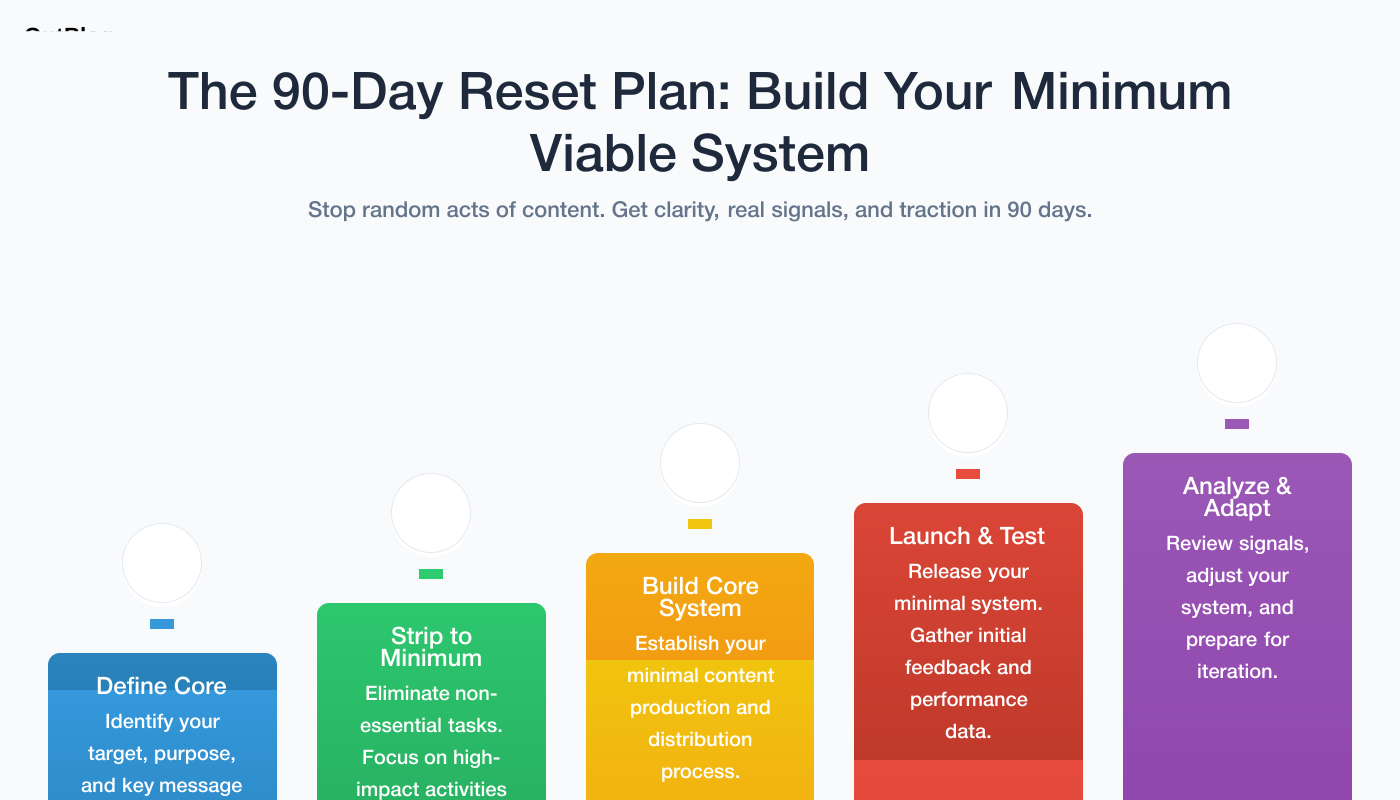
– and you need it fast. So, we're talking about a 90-day reset plan. This isn't another five-year strategic roadmap destined to be ignored. This is about clarity, about discerning real signals, and about achieving tangible traction instead of merely pushing out more words.
Here
’s how you execute it. For a short period, set everything else aside.
Phase 1: Days 1-14
– Define Your Wedge.
This phase is absolutely critical. You must identify one specific thing: one precise customer, one acute problem they face, and your unique ability to solve that problem better than anyone else. Just one. No spreading yourself thin. How do you find it? You talk to people. Your actual potential customers. This is the essence of customer development. Ask them about their struggles. Observe what truly frustrates them, what makes them despair, or what they'd readily pay you to alleviate. You must validate this directly, hearing it in their own words. Because if you're guessing, you're already losing.
Phase 2: Days 15-30
– Build Your Conversion Path.
Now that you've unequivocally identified who you're speaking to and what problem you're solving, you need a straightforward way for them to act. So, build one landing page. Just one. Make it hyper-focused with a single, clear call to action. Get them to sign up for something: a trial, a demo, an email list. Whatever makes the most sense. Follow this with a simple, automated follow-up sequence. Keep it clean. Keep it frictionless. The ultimate goal? A direct, unhindered path from encountering your content to taking a specific, desired action. No dead ends, no confusing detours.
Phase 3: Days 31-90
– Run Focused Sprints & Learn.
Okay, the basic system is built. It might be minimal, but it
’s operational. Now, you select one channel. Perhaps it's SEO-focused blog posts, or LinkedIn, or a targeted email list. Just one. You then run an intensive 2-4 week sprint on that single channel. No "channel thrash"
– you know, that frustrating cycle of jumping from Facebook to TikTok to Reddit every other week because nothing seems to be working. It never works because you never learn anything significant. Instead, you double down. You experiment. You measure everything. Conduct weekly reviews: what worked? What bombed? And if something clicks, you lean into it. Hard. This focused approach allows you to learn more in 90 days than most people do in six months of merely throwing spaghetti at the wall. And trust me, I've witnessed too many founders disregard this. I know a founder who built and sold a huge startup, only to confess his biggest regret was ignoring SEO for 14 years. Crazy, right? Before scaling content production, you must first validate a single, repeatable path from attention to action with a specific audience. So, stop overthinking, and simply do the damn work. Get some real data. Build your system. You'll thank me later.
Pillar 1: Create Content That Actually Converts
You are writing for one person. Hear me on this: one. Because if you're attempting to appeal to everyone, you will, in fact, appeal to no one. That's simply how it works. Yes, you'll delve into keyword research (I understand its necessity), but that's merely a map, a starting point. Solid SEO fundamentals are crucial. Your true objective? To craft every article as if you're sitting directly across from that one ideal customer
– your wedge ICP
– the individual whose specific problem you are committed to solving. Speak to them: directly, personally. Anything less is just noise.
Forget features. Seriously. Nobody cares that your tool boasts "multi-user support." So what? It's boring. It's expected. They care deeply about their problem and the tangible solution. They want to know they can "Stop sharing passwords and give your team secure access" because that speaks directly to their pain point and the outcome they desperately desire. If you're not articulating outcomes, you're merely spewing specifications. Garbage, I tell you. Absolute garbage.
But how do you uncover those crucial outcomes? It's simple: you don't invent them. You listen. Go to Reddit. Explore Quora. Dive into those niche forums (yes, even the obscure ones with terrible UI). People are pouring out their frustrations there, articulating, in their own raw words, what truly hurts, what they aspire to, and what they're trying to avoid. Adopt that language. Replicate their exact phrasing. Because when you echo their words back to them, they feel seen, understood, and valued. That's precisely when they convert, not when you sound like some impersonal corporate bot. Effective conversion rate optimization starts with understanding user language.
Every single piece of content you publish must pass the 3-Second Test. No exceptions. If your reader (that one person) cannot glance at your headline and the opening lines and immediately grasp "What is this for?" and "Why should I care?"
– you've failed. Instantly. And they're gone. Just like that. Broad, untargeted traffic is a financial black hole. And Similarweb (2024) data confirms that if you miss these crucial marks, if your focus isn't laser-sharp on your actual prospects, your blog is dead on arrival. Low-quality leads will cost you significantly more in the long run. So, write for that one person. Make them feel it. Because that
’s how you build real relationships, and ultimately, that's how you generate revenue.
Pillar 2: Promote Your Content Beyond 'Publish and Pray'
You could write the most groundbreaking content the world has ever seen
– pure gold. But if you simply hit "publish" and then passively hope someone, anyone, stumbles across it? That's not a strategy; that's a prayer. And let me tell you, prayers do not pay the bills in this industry. You must flip the script entirely. So, listen closely: apply the 80/20 rule, but in reverse. You dedicate 20% of your time to creating the content. The other 80%? That's for content promotion. Distribution. Getting it directly in front of the right eyes. It
’s the only way this framework truly works.

First, you need something genuinely worth promoting
– a linkable asset. Not just another blog post, but something so exceptionally valuable
– a definitive guide, original data no one else possesses, or a free tool that genuinely solves a problem
– that people feel compelled to share it. They want to link to it. So, craft it to be irresistible. This asset becomes your anchor, your leverage.
And then you promote. But not haphazardly. You strategically pick your spots. Just a few. And you hit them relentlessly.
- Share it. Leverage your founder
’s personal LinkedIn and Twitter profiles. That's where authentic credibility and network reach reside. - Post it. Select two or three highly specific online communities where your ideal customers actively gather
– think relevant subreddits, specialized Slack groups, or niche forums. - Send it. Distribute it to your email list, no matter how small. Every single subscriber on that list is a golden opportunity.
And here
’s a deceptively simple tactic that consistently delivers results: Did you mention anyone in the article? A company, an expert, an influencer? Email them directly. Seriously. It
’s not cold outreach; it's a warm, appreciative gesture. They are often genuinely thrilled you included them, prompting them to share it, or link to it, just like that. Because consistent, focused effort in a few key channels dramatically outperforms scattered attempts to be everywhere. You see this repeatedly in Reddit case studies: one excellent post, combined with targeted content distribution, can generate tens of thousands of views, leads, and valuable links. Promote the hell out of that content, or it will die a lonely, unread death.
Pillar 3: Measure for Outcomes, Not for Ego
So, your traffic numbers are soaring. Page views are through the roof. Looks impressive on a dashboard, doesn't it? But is your revenue curve following the same trajectory? If not, congratulations: you
’ve fallen squarely into the Vanity Metric Trap. This is a classic symptom of a content strategy that
’s fundamentally misaligned. Because traffic, tracked with tools like Semrush, in isolation, means absolutely squat if it doesn't translate into actual business outcomes. Nothing at all.
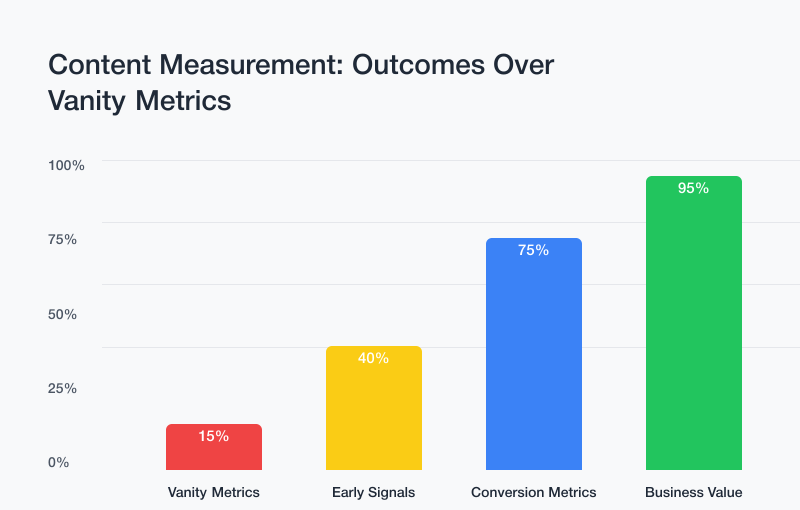
Furthermore, you cannot measure everything identically, all the time. Your blog, especially in its early stages, isn't primarily about immediate, scaled growth. Not yet. It's about gathering signals. It's about learning. Therefore, you need a measurement framework that precisely matches your current stage. Because a system without a robust feedback loop is merely a machine running blind.
Here
’s how to effectively track what truly matters:
- Early Signal Metrics (Weeks 1-4). At this stage, you're validating your core message. Are people engaging in conversations with you? Are they actively requesting demos? What's the reply rate when you proactively reach out? This initial feedback is pure gold.
- Conversion Metrics (Weeks 3-8). Now, you analyze the user journey. How many visitors are reaching your landing page? How many are clicking that critical call to action? Use this data to fine-tune your funnel, systematically fixing any bottlenecks.
- Business Value Metrics (Weeks 6-12+). This is the real deal, the SaaS metrics that underpin your existence. Think trial activations, Marketing Qualified Leads (MQLs) directly attributable to your content, and, crucially, customer lifetime value. This is the data that truly justifies your investment.
And listen closely: abandon the quest for perfect marketing attribution. That's a unicorn. What you need is directional data. Simple tracking mechanisms: UTM parameters, a concise "how did you hear about us" field. That's sufficient to make intelligent, impactful decisions. Because if you cannot draw a clear line from your content efforts back to tangible revenue, if you cannot connect those dots, then you cannot justify the ongoing investment. Far too many SaaS companies mislead themselves with all that page view nonsense. So, choose one funnel. Track it meticulously, end-to-end. Measure what truly matters, because sustained business growth, not ego gratification, is the only metric that keeps the lights on.
Alright, enough talk. You've absorbed the diagnosis. You now understand: your blog isn't just "underperforming." It's likely dead weight. A severe resource drain. Most of you treat it like a damn content checklist, churning out posts for the sake of activity, with no coherent strategy, no measurable ROI. Just a glorified digital diary. That
’s precisely why it stalls. Every. Single. Time.
But here's the crucial pivot: it doesn't have to remain a digital ghost town. Your blog, if constructed correctly, can become a formidable acquisition machine, a genuine lead magnet. (Yes, a real one.) Stop thinking like a casual content publisher and start thinking like a strategic engineer. You need a system, not just more articles. This is the core principle of any successful startup playbook.
So, let's cut through the remaining noise and distill the bottom line for resurrecting your blog from its digital slumber:
- Your biggest problem isn't a writing drought; it's a fundamental misunderstanding: a blog isn
’t a collection of posts, it
’s a living, breathing system designed to convert customer learning into predictable growth. Get that straight first. - Content for content
’s sake is utterly pointless. Every single word you publish must serve a clear purpose: to answer a real customer question, solve a genuine problem, and ultimately, drive a measurable outcome. If it doesn't convert, it's merely noise. - Hitting "publish" is just the beginning. You must actively promote that content as if your business depends on it (because, if you're doing this right, it absolutely does). And then, you must measure outcomes, not vanity metrics. Forget ego; focus relentlessly on tangible impact.
This isn't just abstract theory, by the way. This is the proven methodology employed by the industry's real players.
So, what's your immediate next move? You can continue to flounder, hoping for some miraculous turnaround. Or, you can get deadly serious about building that system. Start digging in, applying this framework rigorously. Or, if you're ready to accelerate, explore tools like OutblogAI that can truly automate that entire damn system for you, transforming your insights into authority and traffic on autopilot. Stop just blogging. Build the engine.