Building Authority Before Product-Market Fit: A Founder's Guide
Research shows 73% of B2B buyers trust thought leadership more than traditional marketing content, yet most founders wait until after launch to build their voice. This creates a silent gap, allowing competitors to define the narrative and earn trust first. In a fast-moving market, the company that shapes the conversation early gains an insurmountable advantage. This guide presents a practical framework for building market authority before you have a product, turning your insights into your most valuable pre-launch asset. The core thesis is that establishing thought leadership is not a marketing-afterthought; it is a fundamental strategy to de-risk your startup, warm the path for sales, and accelerate your journey to product-market fit.


Research reveals a stark truth: 73% of B2B buyers place their trust in thought leadership above traditional marketing content.
Yet, most founders delay building their market voice until after product launch. This strategic oversight creates a critical silent gap, ceding the narrative to competitors and forfeiting invaluable early trust.
In a relentlessly competitive market, defining the conversation before you even launch is not merely an option—it is an insurmountable advantage. This guide presents a tactical framework to establish undeniable authority and transform your unique insights into your most potent pre-launch asset.
Establishing thought leadership is not a post-launch marketing task; it is a fundamental strategy to de-risk your venture, warm the path for accelerated sales, and propel your journey to product-market fit. Prepare to redefine your startup's trajectory by building authority from day one.
Brief and TL;DR
For busy founders, here's a concise overview of how to build significant authority even before achieving Product-Market Fit:
- Your insights are your first product. Share your unique perspective on the problem long before your code is ready.
- Pre-PMF thought leadership demonstrates an obsession with solving a specific problem, not self-promotion.
- Build sustainable authority by teaching the problem, fostering discussion, and focusing on one or two key channels.
- Authentic authority relies on four pillars: a strong Point of View (POV), unique Market Insight, a compelling Vision, and concrete Credibility Signals.
- Avoid pitfalls: don't overhype non-existent features, publish generic content, or spread your efforts too thin.
- Early authority accelerates moving from 'Nascent' to 'Developing' Product-Market Fit, validating ideas and building a waitlist, reflecting principles from successful pre-PMF startups.
By systematically sharing your point of view before launch, you shape your niche, build foundational trust, and attract the talent, investors, and customers needed to succeed.
Why 'Authority First' Is a Non-Negotiable Strategy
Consider this: 73% of B2B buyers trust thought leadership more than traditional marketing content. This statistic alone underscores a crucial strategic imperative for startups: building authority isn't merely a marketing tactic; it's a fundamental business function. Waiting until your product is fully launched to cultivate this trust creates a significant "silent gap." This period allows competitors to dominate the narrative and build crucial relationships with potential customers and investors before you even enter the conversation. A classic founder problem is waiting until your product is in-market before you start building your authority.

True leadership, especially pre-Product-Market Fit (PMF), transcends simple feature promotion. Instead, it's about demonstrating an unparalleled understanding of the problem you aim to solve. Your deep insights into the pain points and challenges facing your target audience become your most credible asset. By articulating these issues clearly and offering novel perspectives, you signal expertise and empathy.
These early insights function as your first Minimum Viable Product (MVP). They allow you to test your core assumptions about the market and the problem's gravity with real people, long before you invest heavily in complex code. This iterative sharing provides invaluable feedback, shaping your product's direction and validating your hypotheses publicly.
Establishing your voice and authority early also serves as a powerful magnet for vital resources. It attracts engaged investors who see your vision and market understanding, top-tier talent eager to work on impactful problems, and, crucially, a pre-qualified waitlist of potential customers already aligned with your mission. Salesforce famously leveraged this approach with its "The End of Software" campaign, defining the SaaS category and establishing leadership before its product was mature. They proved that bold ideas and market framing can establish leadership before features are fully developed. This early engagement builds a community around your solution, not just a customer base.
Early authority-building is not a 'nice-to-have'; it's a critical mechanism for de-risking the journey to product-market fit by building trust before you ask for a sale.
The Pre-PMF Landscape: Using Authority to Escape the 'Nascent' Stage
Product-Market Fit (PMF) is often perceived as a singular, binary achievement, but in reality, it's a graduated journey. The earliest, most uncertain phase is known as the 'Nascent' stage, or Level 1 PMF, a framework popularized by First Round. This initial period is characterized by a fundamental lack of repeatability; finding the marginal customer is the opposite of easy, and the path to achieving extreme PMF can take two to six years. At this level, you’re not entirely clear on what a customer needs to look like to be the right fit.
During this 'Nascent' stage, your primary mission is to identify a problem truly worth solving for a small cohort of 3-5 initial customers. This isn't about scaling; it's about deeply understanding. Your thought leadership content becomes an invaluable public tool for validating your problem and persona hypotheses. By sharing your evolving understanding of the market's pain points, you attract individuals who resonate with those issues, effectively pre-qualifying them as potential early adopters.
Think of your content as part of your Minimum Viable Product (MVP). Shipping what you’re building in the form of insights and discussions creates more opportunities to test in-market. While competitors are often heads-down focused on their own execution, the strategic value of building an audience early far outweighs any perceived risk of imitation. Your unique perspective and genuine engagement are difficult to replicate.
Embracing a 'build in public' approach during this phase is particularly powerful. This means openly sharing your learnings, the tradeoffs you're making, and even the failures you encounter. This level of transparency fosters profound trust. People inherently value authenticity over claims of premature perfection. Rather than presenting a polished, finished solution, you invite your audience into the development journey, making them feel invested in your mission. Your discussions, blog posts, and public analyses become essential feedback loops, helping you refine your target persona and problem definition.
Thought leadership in the 'Nascent' stage is not about generating mass demand; it's a strategic process of using public discourse to find your first true believers and validate your core mission.
The Four Pillars of a Pre-Product Narrative
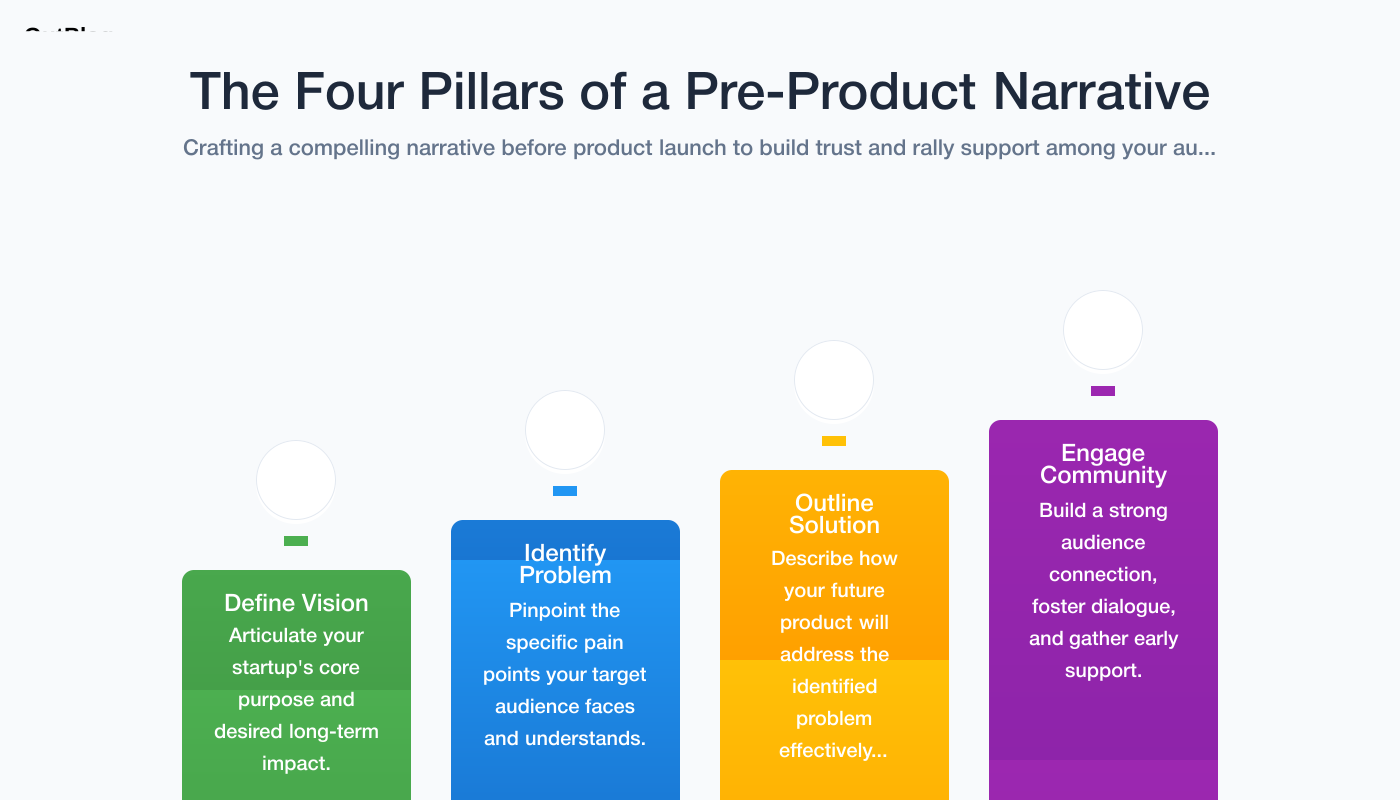
Launching a startup requires more than just a great idea; it demands establishing a presence, especially when your product is still taking shape. Building authority before product-market fit isn't about selling features; it's about crafting a narrative that resonates deeply with your audience. This pre-product narrative is strategically constructed from four essential pillars, each designed to cultivate trust and rally support.
Point of View (POV)
Your Point of View is your bold, memorable stance on the core problem you're addressing. It's not just a statement, but a belief that cuts through market noise and gives your audience a clear position to either agree with or challenge. A strong POV stems from your deep obsession with the problem and a precise understanding of the specific audience you intend to serve. For instance, a cybersecurity startup might assert, "attackers exploit people before they exploit code," immediately framing their approach (Research data).
Market Insight
Beyond a strong opinion, share unique insights derived from your research, interviews, or firsthand experience. This pillar demonstrates you possess a superior understanding of market dynamics. Translate complex trends into simple, actionable takeaways that reveal what others might be missing. Insights can emerge from extensive customer discovery interviews and the synthesis of existing industry research, proving your acute perception of the market landscape (Proof anchor).
Vision
Connect current challenges to a compelling future. Your vision illustrates where the market is heading and articulates why your perspective on this future matters. It invites your audience to join a larger journey, positioning your startup as a guide or catalyst for this impending transformation. A clear vision inspires belief and encourages early adopters to invest emotionally in your impending solution.
Credibility Signals
Authority isn’t built on words alone; support your narrative with tangible evidence (Research data). This includes citing relevant data, sharing anonymized stories from early customer conversations, highlighting respected advisors, or leveraging your personal track record. These signals act as proof anchors, validating your claims and substantiating your expertise. They provide concrete reasons for your audience to trust your pre-product assertions.
Note: When you combine these four elements effectively, you create thought leadership that feels authentic and builds trust significantly faster than merely showcasing features.
A compelling pre-product narrative is built not on features, but on a unique combination of a strong point of view, insightful market analysis, a clear vision for the future, and tangible signals of credibility.
From Strategy to System: A Repeatable Content Workflow for Founders
For founders navigating the intense demands of building a company, consistent content creation can feel like an impossible burden. Yet, establishing authority requires continuous engagement. The solution lies not in adding more tasks, but in implementing a repeatable content system that leverages existing activities, transforming thought leadership from an arduous task into a streamlined routine.

- Treat Every Conversation as Raw Material:
Every interaction you have—whether with an investor, advisor, or potential customer—is a treasure trove of content. A single 30-minute call can be repurposed into a LinkedIn post, a short video segment explaining a concept, or even a detailed section for a blog post (Research data). Document key takeaways and frequently asked questions; these are direct insights into your audience's concerns. This approach keeps your content pipeline full without generating new workload, a process that can be further streamlined with AI-powered content tools. - Focus on Teaching the Problem, Not Pitching the Product:
Before you have a product to sell, focus entirely on the pain points your audience experiences. Write about the root causes, the hidden complexities, and the consequences of these struggles. Authenticity and depth about a complex problem are more valuable than polished prose (Proof anchor). Your ability to articulate their pain demonstrates empathy and positions you as a trusted expert, not just a seller. - Create Small, Focused Platforms:
Organize low-effort, high-impact gatherings like a private online roundtable or a webinar series. These platforms enable you to convene valuable conversations and associate with other industry experts, lending you credibility by proxy. By facilitating dialogue, you naturally position yourself as a central figure in the problem space. - Pick One or Two Strategic Channels for Deep Engagement:
Resist the urge to be everywhere. Identify where your target buyers genuinely spend their time—it might be LinkedIn, specific industry forums, or niche Slack groups. Focus your efforts deeply on these one or two channels, engaging consistently. As a cybersecurity founder demonstrated, posting weekly breakdowns of real-world breaches on LinkedIn built a substantial waitlist before their product even launched (Research data). Depth and consistent presence in chosen channels significantly outweigh a shallow, fragmented presence across many. Setting a weekly cadence, for instance, is often enough to maintain momentum (Research data).
A sustainable content system for founders relies on repurposing conversations, teaching the problem space, and engaging deeply in a few key channels, transforming thought leadership from a task into a routine.
Common Pitfalls: How to Build Credibility Without the Hype

Building genuine authority pre-product is a delicate balancing act. While the drive to stand out is strong, certain missteps can erode trust faster than any content can build it. Founders must navigate these common pitfalls as crucial guardrails, ensuring their efforts cultivate authentic credibility rather than fleeting hype.
Overhyping Product Specifications
It's tempting to talk about impressive features and capabilities, especially when developing cutting-edge technology. However, making promises about features before they exist can severely erode trust (Research data). Instead, maintain focus on the problem you're solving and your overarching vision. Excitement rooted in a deep understanding of the problem is far more sustainable than excitement built on unfulfilled feature promises (Proof anchor). Keep feature discussions reserved for when they are tangible and proven.
Making It About You
Thought leadership fails when it devolves into self-promotion (Research data). True authority stems from helpfulness and a genuine desire to address your audience's challenges, a core principle in entrepreneurship, not from boasting about your achievements or potential. Shift your narrative focus entirely to the reader's pain points and aspirations. Your value is demonstrated by the insights you provide, not by how loudly you champion yourself.
Publishing Generic Content
Statements devoid of specific insight, such as "innovation is important" or "data is the new oil," add no value and signal a lack of depth (Research data). Your audience expects specific insights, unique data points, or compelling, anonymized stories that prove your deep, nuanced understanding of their world. Generic content is background noise; precise, valuable content is what cuts through.
Spreading Yourself Too Thin
Attempting to establish a presence on every social media platform or content channel dilutes your message and fragments your impact (Research data). This strategy can quickly lead to burnout and superficial engagement. Instead, identify the one or two channels where your target buyers genuinely spend their time and commit to mastering them. Deep engagement in a few strategic locations is always more effective than a shallow, fragmented presence across many. Trust, the ultimate currency, is damaged by hype that doesn't match reality (Proof anchor).
Building genuine authority requires discipline; avoiding common pitfalls like premature feature-talk and generic statements is as critical as the content you create.
The journey to product-market fit is often fraught with uncertainty, yet this guide has demonstrated that establishing market authority prior to launch is not just beneficial, but a strategic imperative. It de-risks your venture and sets an accelerated trajectory for success.
By proactively shaping the narrative, founders transform insight into an invaluable pre-launch asset. Key takeaways from this strategic framework include:
- Strategic Imperative: Establishing thought leadership is a fundamental strategy to de-risk your startup, warm the path for sales, and accelerate your journey to product-market fit.
- Competitive Advantage: Proactive authority building closes the "silent gap," preventing competitors from dominating the narrative and earning trust first.
- Systematic Execution: A practical framework and repeatable content workflow empower founders to systematically turn their unique insights into tangible pre-launch assets.
Embracing this authority-first mindset transforms your pre-product phase from a waiting game into a period of strategic build-up, laying an undeniable foundation for market dominance. For founders looking to automate and scale this process, platforms like OutblogAI offer a significant advantage.
Implementing these principles with precision is now essential for founders to accelerate their path to market leadership and secure an insurmountable competitive advantage.